
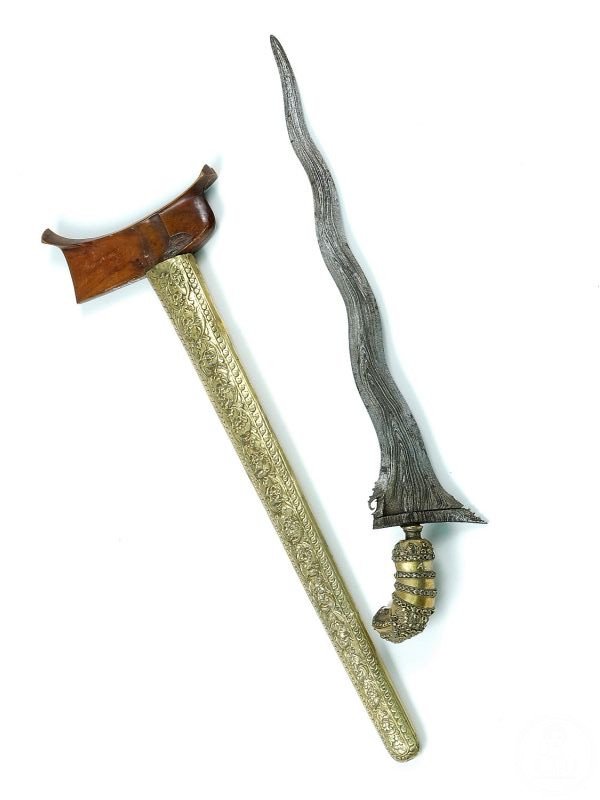
An asymmetrical dagger of iron and patterned metal, the kris merges martial prowess with spiritual presence. For centuries, Javanese smiths have crafted these blades as weapons, talismans, heirlooms, and ritual objects—each one a vessel of cultural meaning and, some believe, supernatural power.
In UNESCO’s words
The kris or keris is a distinctive, asymmetrical dagger from Indonesia. Both weapon and spiritual object, the kris is considered to possess magical powers. The earliest known kris go back to the tenth century and most probably spread from the island of Java throughout South-East Asia. Kris blades are usually narrow with a wide, asymmetrical base. The sheath is often made from wood, though examples from ivory, even gold, abound. A kris’ aesthetic value covers the dhapur (the form and design of the blade, with some 40 variants), the pamor (the pattern of metal alloy decoration on the blade, with approximately 120 variants), and tangguh referring to the age and origin of a kris. A bladesmith, or empu, makes the blade in layers of different iron ores and meteorite nickel. In high quality kris blades, the metal is folded dozens or hundreds of times and handled with the utmost precision. Empus are highly respected craftsmen with additional knowledge in literature, history and occult sciences. Kris were worn everyday and at special ceremonies, and heirloom blades are handed down through successive generations. Both men and women wear them. A rich spirituality and mythology developed around this dagger. Kris are used for display, as talismans with magical powers, weapons, sanctified heirlooms, auxiliary equipment for court soldiers, accessories for ceremonial dress, an indicator of social status, a symbol of heroism, etc. Over the past three decades, kris have lost some of their prominent social and spiritual meaning in society. Although active and honoured empus who produce high-quality kris in the traditional way can still be found on many islands, their number is dramatically decreasing, and it is more difficult for them to find people to whom they can transmit their skills.
Official description, UNESCO Intangible Cultural Heritage List — Indonesian Kris
At a glance
The kris is a distinctive asymmetrical dagger from Indonesia, valued both as a weapon and a spiritual object believed to possess magical powers. The blade is characteristically narrow with a wide asymmetrical base, typically housed in a wooden sheath, though ivory and gold examples exist. Its aesthetic depends on three elements: the dhapur (blade form and design), the pamor (metal alloy pattern on the blade), and tangguh (the kris's age and origin).
Origins & history
The earliest known kris date to the tenth century and most probably spread from Java throughout South-East Asia. Over centuries, kris became central to Indonesian culture, worn daily and at ceremonies by both men and women. Heirloom blades passed through generations, accumulating spiritual and mythological significance. However, over the past three decades, kris have lost prominence in society, and the number of master bladesmiths has declined sharply.
The practice
A bladesmith, or empu, creates the blade by layering different iron ores and meteorite nickel, folding the metal dozens or hundreds of times with precise technique. High-quality work requires mastery that empus traditionally transmit through apprenticeship. The blade's approximately 120 pamor variants and roughly 40 dhapur variants provide endless aesthetic possibilities. Sheaths are carved from wood, ivory, or gold. Empus are highly respected craftsmen who possess knowledge in literature, history, and occult sciences.
Cultural significance
The kris serves multiple roles: weapon, talisman, heirloom, ceremonial accessory, and marker of social status and heroism. Both men and women wear them, and a rich spirituality surrounds the dagger. Kris are handed down through families as sanctified heirlooms. Today, the tradition faces crisis as fewer young people learn the empu's craft, making it increasingly difficult for bladesmiths to pass their knowledge to new practitioners.
Key facts
- Country: Indonesia
- Inscribed: 2008
- UNESCO list: Representative List of the Intangible Cultural Heritage of Humanity
- UNESCO reference: 00112
- UNESCO vocabulary: Bladed weapons; Craft workers; Metalworking
- Map: Java — the locality named in UNESCO’s official description of this element
Where to experience it
The kris remains part of everyday life and ceremonial practice across many islands of Indonesia, particularly Java, where the tradition originated. Visitors may encounter kris in craft workshops where master bladesmiths, or empus, continue forging and decorating blades using traditional layering and folding techniques. The daggers appear in palace collections, museum displays, and during special ceremonies where they are worn as markers of spiritual significance, social status, and heritage. Though the number of skilled empus is declining, those who practise the craft remain highly respected guardians of this ancient art.
Sources & resources
- UNESCO — official element page: Indonesian Kris
- UNESCO — open data record: Intangible Heritage List, reference 00112
- UNESCO — official video: UNESCO film on this element — embedded on this page
- UNESCO — official photograph: Photograph of this element — Gaura Mancacaritadipura — Gaura Mancacaritadipura
- Reference — Wikipedia (secondary): Kris — consulted as a secondary reference, not as confirmation
- Cultural Heritage Online: Our archive and city guides

Find it on the map
See this place and what’s around it →📷 Become a Cultural Heritage Online photographer
Share your photos of places: they stay published under your name as the author. The more they're seen, the more you get noticed — and soon a contest will reward the most appreciated photos.
Log in or sign up free to add a photo