
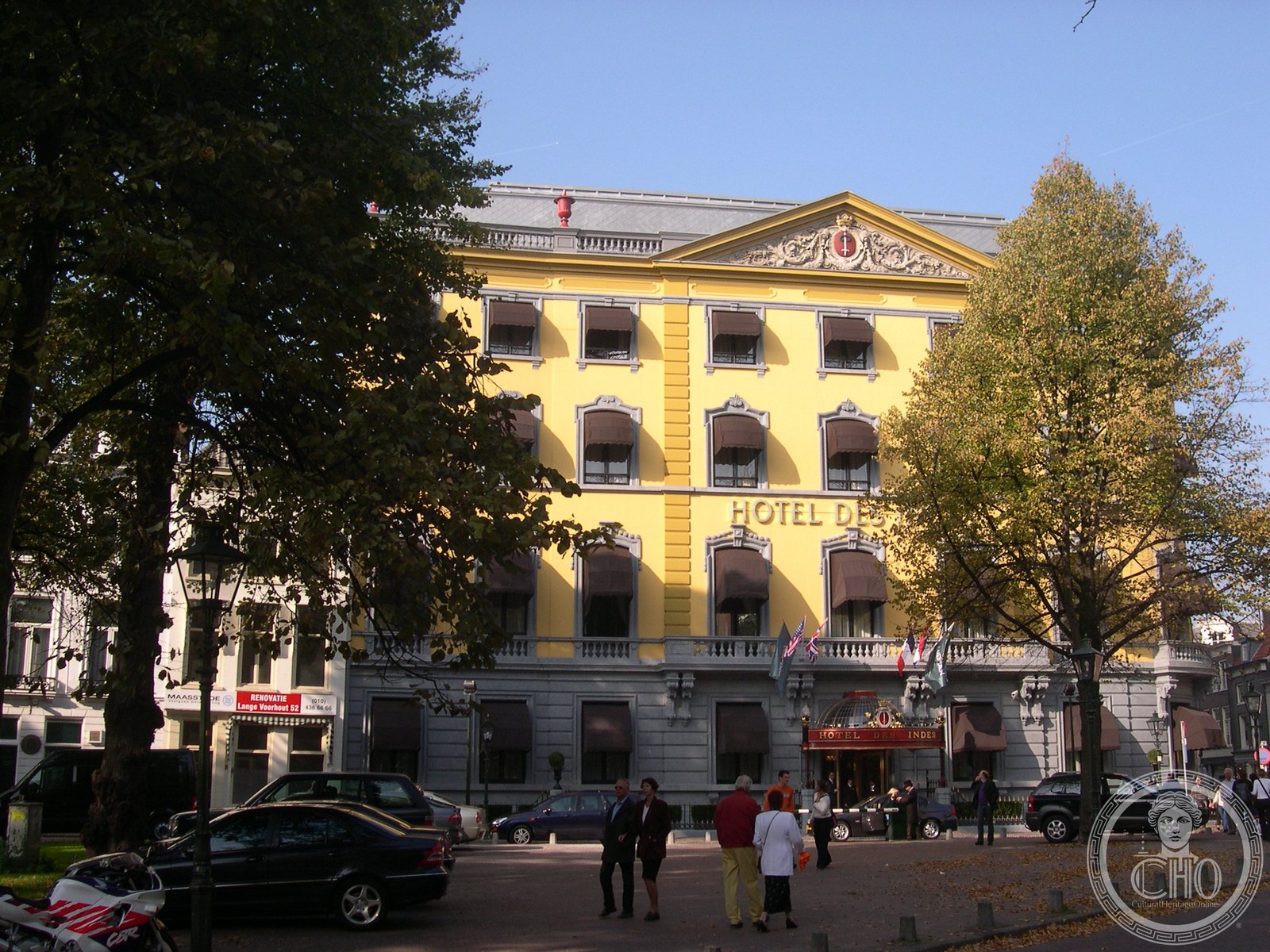
Mata Hari checked into the Hotel des Indes on 13 October 1917 — and checked out the next morning under arrest. The Dutch spy, dancer, and courtesan was taken from the hotel to face a French firing squad.
At a glance
Built in 1881 as the private residence of Baron van Brienen van de Groote Lindt and converted into a hotel in 1881, the Hotel des Indes occupies a Neo-Renaissance mansion on the Lange Voorhout — the lime tree-lined avenue at the heart of The Hague’s diplomatic quarter, where the permanent missions of foreign states have been concentrated since the 17th century. The hotel became the address of the Dutch colonial establishment: planters, administrators, and officials returning from the Dutch East Indies (hence the name) used it as their base in the metropolitan capital.
Key facts
- Built: 1881 as private residence; hotel from 1881
- Style: Neo-Renaissance — consistent with the patrician architecture of the Lange Voorhout
- Address: Lange Voorhout 54–56, 2514 EG The Hague, Netherlands
- GPS: 52.0799, 4.3071
- Status: InterContinental Hotel des Indes; five-star; heritage-protected
- Key event: Mata Hari arrested here on 13 October 1917; executed by French firing squad 16 October
History
The Lange Voorhout had been The Hague’s diplomatic address since the 17th century, when the Dutch Republic established its foreign affairs apparatus in the city that housed the States-General. The Hotel des Indes, facing this avenue, naturally attracted the colonial commercial elite who needed proximity to the Dutch ministries and to the foreign embassies that lined the same street. The “Indies” of the name referred to the Dutch East Indies (modern Indonesia), the source of the fortunes that built The Hague’s 19th-century prosperity.
Mata Hari — born Margaretha Geertruida Zelle in the Dutch city of Leeuwarden in 1876 — had lived an extraordinary life as an exotic dancer, courtesan, and intelligence operative by the time she checked into the des Indes on the evening of 12 October 1917. The French Deuxième Bureau had been tracking her movements for months, convinced (on disputed evidence) that she was passing intelligence to Germany. French agents arrested her in her room on the morning of 13 October; she was transferred to Paris, tried by military tribunal, and executed at Vincennes on 15 October 1917. Her execution was photographed and the images distributed internationally.
What you see
The Neo-Renaissance facade on the Lange Voorhout is characteristic of the late 19th-century patrician style of The Hague — three stories in cream render with arched windows, classical rustication, and a modest cornice. The public interiors, redesigned in the early 20th century, feature a palm court atrium with a glass ceiling and iron columns — a common solution for hotel lobbies of the Edwardian era that admitted natural light to a deep plan.
Practical information
The Lange Voorhout hosts an antiques market (Thursdays and Sundays). The Mauritshuis museum, housing Vermeer’s Girl with a Pearl Earring and Rembrandt’s The Anatomy Lesson, is a 10-minute walk. The Hague is 50 minutes from Amsterdam by train and 20 minutes from the Hook of Holland ferry terminal.
Find it on the map
See this place and what’s around it →📷 Become a Cultural Heritage Online photographer
Share your photos of places: they stay published under your name as the author. The more they're seen, the more you get noticed — and soon a contest will reward the most appreciated photos.
Log in or sign up free to add a photoIs this page about you?
This page is read by travellers and heritage enthusiasts who find it on Google. Tell us how you are connected to this place and we will take it from there.