
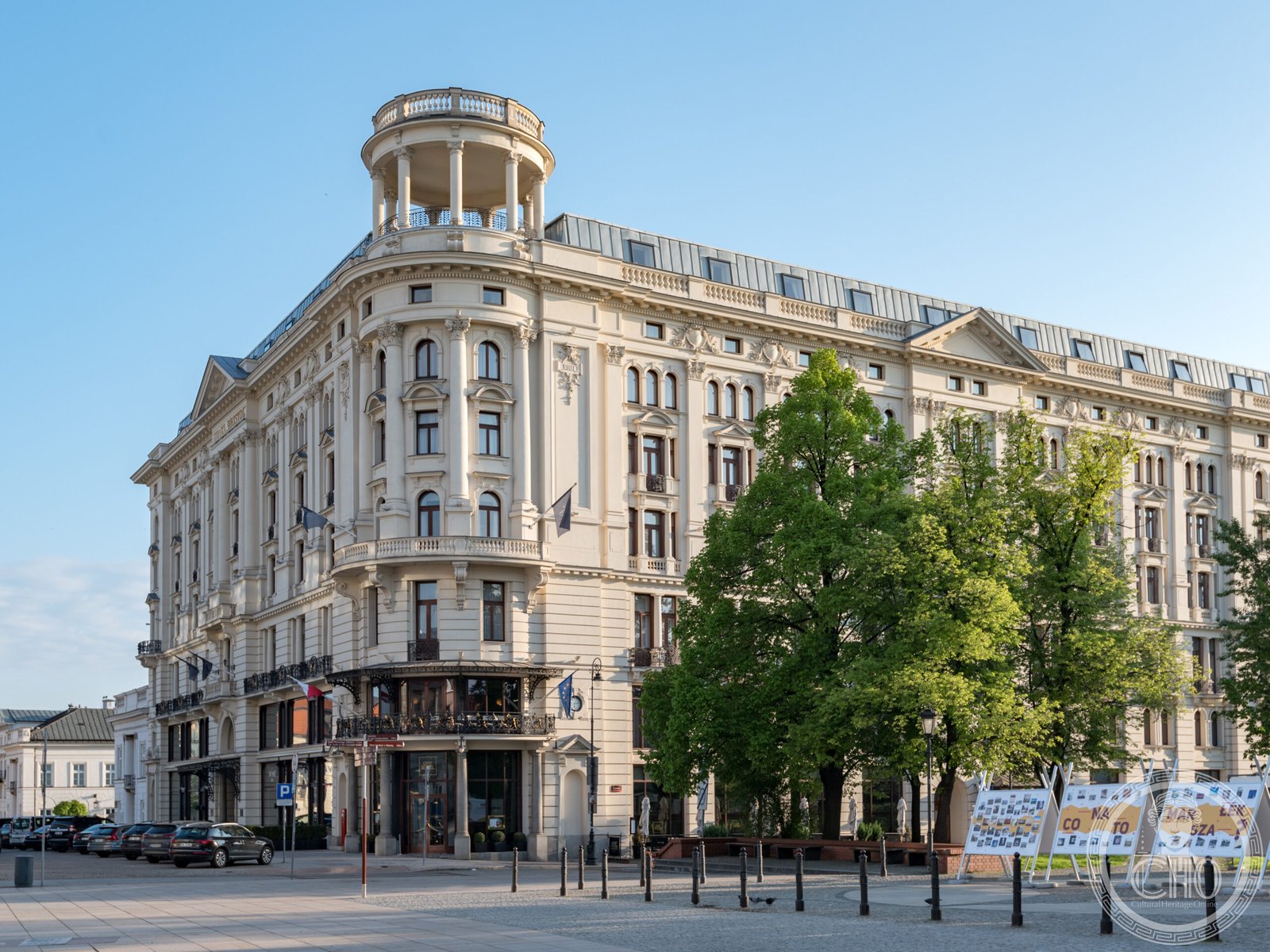
A survivor among ruins. Hotel Bristol has anchored Warsaw’s Royal Route since 1901, outlasting the near-total destruction of a city that had to rebuild itself from ash.
At a glance
Designed by Władysław Marconi (1848–1915) in the Neo-Renaissance style and opened on 19 November 1901, the Hotel Bristol is one of the few Warsaw landmarks to have survived the Second World War with its structure largely intact. Originally conceived as an Art Nouveau building — the first competition was won by Tadeusz Stryjeński and Franciszek Mączyński — the brief shifted when Marconi was brought in to enrich the façade with classical stucco work and a rounded corner belvedere. Today it operates as a five-star Luxury Collection property under Marriott International, its survival making it an irreplaceable document of pre-war Warsaw’s grandeur.
Key facts
- Built: 1899–1901 by Władysław Marconi; interiors by Otto Wagner Jr.
- Style: Neo-Renaissance with Art Nouveau interiors; Art Deco modernisations 1928–1931
- Status: Five-star hotel (Luxury Collection / Marriott International)
- Address: Krakowskie Przedmieście 42/44, 00-325 Warsaw, Poland
- GPS: 52.24222, 21.01611 — Open in Google Maps
- Listed: Historic Monument of Poland (designated 8 September 1994)
History
The project began in 1895 when a consortium led by Polish pianist and statesman Ignacy Jan Paderewski — who personally purchased the majority of the 4,000 shares at 250 rubles each — acquired the site of the former Tarnowski Palace. The cornerstone was laid on 22 April 1899. Viennese architect Otto Wagner Jr. executed the interior decoration, producing some of the earliest Art Nouveau reception rooms in Central Europe. When the hotel opened, it boasted the country’s first elevator and 200 rooms, 20 of them with private bathrooms.
Between 1928 and 1931 the interiors were gutted and refitted in the Art Deco style by designer Antoni Jawornicki, adding 250 modernised rooms and 80 bathrooms. The building survived the Second World War in a city that lost more than 80% of its fabric — a near-miraculous outcome that secured its status as a living memorial. Israel opened its first diplomatic embassy here on 29 September 1948. After decades of state management under Orbis, the hotel was restored between 1991 and 1992 and ceremonially reopened by Margaret Thatcher on 17 April 1993.
Rosmarinum Investments has owned the property since 2011, with Marriott International as operator. Its designation as a Historic Monument of Poland in 1994 placed it among the country’s most protected cultural sites.
What you see
The façade runs along Krakowskie Przedmieście in a confident Neo-Renaissance register: rusticated stonework at street level, rhythmic pilastered bays above, and a rounded corner capped by a belvedere that commands the view south toward the Presidential Palace next door. Marconi’s stucco enrichments give the surface a jewel-like density without tipping into excess — classical grammar deployed with Italianate precision.
Inside, the surviving Art Deco interiors from the 1928–1931 refurbishment set the prevailing tone: geometric metalwork, warm timber panelling, and the polish of a hotel that has hosted heads of state for over a century. Suite 211 — where Paderewski himself stayed — remains a reference point in the building’s layered biography.
Practical information
- Hotel guests and restaurant/café visitors; the public spaces are accessible to non-guests
- Best visited in spring or early autumn when Krakowskie Przedmieście is at its most animated
- Guided architectural tours available through the hotel concierge
- Allow 30–60 minutes to explore the public interiors and façade
Getting there
Warsaw Chopin Airport (WAW) lies approximately 10 km to the south; a taxi or Uber takes 20–30 minutes. The hotel sits on Krakowskie Przedmieście in the heart of the Royal Route, a 10-minute walk from the Old Town Market Square. Tram and bus stops on the adjacent boulevard provide direct links to Warsaw Central Station.
Nearby
- Presidential Palace — immediately adjacent; seat of the Polish head of state, with a Neoclassical colonnaded façade
- Hotel Europejski — across Krakowskie Przedmieście; another 19th-century grand hotel by Enrico Marconi (Władysław’s father), now restored as a Raffles property
- Royal Castle, Warsaw — 500 m north; rebuilt after wartime destruction and now a national museum housing the Canaletto views of 18th-century Warsaw
- St Anne’s Church — 300 m north; Gothic and Baroque landmark with a panoramic viewing terrace on its tower
Sources
Find it on the map
See this place and what’s around it →📷 Become a Cultural Heritage Online photographer
Share your photos of places: they stay published under your name as the author. The more they're seen, the more you get noticed — and soon a contest will reward the most appreciated photos.
Log in or sign up free to add a photoIs this page about you?
This page is read by travellers and heritage enthusiasts who find it on Google. Tell us how you are connected to this place and we will take it from there.