

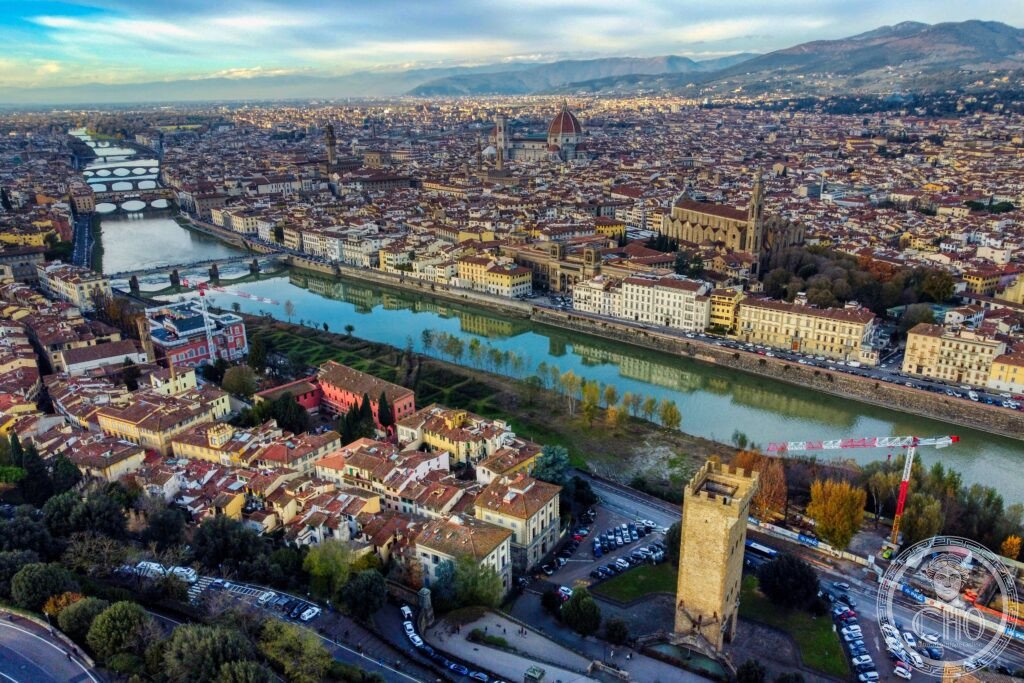
Historic Centre of Florence

Florence Duomo Brunelleschi dome Renaissance Arno Firenze Italy UNESCO World Heritage
The Cathedral of Santa Maria del Fiore (Il Duomo; the Cathedral of Florence; begun 1296 under Arnolfo di Cambio; the dome (the Cupola del Brunelleschi; Filippo Brunelleschi won the competition to design the dome in 1418; the dome was completed in 1436 — the largest brick dome ever constructed (42 m internal diameter; 91 m height to the lantern; approximately 4 million bricks; the dome was the first to be built without a wooden supporting frame (centring) — a technique so unprecedented and so closely guarded by Brunelleschi that the exact method is still debated by engineers today; Brunelleschi built a smaller test dome (the cupola della Sagrestia Vecchia in San Lorenzo (1421–1428)) to develop and demonstrate the technique; the herringbone brick pattern (the secret structural element that allowed the dome to build itself upward without centering by locking the bricks into a self-supporting spiral); the Piazzale Michelangelo view (the most photographed view of Florence; the panoramic hillside terrace south of the Arno with the dome dominating the city skyline)), Florence (Firenze), Tuscany, Italy — UNESCO World Heritage Site 1982. Photo via Wikimedia Commons.
Florence (Firenze), Tuscany, Italy · Cradle of the Italian Renaissance; Brunelleschi’s dome (1436; 42m diameter; largest brick dome ever; no centering frame); Uffizi (Leonardo/Michelangelo/Raphael/Botticelli/Caravaggio; most important Renaissance collection); Accademia (Michelangelo’s David, 1504; the most important marble sculpture in the world); Santa Croce (Dante/Michelangelo/Galileo tombs); Ponte Vecchio (1345; jewellers since 1593; Vasari Corridor above); Pitti Palace; Boboli Gardens · UNESCO World Heritage 1982

Historic Centre of Florence

The city that invented the Renaissance and produced the greatest concentration of art, architecture, and sculpture in the world — Florence’s historic centre holds the Uffizi Gallery (the world’s most important collection of Renaissance painting), Michelangelo’s David, Brunelleschi’s dome (the most audacious feat of engineering between antiquity and the Industrial Revolution), and the architectural legacy of the Medici family whose patronage financed the rebirth of Western civilisation.

At a glance

The Historic Centre of Florence (UNESCO WHS 1982; area approximately 505 ha; population of Florence approximately 370,000 (the capital of Tuscany; the most visited city in Tuscany; the seventh most visited city in Italy); the city that can reasonably claim to have invented the modern world: Dante Alighieri (1265–1321; the father of the Italian language; the Divine Comedy (c.1308–1321) is the first major work of literature written in the Italian vernacular rather than Latin — the most consequential decision in Italian literary history; the Inferno is the most read and most quoted work of Italian literature in the 21st century)); Petrarch (Francesco Petrarca; 1304–1374; the first humanist; the “father of humanism” — the intellectual movement that placed human beings, rather than God, at the centre of scholarly inquiry; the most important intellectual transition in the European tradition between Augustine and Descartes); Boccaccio (Giovanni Boccaccio; 1313–1375; the Decameron (1353; the most important prose work in the Italian language before the 19th century; 100 stories told by 10 people sheltering from the Black Death for 10 days — the most socially realistic narrative of 14th-century Italian life)); the Florentine school of art (the quattrocento (the 15th century; the first century of the Renaissance; Masaccio (1401–1428; the inventor of the modern approach to pictorial perspective and volume; the Brancacci Chapel frescoes (the most important single interior of early Renaissance painting)); Donatello (1386–1466; the greatest sculptor of the 15th century; the bronze David (c.1440; the first life-size free-standing nude male sculpture since antiquity; the most important single sculpture of the quattrocento)); Ghiberti (Lorenzo Ghiberti; 1378–1455; the Gates of Paradise (the East Doors of the Baptistery; 1425–1452; Michelangelo said of them that they deserved to be the gates of Paradise — the most famous compliment one artist has paid to another in the entire Western tradition); Botticelli (1445–1510; the Birth of Venus; the Primavera; the finest flowering of the Neoplatonic aesthetic).

Key facts

  • The Uffizi Gallery: the most important collection of Renaissance paintings in the world — the Galleria degli Uffizi (the building: the Uffizi (Italian for “offices”; the building was commissioned by Cosimo I de’ Medici (1519–1574; the first Duke of Florence and Grand Duke of Tuscany; the most powerful Medici ruler) in 1560 from Giorgio Vasari (1511–1574; the painter, architect, and art historian; the author of the Lives of the Artists (1550) — the most important single source on Italian Renaissance art; the founding text of art history as a discipline; Vasari designed the Uffizi building and the Vasari Corridor) as the administrative offices of the Florentine state); the collection (the most important works: Botticelli’s Birth of Venus (c.1484–1486; the painting on which every idealized representation of female beauty in Western art from the 15th century to the present draws; the most immediately recognisable single painting from the Florentine Renaissance); the Primavera (c.1477–1478; the most complex allegory in Renaissance painting; the most debated iconographic programme in Italian art — the subject is still not definitively identified after 500 years of scholarship); Leonardo da Vinci’s Annunciation (c.1472–1476; Leonardo’s earliest complete painting; the most important early Leonardo in any public collection); Michelangelo’s Doni Tondo (c.1506–1508; the Holy Family; the only completed panel painting by Michelangelo; the technical virtuosity of the foreshortening and the colour are qualities that Michelangelo achieved on no other painted surface); Caravaggio’s Medusa (c.1596–1597; the shield painting; the most terrifying image in the Caravaggio collection; the most technically complex painting of the artist’s early career); Raphael’s Madonna of the Goldfinch (c.1505–1506; the most gentle and humanist of the Raphael Madonnas in Florence; the goldfinch held by the child Baptist is a symbol of the Passion))
  • Michelangelo’s David: the most important marble sculpture in the Western tradition — the David (Michelangelo Buonarroti; 1501–1504; the Galleria dell’Accademia; the commission history (the Opera del Duomo (the works committee of the Cathedral) commissioned the marble block in 1464 for Agostino di Duccio, who abandoned it after roughing out the legs; the block stood unused for 25 years until the commission was given to Michelangelo in 1501 (when he was 26 years old)); the subject (David before the confrontation with Goliath — the moment of focused concentration before action (not the triumphant aftermath, as in Donatello’s and Verrocchio’s earlier Davids)); the scale (5.17 m including the base; the largest marble figure carved since antiquity; the most demanding technical project in 15th–16th century sculpture); the anatomy (the deliberate distortions: the right hand is too large (the Italian mano means both hand and power); the head is too large (designed to be seen from below on the Cathedral facade, where it was originally intended to stand; Michelangelo anticipated the perceptual correction needed when seen from a low viewpoint); the veins in the hands and neck are unnaturally prominent (they are tense — the body is preparing for maximum exertion)); the original placement (the David was placed outside the Palazzo della Signoria (now the Palazzo Vecchio; the seat of the Florentine republic) as a symbol of the republic’s civic virtue and military readiness; in 1873 it was moved to the Accademia for conservation and a marble copy placed in the original location))
  • Santa Croce: the Pantheon of Italian art and genius — the Basilica di Santa Croce (the largest Franciscan church in the world; begun 1294; the most important church in Florence for heritage tourists; the reason (the tombs: the most important burial church in Italy after St. Peter’s Basilica); the most important tombs (Michelangelo (1475–1564; buried in Santa Croce since 1570; the tomb designed by Vasari; the three allegorical female figures (Painting, Sculpture, Architecture) weeping over the sarcophagus); Galileo Galilei (1564–1642; buried in Santa Croce since 1737 — the reburial (Galileo was denied burial in the main church because he had been condemned by the Inquisition in 1633; his tomb was in a small antechamber; in 1737, 95 years after his death, the Florentine academy received permission to rebury him with full honours in the main nave; during the reburial, three fingers, a tooth, and a vertebra were removed from the body and kept as relics — the right middle finger and two others are now displayed in the Galileo Museum in Florence; the most precisely documented instance of a scientist being treated as a saint)); Dante Alighieri (1265–1321; the cenotaph (the empty monument) — Dante died in Ravenna in 1321 and is buried there; Ravenna has refused to return the body to Florence; the cenotaph in Santa Croce (the most famous empty monument in Italy; the most bitter ongoing diplomatic dispute between two Italian cities)))
  • Heritage: UNESCO World Heritage Site, Historic Centre of Florence, inscribed 1982
  • GPS: 43.7731° N, 11.2560° E

History

The Roman origins (Florentia; founded 59 BCE as a Roman military colony for veterans; the original rectangular street grid (the cardo and decumanus) is still visible in the street plan of the Santa Croce neighbourhood; the most legible Roman urban plan in Tuscany)); the medieval commune (the 11th–13th centuries; the rise of the Florentine wool and banking guilds; the Arti (the guild system that governed Florence; the Art of the Wool (Arte della Lana) and the Art of the Bankers (Arte del Cambio) were the wealthiest; the Florentine guilds financed the great Cathedral, the Baptistery, and Orsanmichele)); the Medici (the Medici bank (founded c.1397 by Giovanni di Bicci de’ Medici; by 1450 the most powerful bank in Europe; branches in London, Bruges, Geneva, Venice, Rome, Avignon, Naples); Cosimo de’ Medici “il Vecchio” (1389–1464; the first great Medici patron; the builder of the Medici library; the patron of Fra Angelico, Donatello, and Michelozzo); Lorenzo de’ Medici “il Magnifico” (1449–1492; the greatest patron of the quattrocento; the friend and patron of Botticelli, Leonardo da Vinci, and Michelangelo; the Platonic Academy (the intellectual circle of Lorenzo’s court — the most important single concentrati on of humanist scholarship in the 15th century; Marsilio Ficino, Pico della Mirandola, Poliziano); the expulsion and return (the Medici were expelled in 1494 after the French invasion; restored in 1512; exiled again 1527–1530; restored permanently 1530 by Emperor Charles V)); the Grand Duchy (1569–1801; the Medici Grand Dukes (Cosimo I; Francesco I; the Pitti Palace; the Uffizi; the Boboli Gardens; the creation of the museum tradition)); UNESCO WHS 1982.

What you see

The essential Florence (all within walking distance): the Duomo complex (the Cathedral + Brunelleschi’s dome (the climb to the top (463 steps; the only way to understand the structural genius; the view from the lantern at 91 m; book in advance); the Baptistery (the gilded bronze doors; the east doors — Ghiberti’s Gates of Paradise (1425–1452) — are copies; the originals are in the Museo dell’Opera del Duomo (the most underrated museum in Florence; the original panels of the Gates of Paradise at eye level; the Cathedral museum))); the Uffizi (book weeks in advance; allow 3–4 hours; go early; the sequence (rooms 2–9 for the Florentine quattrocento; rooms 10–14 for Botticelli; room 41 for Caravaggio; the Michelangelo room)); the Accademia (the David; book in advance; allow 90 min; the approach corridor (the unfinished Prisoners or Slaves — the four incomplete figures from the Julius II tomb (Rome) are displayed here; the most important demonstration anywhere of Michelangelo’s working method (you can see the figures emerging from the block, as if the sculptor is releasing rather than carving them — the most direct visual illustration of his creative philosophy))); the Ponte Vecchio (the medieval bridge (1345; the only bridge in Florence not destroyed by the retreating Germans in 1944 — Hitler specifically ordered the Ponte Vecchio preserved); the shops (jewellers and goldsmiths since 1593; the Vasari Corridor (built by Vasari 1565–1566 for Cosimo I to walk from the Palazzo Vecchio to the Pitti Palace without going through the streets; runs above the shops of the Ponte Vecchio; closed since 2016 for restoration; scheduled to reopen)).

Practical information

  • Getting there: Florence Airport (FLR; Amerigo Vespucci Airport; 4.5 km from the city centre; the Vola in Bus (shuttle bus; EUR 6; 20 min to Santa Maria Novella station)); the high-speed train (Santa Maria Novella station (SMN; the most important train hub in Tuscany); Frecciarossa: Rome (1h 28min; from EUR 24); Milan (1h 47min; from EUR 22); Bologna (37 min; from EUR 15); Venice (2h; from EUR 27)); the city (the historic centre is largely car-free; the most walkable significant city in Italy (the main sights are within a 20-minute walk of each other); Florence passes (the Firenze Card (72h card; EUR 85; fast-track entry + unlimited museums; worth it if you plan to visit Uffizi, Accademia, Bargello, Medici Chapels, and Santa Croce in the same 3 days))
  • The over-tourism problem: the most over-visited city per square kilometre in Italy — Florence (approximately 13 million visitors per year for a city of 370,000 — the highest tourist-to-resident ratio of any major Italian city; the management (the city centre is increasingly unaffordable for local residents; the short-term rental density is the highest in any Italian city; the mayoralty of Sara Funaro (elected 2024) has introduced restrictions on new short-term rental licences in the historic centre); the crowds (the Uffizi in July–August is the most crowded museum experience in Italy — more so than the Vatican Museums because the rooms are smaller; the David in high season requires queuing even with a timed ticket; the best strategy (visit in early March or late October; arrive at museum opening; avoid Saturdays — the single worst day in Florence throughout the year))
  • The Tuscan table: the most influential regional cuisine in Italian history — the essential Florentine foods (the bistecca alla Fiorentina (the T-bone steak (the cut includes both the sirloin and the tenderloin, separated by the T-bone; the breed (Chianina; the white Tuscan cattle; the most important beef breed in Italian cooking; the Chianina from the Val di Chiana between Arezzo and Siena); the thickness (at least 4 cm; usually 5–6 cm; thin Fiorentina is a contradiction in terms); the cooking (always very rare — the inside is red and warm, not raw and cold; a Florentine who orders a Fiorentina “ben cotta” (well done) is considered to have committed a social gaffe; the asking price in a restaurant is by weight (per etto = 100g; a 1.5 kg steak for two people (the usual size) typically costs EUR 50–80 total))); the ribollita (the most important Tuscan vegetable soup; bread soup with cavolo nero (the black Tuscan kale), cannellini beans, carrots, onion, and stale bread; the name (ribollita means “reboiled” — the soup was traditionally made in large quantities and reheated (and improved) over several days; the version in a good Florentine trattoria on a cold December evening is the best expression of simple Tuscan cooking))

Getting there

Airport FLR (4.5 km; shuttle EUR 6). Frecciarossa: Rome 1h28, Milan 1h47, Bologna 37min. Historic centre is walkable; most sights within 20min of each other. GPS: 43.7731, 11.2560.

Nearby

  • Siena Historic Centre (UNESCO WHS 1995) — 75 km south of Florence (1h 15min by bus from Florence Santa Maria Novella station; the direct Siena Mobilità bus is the only practical option as there is no direct train); the most perfectly preserved medieval city in Italy and the greatest Gothic city in Europe — Siena (the medieval rival of Florence; the most important artistic centre of the early Italian Middle Ages; the Palio (the most famous horse race in Italy; held twice a year in the Piazza del Campo on 2 July and 16 August; the 17 contrade (city districts) each enter a horse; the race itself lasts approximately 90 seconds; the preparation and rituals last the entire year; the Palio is the most intense civic ritual in Italy); the Piazza del Campo (the most beautiful medieval public square in the world; the shell-shaped brick plaza; the Palazzo Pubblico (the 14th-century civic palace; the Torre del Mangia (102 m; the most elegant Gothic tower in Italy; the views of the city and the surrounding Crete Senesi); the Mappamondo (the 9th room; Simone Martini’s Maestà of 1315 — the most important single fresco in the history of Sienese painting)); the Cathedral (the Duomo di Siena; the most magnificent Gothic cathedral in Italy (more so than the Duomo of Milan or the Duomo of Orvieto, because the Siena interior (the striped black and white marble walls and columns; the inlaid marble floor (the largest inlaid marble floor in the world; 56 panels depicting biblical scenes and allegories; the work of 40 artists over 200 years (1369–1562)); the Pisano pulpit (Nicola Pisano; 1265–1268; the most important pulpit in Italian Gothic sculpture; the direct model for the Pisa pulpit and the beginning of the modern Western sculptural tradition))))
  • Pisa (UNESCO WHS 1987) — 80 km west of Florence (1h by regional train; approximately EUR 9); the Leaning Tower and the finest Romanesque complex in Italy — the Piazza dei Miracoli (the Campo Santo; the Cathedral (Duomo di Pisa; begun 1063; the finest Romanesque cathedral facade in Italy; the alternating stripes of white marble and dark limestone; the bronze doors cast by Bonanno Pisano in 1186 (cast before the Leaning Tower was begun in 1173)); the Baptistery (begun 1152; the largest baptistery in Italy; the acoustic phenomenon (the baptistery creates a remarkable echo that sustains a note for approximately 5 seconds — the longest natural reverberation of any roofed structure in Italy; no audio guide needed — any tourist who sings or shouts a note will discover this immediately)); the Leaning Tower (Torre Pendente; begun 1173; the soft subsoil of the Piazza dei Miracoli caused the foundations to sink unevenly during construction; the lean (the tower was already leaning before it was finished; 294 steps to the top; the current lean = 3.97° after the stabilisation works of 1990–2001 (the lean was corrected from 5.5° in 1990 to the current 3.97° — not to vertical, because a vertical tower in Pisa would be worth nothing commercially); Galileo Galilei (born Pisa 1564; the story of dropping balls from the top (the story is almost certainly apocryphal; Galileo never mentions it in his writings; the balls would not have behaved as described in the story because air resistance makes the fall rate of different masses slightly different at atmospheric pressure))))
  • San Gimignano (UNESCO WHS 1990) — 56 km south of Florence (1h 15min by bus); the medieval “Manhattan” with its surviving skyline of medieval tower-houses — San Gimignano (the medieval hill town in the Sienese hills; the 14 surviving towers (originally there were 72 towers; the towers were status symbols built by rival noble families; the taller your tower, the more powerful your family; the 14 remaining towers make San Gimignano the single most striking medieval skyline in Tuscany); the Collegiate Church (the Duomo; the interior frescoes (the most important fresco cycle in a small Tuscan church: the Old Testament scenes (school of Bartolo di Fredi; c.1367) on the north wall; the New Testament scenes (Lippo Memmi; 1333) on the south wall; the Last Judgement by Taddeo di Bartolo (1393) in the entrance bay — the most visually arresting final judgement in Tuscany); the gelato (San Gimignano claims to have the best artisan gelato shop in Italy (Gelateria Dondoli; Piazza della Cisterna; two-time winner of the World Gelato Championship; the most credentialed gelato in Tuscany))

Sources

  • Wikipedia, Florence; Uffizi; Michelangelo; Filippo Brunelleschi, accessed June 2026
  • UNESCO, Historic Centre of Florence, WHS reference 174, inscribed 1982
  • Ross King, Brunelleschi’s Dome, Pimlico, 2001

Hero image: Florence skyline with Brunelleschi’s dome, Wikimedia Commons. Editorial text © Cultural Heritage Online, 2026.

📷 Diventa un fotografo di Cultural Heritage Online

Condividi le tue foto dei luoghi: restano pubblicate con la tua firma come autore. Più vengono viste, più ti fai conoscere — e presto un concorso premierà le foto più apprezzate.

Accedi o registrati gratis per aggiungere una foto
📋 Copy & share on social
Scroll to Top