

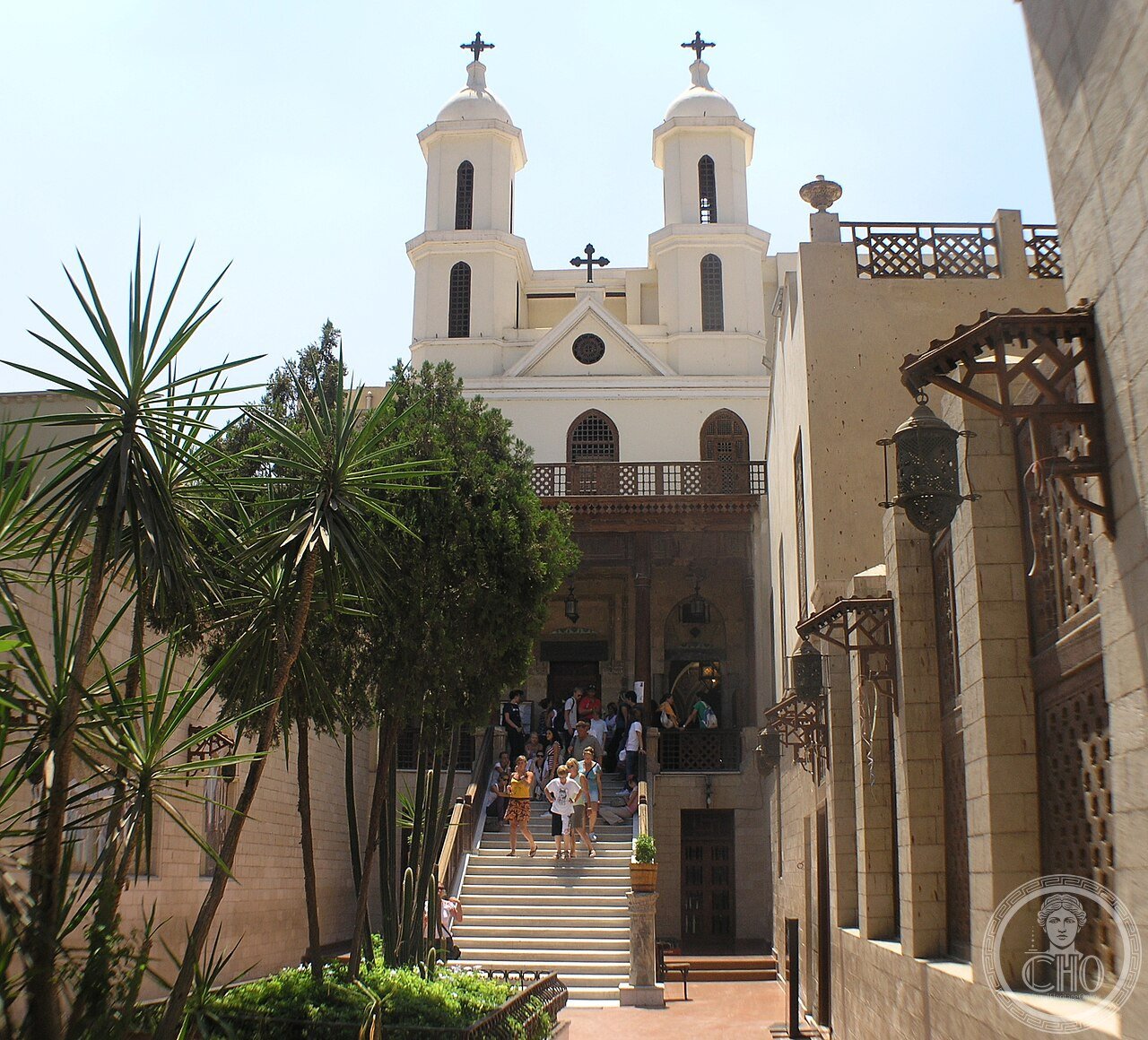
The Hanging Church owes its name to its position: built above a gateway of the fortress of Babylon, the Roman stronghold that commanded the area of Old Cairo, the building’s nave is literally suspended over a passage, with no foundations resting directly on the ground below. The first travellers to reach Cairo nicknamed it “the church of the stairs”, since twenty-nine steps must be climbed to reach it. It was probably built during the patriarchate of Isaac, though an older religious building may have stood on the same site as early as the third or fourth century, perhaps as a place of worship for the soldiers garrisoning the Roman fortress. Dedicated to the Virgin Mary, with shrines also to Saint John the Baptist and Saint George, the church is traditionally associated with the flight of the Holy Family into Egypt. In 1047 Cairo became the official and permanent residence of the Coptic patriarch at this very church, confirming its role as the spiritual heart of Egyptian Coptic Christianity.
About the Hanging Church
The Hanging Church takes its name directly from its unusual physical position: built above a gatehouse of the Babylon Fortress, the Roman citadel that once dominated the district now known as Old Cairo or Coptic Cairo, the church’s nave is genuinely suspended over a passage below, without a continuous foundation resting directly on the ground beneath it. Early European travellers to Cairo, struck by the church’s approach, dubbed it “the Staircase Church,” since reaching the entrance requires climbing twenty-nine steps from street level. The church was probably built during the patriarchate of Isaac, though an earlier religious structure may have existed on or near the same site as far back as the 3rd or 4th century CE, quite possibly serving as a place of worship for the Roman soldiers garrisoned within the Babylon Fortress itself. The fortress’s own origins remain disputed among Coptic historians: some trace its foundation to as early as the 19th century BCE, following Pharaoh Sesostris’s defeat of Babylonian forces and the subsequent rebellion and fortress-building of Babylonian prisoners settled in Egypt, while others attribute its construction to the late 6th century BCE, under Nebuchadnezzar II of Babylon following his conquest of Egypt. The Hanging Church is dedicated to the Virgin Mary and contains further sanctuaries devoted to Saint John the Baptist and Saint George, and the site holds deep devotional significance for its long-standing association with the Holy Family’s flight into Egypt, described in the Gospel of Matthew. The church’s historical importance within Coptic Christianity reached its peak in 1047, when Cairo formally became the fixed, official residence of the Coptic Orthodox Patriarch, based specifically at the Hanging Church — a status that cemented the building’s role as one of the central spiritual and administrative sites of Egyptian Coptic Christianity for centuries thereafter.
Key facts
- 3rd-4th century CE (possible): earlier church structure on or near the site
- Patriarchate of Isaac: probable construction date of the present church
- Nave suspended directly over the Babylon Fortress gatehouse passage
- 29 steps lead up to the church entrance, giving rise to its nickname “the Staircase Church”
- Dedication: the Virgin Mary, with further sanctuaries to Saint John the Baptist and Saint George
- 1047: Cairo becomes the fixed seat of the Coptic Orthodox Patriarch, based at the Hanging Church
History
The Hanging Church’s construction directly above the gatehouse of the ancient Roman Babylon Fortress represents one of the more architecturally distinctive solutions found anywhere among early Christian churches, its suspended nave reflecting the practical constraints of building within a dense, already fortified Roman military and administrative complex. The fortress itself, with disputed origins stretching back potentially as far as the second millennium BCE, situates the Hanging Church within one of the longest continuously significant urban sites in the entire history of Cairo, predating the Islamic-era foundation of the city by many centuries.
The church’s elevation to the fixed seat of the Coptic Orthodox Patriarchate in 1047 marked a pivotal moment in the institutional history of Coptic Christianity in Egypt, formalising Cairo’s role as the religious centre of the Coptic Church at a site already deeply associated, through long-standing tradition, with the biblical narrative of the Holy Family’s flight into Egypt.
What you see
The church’s 19th-century facade, with its twin bell towers, rises beyond a narrow courtyard decorated with modern biblical mosaic and tile artwork, including scenes depicting the Holy Family’s journey, before visitors climb the historic 29 steps to reach the suspended nave itself. Inside, the church preserves important early Coptic architectural and artistic elements alongside later additions accumulated across its long history as the seat of the Coptic Patriarchate.
Practical information
- Opening hours: generally open daily with seasonal variation; free admission; check current hours before visiting
- Address: Qasr El Shama Street, Old Cairo (Coptic Cairo), Cairo, Egypt
Getting there
The Hanging Church stands within the Coptic Cairo district of Old Cairo, Egypt, easily reachable via Cairo’s metro system to Mar Girgis station. GPS: 30.0053° N, 31.2300° E.
Nearby
- Coptic Museum — museum of Coptic art and history, immediately adjacent
- Church of Saint George — nearby Greek Orthodox church within the same historic district
- Babylon Fortress ruins — surviving sections of the ancient Roman citadel, surrounding the area
Sources
- Wikipedia — “Hanging Church” (en.wikipedia.org)
- Atlas Obscura — “The Hanging Church in Cairo” (atlasobscura.com)
- Egypt Tours Portal — “The Divine Hanging Church of Coptic Cairo” (egypttoursportal.com)
Find it on the map
See this place and what’s around it →📷 Become a Cultural Heritage Online photographer
Share your photos of places: they stay published under your name as the author. The more they're seen, the more you get noticed — and soon a contest will reward the most appreciated photos.
Log in or sign up free to add a photo