
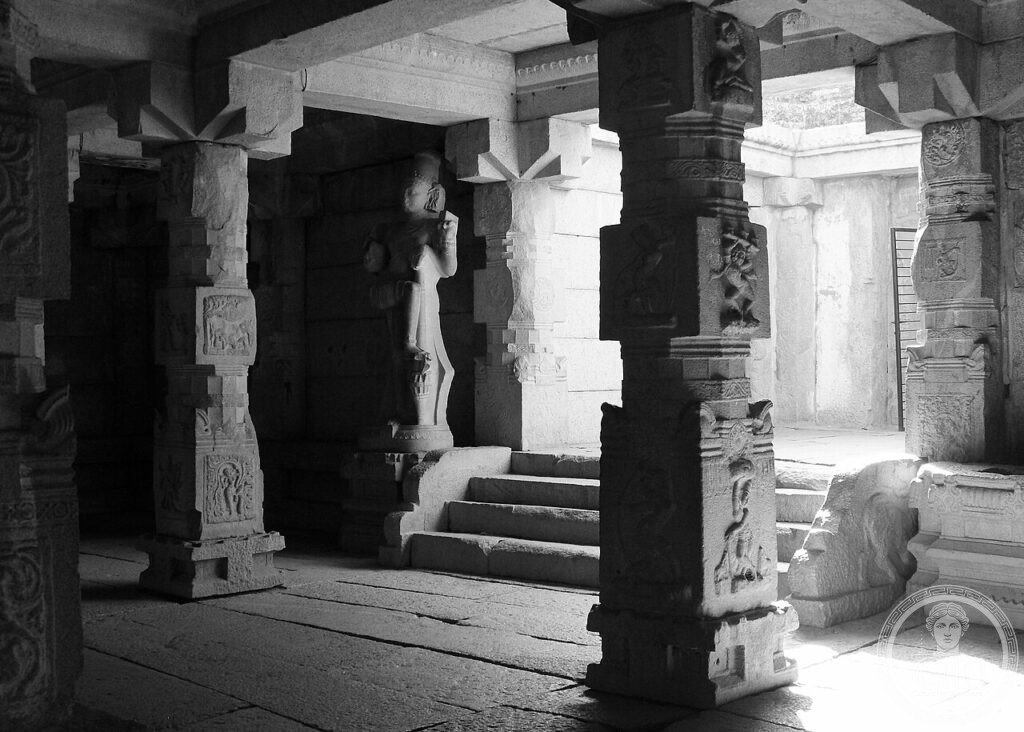
Hampi is what remains of Vijayanagara, once the capital of the last great Hindu empire of southern India and one of the largest cities of its age. Its temples, market streets and royal enclosures sit scattered among house-sized granite boulders on the banks of the Tungabhadra River, largely untouched since the city was destroyed in 1565.
At a glance
Hampi occupies the site of Vijayanagara, capital of the Vijayanagara Empire from 1336 to 1565. At its height the city is thought to have held several hundred thousand inhabitants within a fortified royal complex of temples, market streets, water channels and elephant stables. The ruins stand among an unusual landscape of enormous granite boulders, remnants of an ancient weathered granite dome known as the Dharwar Craton.
The site is inscribed as a UNESCO World Heritage Site, listed in 1986 as the Group of Monuments at Hampi.
Key facts
- Location: Ballari District, Karnataka, India, on the banks of the Tungabhadra River
- Historical role: capital of the Vijayanagara Empire, 1336–1565 CE
- Founders: Harihara I and Bukka I of the Sangama dynasty
- Status: UNESCO World Heritage Site, inscribed 1986
- Landmark monument: the Virupaksha Temple, in continuous religious use since the 7th century CE, with a gopuram roughly 50 metres tall built in 1510 under Krishnadevaraya
History
Vijayanagara, meaning City of Victory, was founded in 1336 by Harihara I and Bukka I of the Sangama dynasty on the southern bank of the Tungabhadra River. Its founding followed earlier incursions into the Deccan by the Delhi Sultanate, and the new empire is described as a Hindu bulwark against the advance of Islamic sultanates into peninsular India.
The empire reached its peak under Krishnadevaraya, who ruled in the early sixteenth century. A successful military commander, celebrated poet and prolific builder, he defeated the Bijapur Sultanate at the Battle of Raichur, wrote the Telugu epic Amuktamalyada, and commissioned major building work at Hampi, including the Vitthala Temple and the gopuram of the Virupaksha Temple.
In 1565 the Vijayanagara army was defeated at the Battle of Talikota by a coalition of the Deccan Sultanates of Bijapur, Bidar, Ahmadnagar and Golconda. The capital was looted and systematically destroyed over several months, its canals and irrigation works broken along with its temples and palaces. The city was never reoccupied as a capital.
What you see
The Virupaksha Temple is the only monument at Hampi still in religious use, dedicated to Shiva and dominated by a tall gopuram built under Krishnadevaraya. Steps lead down from the temple to the Tungabhadra River, where pilgrims bathe, and banana gardens cultivated by the local Lambani community line the far bank.
The Vitthala Temple, unfinished when the city fell in 1565, is considered the most architecturally accomplished structure at Hampi. Its courtyard holds the stone chariot, a full-scale granite replica of a processional temple chariot representing the vehicle of Garuda, consistent with the temple’s dedication to Vitthala, a form of Vishnu. The temple’s hall is famous for its stone pillars, which produce different musical notes when struck.
The former Royal Enclosure includes the Hazara Rama Temple, the royal family’s private shrine decorated with carved friezes depicting the Ramayana, and the Mahanavami Dibba, a large square platform used for royal festival ceremonies. Nearby, the Elephant Stables form a long building of alternating domes and vaults built to house the royal elephants. The Zanana Enclosure, the former women’s quarters, contains the Lotus Mahal, a two-storey pavilion in a hybrid Hindu-Islamic style named for the lotus-like curves of its arches.
Practical information
- Getting to the area: Bengaluru is the main gateway airport; travellers continue by bus or train to Hospet, the nearest large town, and then on to Hampi by road.
- Where to stay: most visitors base themselves in Hampi village near the Virupaksha Temple or across the river at Virupapur Gadde, traditionally reached by coracle boat.
- Best time to visit: the dry season from October to March offers the most comfortable conditions; the monsoon months from June to September leave the site muddy but the river and boulders are at their most dramatic.
- Tickets and access: current entry arrangements and any charges should be checked with the site’s official heritage authorities before travelling.
Getting there
Bengaluru is the usual entry point for travellers heading to Hampi, with onward road or rail connections to Hospet, the nearest town, followed by a short journey by road to the ruins themselves. A smaller regional airport nearer Hospet has limited flight connections, so most visitors route via Bengaluru.
Nearby
- Badami, Aihole and Pattadakal — roughly 130 km south, early Chalukya-dynasty sites of the sixth to eighth centuries CE; Badami is known for its rock-cut cave temples, and Pattadakal, itself a separate UNESCO World Heritage Site inscribed in 1987, combines north Indian Nagara and south Indian Dravida temple styles.
- Bijapur (Vijayapura) — roughly 200 km north, former capital of the Adil Shah dynasty.
Sources
- UNESCO
Find it on the map
See this place and what’s around it →📷 Become a Cultural Heritage Online photographer
Share your photos of places: they stay published under your name as the author. The more they're seen, the more you get noticed — and soon a contest will reward the most appreciated photos.
Log in or sign up free to add a photoIs this page about you?
This page is read by travellers and heritage enthusiasts who find it on Google. Tell us how you are connected to this place and we will take it from there.