
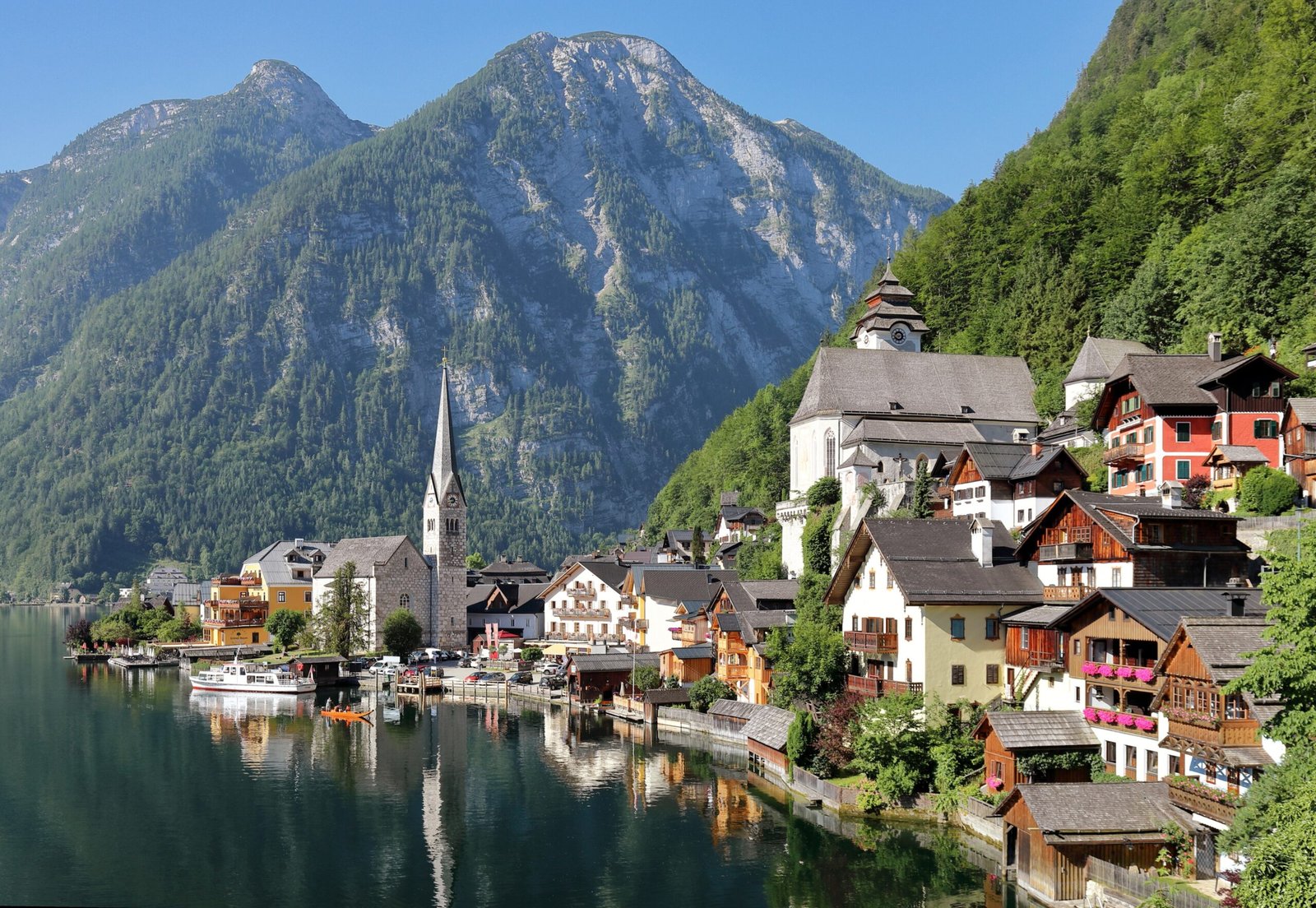
A UNESCO World Heritage village wedged between an Alpine lake and a vertical mountain face in Austria’s Salzkammergut, above which lies the world’s oldest known salt mine — whose Iron Age contents were so comprehensive that an entire period of European prehistory takes its name from Hallstatt.
At a glance
Hallstatt combines two distinct categories of significance that rarely coincide: one of the most photographed village streetscapes in Europe, and directly above it, the world’s oldest continuously operational industrial facility. The salt mine has been worked since at least 5,000 BC and is still commercially operational today. Its contents — excavated systematically since the 1840s — provided so complete a picture of early Iron Age culture that the entire first phase of the Iron Age (c. 800–450 BC) is now called the “Hallstatt period.” Inscribed as part of the Hallstatt–Dachstein / Salzkammergut UNESCO World Heritage Site in 1997.
Key facts
- UNESCO designation: World Heritage Site since 1997, as part of “Hallstatt–Dachstein / Salzkammergut Cultural Landscape”
- Salt mine in operation since: At least 5,000 BC (Bronze Age tools and remains found deep inside the mountain)
- World record: The oldest known industrial facility in continuous use on Earth
- Hallstatt period: c. 800–450 BC — the first phase of the European Iron Age, named after this site
- Preserved miner: A Bronze Age miner killed in a tunnel collapse approximately 3,400 years ago was recovered essentially intact in 1734, preserved by the salt
- Cemetery: Approximately 2,000 burials from 800–400 BC providing the type assemblage for Hallstatt culture
- Organic preservation: The mine preserved wooden tools, leather backpacks, woollen textiles, leather shoes, and even prehistoric miners’ dietary remains — materials that almost never survive in European prehistory
History
Salt has been extracted from the mountain above Hallstatt since at least the Early Bronze Age — a span of approximately 7,000 years of continuous human mining. The site’s importance in the first millennium BC was immense: salt was the primary food preservative of the ancient world, and Hallstatt’s salt gave the communities controlling it access to a commodity of empire-grade value. The wealth visible in the associated cemetery (approximately 2,000 burials from 800–400 BC) reflects this: bronze and iron weapons, ornate fibulae indicating sophisticated metalworking, imported amber from the Baltic and glass from the Mediterranean, and a distinctive geometric artistic style that influenced Celtic art across all of Europe. The systematic excavation of these burials beginning in the 1840s provided such a coherent picture of a specific cultural moment that archaeologists named the entire phase — the first period of the European Iron Age — after Hallstatt.
The salt mine itself has preserved organic materials that almost never survive in European prehistoric contexts: wooden mining tools and ladders, leather backpacks with shoulder straps used to carry salt out of the mountain, woollen textiles showing complex weave patterns, leather shoes, and human faeces which when analyzed revealed the prehistoric miners’ diet and intestinal parasites in forensic detail. Most remarkably, the body of a Bronze Age miner killed in a tunnel collapse approximately 3,400 years ago was recovered essentially intact in 1734, preserved by the salt for over three millennia.
The village of Hallstatt itself — perched on a narrow ledge between lake and mountain — developed as the mining community’s settlement. Its steeply tiered houses, boat landing, and late Gothic parish church create the distinctive silhouette reproduced in approximately 1,000 photographs per hour during the peak tourist season, making Hallstatt one of the most photographed places in central Europe.
What you see
The village street, the Seestrasse, runs along the edge of the Hallstätter See (lake) and is best approached by boat from the opposite shore — the classic view shows the church spire and stacked pastel houses rising directly from the water’s edge against the mountain backdrop. The late Gothic parish church of Maria Himmelfahrt has an unusual charnel house (Beinhaus) in its grounds: because the steep terrain limited burial space, bones were periodically exhumed and the skulls painted with the deceased’s name and date — approximately 1,200 decorated skulls are stored here, the last addition dating to 1995.
The salt mine tour (accessible by funicular from the village) follows the preserved prehistoric and Roman-era workings, includes a wooden slide used by miners to descend between levels (now a tourist attraction), and exhibits the organic finds in context. The World Heritage Museum in the village square holds the core archaeological collection from the Hallstatt cemetery excavations, including ornate grave goods and the reconstruction of key burial contexts.
Practical information
- Location: Hallstatt, Salzkammergut, Upper Austria — approximately 75km southeast of Salzburg
- Salt mine: Open daily April–October; book in advance in summer; tour includes funicular ride and underground experience
- World Heritage Museum: Open daily; closed January–February
- Beinhaus: Open May–October
- Crowds: Summer 2019 saw approximately 10,000 visitors/day — arrive before 9:00 or after 17:00 for manageable conditions; the village has only approximately 750 permanent residents
- Photography: The classic view is from the boat landing; early morning light across the lake and mountain is exceptional
Getting there
Hallstatt is approximately 75km southeast of Salzburg and 280km southwest of Vienna. By train: Salzburg to Hallstatt station (opposite shore) in approximately 2 hours, then a 10-minute boat ferry across the lake. By car: A10 motorway to Bad Ischl, then lakeside road — but parking in Hallstatt itself is extremely limited; the village parking area at Lahn (1km south) is more practical. The regional Salzkammergut Bahnen rail network connects the area.n
Nearby
- Dachstein Ice Caves — 10km south, the karst cave system with spectacular ice formations and a 400-metre-long “Mammoth Cave”
- Bad Ischl — 20km north, the Austro-Hungarian imperial summer resort where Emperor Franz Joseph I spent his summers; the imperial villa is now a museum
- Salzburg — 75km northwest, baroque city, Mozart birthplace, and gateway to the Salzkammergut lake district
- Gosausee — 15km west, a glacially formed lake with direct views of the Dachstein glacier and peaks
Sources
Find it on the map
See this place and what’s around it →
📷 Become a Cultural Heritage Online photographer
Share your photos of places: they stay published under your name as the author. The more they're seen, the more you get noticed — and soon a contest will reward the most appreciated photos.
Log in or sign up free to add a photo