
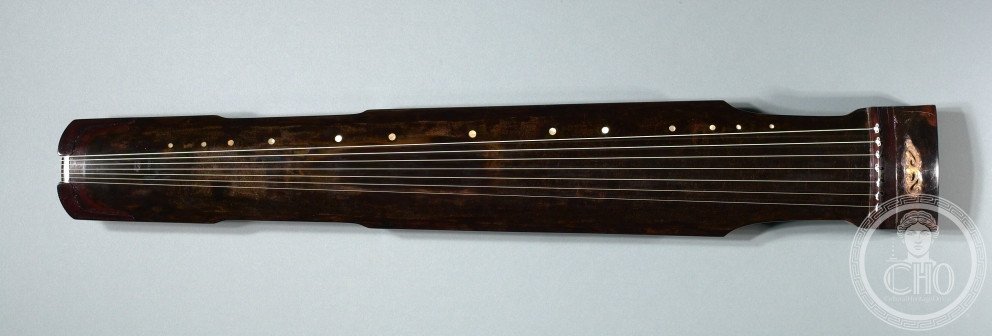
A seven-string plucked instrument of profound subtlety, the guqin has been played for millennia by scholars and sages as a vessel of refinement and philosophical wisdom.
At a glance
The guqin is a plucked seven-string Chinese musical instrument with a range of about four octaves, tuned in the bass register. Its lowest pitch sits about two octaves below middle C—comparable to the lowest note on a cello. Traditionally favoured by scholars and literati, it is sometimes called “the father of Chinese music” or “the instrument of the sages,” and has been associated with the ancient philosopher Confucius.
Origins & history
The guqin has been played since ancient times. By tradition, the instrument originally had five strings representing five notes in the ancient Chinese musical system (gong, shang, jue, zhi, yu), though ancient qin-like instruments with varying numbers of strings have been found. The modern seven-string form has since been stabilized.
Over centuries, the name “qin” came to be applied to many other instruments. By the twentieth century, clarification required—the prefix gu- (“ancient”) was added. More than 3,360 known surviving pieces of guqin music endure from ancient and imperial periods.
The practice
The guqin is a very quiet instrument. Sound emerges from plucking open strings, stopped strings, and harmonics. The glissando—sliding tones between pitches—creates a resonance reminiscent of a pizzicato cello, fretless double bass, or slide guitar.
The instrument features 13 hui, marked positions on each string that allow players to produce different pitches and keys. The guqin is capable of 91 commonly used harmonics, indicated by dotted positions on the instrument. Players perform with a refined, meditative approach befitting its scholarly heritage.
Cultural significance
The guqin embodies scholarly refinement in Chinese culture. A traditional saying holds: “a gentleman does not part with his qin or se without good reason.” The instrument represents subtlety, introspection, and philosophical attainment—tools through which literati communicated wisdom and emotional depth.
Its enduring prestige is reflected in market valuation: in 2010, a Song period guqin sold for $22 million, making it the most expensive musical instrument ever sold. The instrument remains central to understanding classical Chinese music and philosophy.
Key facts
- Seven plucked strings, tuned in the bass register
- Range of approximately four octaves
- Features 13 hui (marked positions) per string
- Capable of 91 commonly used harmonics
- More than 3,360 surviving pieces of guqin music documented
- UNESCO Intangible Cultural Heritage inscription: 2003 (reference 00061)
- Listed in China’s National Non-material Cultural Heritage: 2006
- Anchor community: Beijing, China
Where to experience it
Beijing and other cultural centres across China remain the heartland of guqin practice and study. To encounter the instrument in performance and instruction, seek venues dedicated to classical Chinese music and traditional conservatories in your region of visit.
Sources & resources
Find it on the map
See this place and what’s around it →📷 Become a Cultural Heritage Online photographer
Share your photos of places: they stay published under your name as the author. The more they're seen, the more you get noticed — and soon a contest will reward the most appreciated photos.
Log in or sign up free to add a photo