
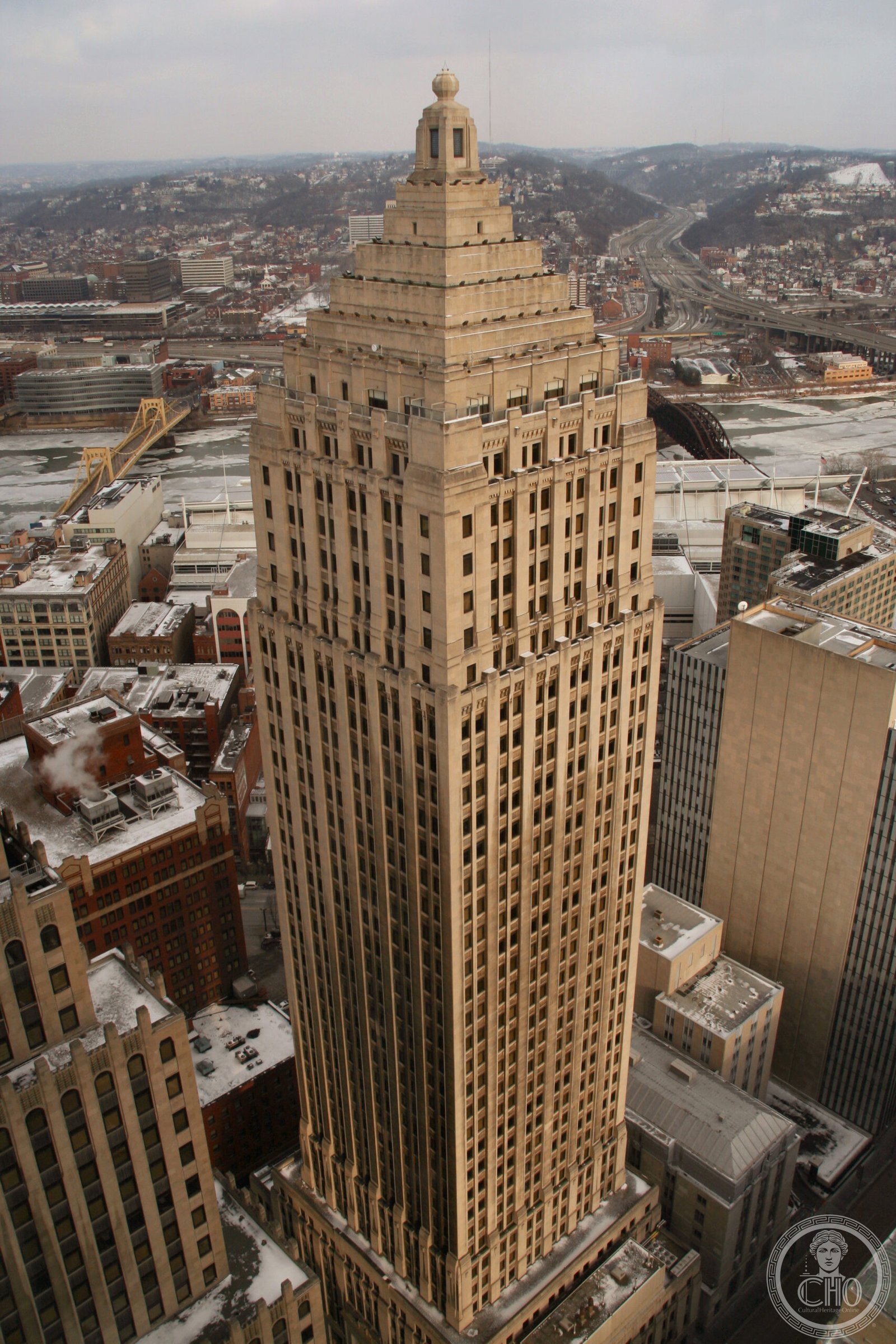

Forty-four stories of Gothic Art Deco crown Pittsburgh’s pre-war skyline. For nearly four decades the Gulf Tower was the tallest structure in the city — a beacon that lit up each night with colour-coded weather signals from the oil empire below.
At a glance
The Gulf Tower climbs 582 feet (177 m) above Grant Street in a controlled sequence of setbacks that borrow Gothic vocabulary — pointed pinnacles, angled piers, a stepped crown — to deliver a decidedly Art Deco effect. Completed in 1932 for Gulf Oil Corporation and its Mellon-family backers, the tower held the title of Pittsburgh’s tallest building until 1969 and remains the dominant mass of its original city block. The crown is illuminated after dark and functions as a weather beacon: green for fair weather, yellow for clouds, red for rain, and blinking amber for snow — an early form of real-time civic information display that continues to operate today.
Key facts
- Address: 707 Grant Street, Pittsburgh, PA 15219
- Height: 582 feet (177 m), 44 stories
- Completed: 1932
- Client: Gulf Oil Corporation
- Style: Gothic-influenced Art Deco
- Weather beacon: Green = fair; yellow = cloudy; red = rain; blinking = snow
- Status: National Register of Historic Places
- Tallest in Pittsburgh: 1932–1969
History
Gulf Oil Corporation was born from the Spindletop oil discovery in Beaumont, Texas in January 1901. The Pittsburgh banking family of Andrew W. Mellon provided the capital to develop the find, and in the following decades Gulf became one of the world’s largest oil companies, with its corporate headquarters firmly planted in Pittsburgh. The Mellon family’s influence on the city’s built environment was enormous: they funded banks, museums, and commercial towers that reshaped the downtown core, and the Gulf Tower was their most vertical contribution to that skyline.
The tower was planned during the late 1920s boom and broke ground as the Depression deepened. Its completion in 1932 made it a defiant symbol of corporate confidence at the nadir of the economic crisis. The building’s stepped profile — required partly by Pittsburgh’s zoning code and partly chosen for aesthetic effect — aligned with the contemporary Gothic skyscraper aesthetic, a style that drew on the pointed-arch tradition of medieval Europe to express modern preoccupations with height and light. The weather-signal crown, installed as a public service and a piece of brand differentiation, reinforced the building’s role as an urban presence rather than merely a corporate address.
Gulf Oil remained at 707 Grant Street for decades, eventually merging with Chevron Corporation in 1984 in what was then the largest corporate merger in American history. The building changed hands and tenants over the years but has been carefully maintained. The weather-signal beacon has been preserved and continues to operate, making the Gulf Tower one of the few Art Deco skyscrapers in the United States that still performs its original decorative-civic function each night.
What you see
From Grant Street looking south, the Gulf Tower presents its full 44-story profile: a broad base in buff-coloured stone with generous window bays, narrowing through two major setback stages before the crown resolves into a cluster of pointed pinnacles around a central illuminated lantern. The Gothic references — pointed arches at the setback transitions, carved stone ornament at the parapet — are evocative rather than literal; there are no flying buttresses, only the suggestion of medieval aspiration translated into steel and limestone.
The crown is best observed after sunset. The weather-signal colours wash the upper pinnacles and can be seen from across the Monongahela River and from the hilltop neighbourhoods of Mount Washington, whose inclines provide some of the finest elevated views of the Gulf Tower’s illuminated cap. The lobby retains its original marble and bronze elements, though the public areas have been reconfigured to accommodate modern office users.
Practical information
- Access: Lobby open during weekday business hours
- Admission: Free to view exterior and lobby
- Best time to visit: Evening, when the illuminated crown and weather beacon are active
- Photography: The crown is best captured from the Mount Washington inclines across the Monongahela River, or from Station Square on the south bank
Getting there
The Gulf Tower stands on Grant Street in Pittsburgh’s central business district, three blocks south of Point State Park and adjacent to the Allegheny County Courthouse. The nearest T (light rail) stop is Steel Plaza, directly below the Grant Street corridor on the north side of the building block. Parking garages are available within a block in most directions.
Nearby
- Koppers Building (1929) — Pittsburgh’s companion Art Deco skyscraper a few blocks north at 436 Seventh Avenue, with its verdigris copper pyramid crown and ornate bronze lobby.
- Allegheny County Courthouse (1888) — Henry Hobson Richardson’s Romanesque Revival masterpiece directly across Grant Street, Pittsburgh’s greatest 19th-century building.
- Pittsburgh City-County Building (1917) — The Beaux-Arts civic landmark on Grant Street that completes the governmental corridor of which the Gulf Tower is the corporate counterpart.
Sources
- National Register of Historic Places nomination, Gulf Tower, Pittsburgh, Pennsylvania.
- Pittsburgh History & Landmarks Foundation — Grant Street corridor documentation.
- Pittsburgh Post-Gazette — archives on Gulf Tower construction and ownership history.
- Wikimedia Commons — Gulf Tower photograph (Derek Jensen / Tysto, Public domain).
Find it on the map
See this place and what’s around it →📷 Become a Cultural Heritage Online photographer
Share your photos of places: they stay published under your name as the author. The more they're seen, the more you get noticed — and soon a contest will reward the most appreciated photos.
Log in or sign up free to add a photoIs this page about you?
This page is read by travellers and heritage enthusiasts who find it on Google. Tell us how you are connected to this place and we will take it from there.