
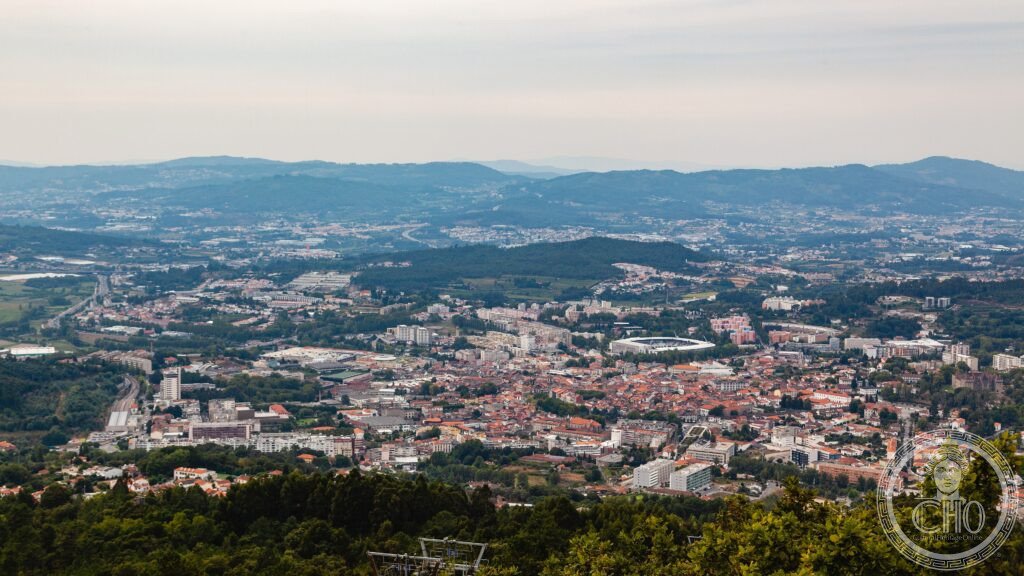
The city where the Portuguese nation was born. Guimarães (Minho, northern Portugal) was the seat of the County of Portucale, the proto-Portuguese state, and the birthplace of Afonso Henriques, who declared Portuguese independence at the nearby Battle of São Mamede in 1128 and became the first King of Portugal. The medieval old town retains its 10th–15th-century street plan almost intact, with the Castle of Guimarães, the Paço dos Duques de Bragança, the Church of Nossa Senhora da Oliveira, and a dense network of medieval stone houses that carry the phrase “aqui nasceu Portugal” (here Portugal was born) in stone above the castle gate.
At a glance
Guimarães (population approximately 55,000 in the urban area) is 55 km north-east of Porto and 22 km south-east of Braga, on the edge of the Serra da Penha in the Minho region. The old town (zona histórica) is a compact area of approximately 0.6 km² centred on the Largo do Oliveira and the Rua de Santa Maria. The Castle and the Paço dos Duques are a short walk north of the old town centre. The city was European Capital of Culture in 2012, which brought significant investment in cultural infrastructure. It remains less touristed than Porto or Sintra and represents one of the best-value heritage destinations in Portugal.
Key facts
- The origins of Portugal at Guimarães: the County of Portucale was created in 1093 when King Alfonso VI of León and Castile gave the territory between the Minho and Douro rivers (the future Portugal) to his son-in-law Henry of Burgundy (Henrique de Borgonha, a French-born Burgundian nobleman) as a hereditary fief. Guimarães was the administrative centre of the new county. When Henry died in 1112, his wife Countess Teresa ruled as regent for their infant son Afonso Henriques (born c. 1109, probably at Guimarães). Afonso Henriques defeated his mother’s Galician allies at the Battle of São Mamede (June 24, 1128, fought approximately 5 km from Guimarães) and seized control of the county. In 1139 he proclaimed himself King of Portugal after the Battle of Ourique (though the date and context of the proclamation are disputed by historians). The Treaty of Zamora (1143) recognized Portuguese independence from the Kingdom of León. The phrase “aqui nasceu Portugal” (here Portugal was born), inscribed on a plaque on the castle tower in the 19th century, captures the nationalist mythology associated with Guimarães and remains one of the most-photographed inscriptions in Portugal.
- The Castle of Guimarães (c. 950–1050 AD): the most important surviving monument of the origins of Portugal. The castle was built on the orders of Mumadona Dias (the Countess of Portucale, c. 950 AD) to defend the monastery she had founded at Guimarães against Norman and Saracen raids. It was substantially rebuilt in the early 11th century and again in the late 12th century. The current castle consists of a rectangular enclosure with 8 rectangular towers and a tall central keep (the Torre de Menagem, approximately 28 metres high). The castle is in a good state of preservation (the keep was heavily restored in the 20th century). The adjacent Chapel of São Miguel do Castelo (c. 1105 AD) is the chapel where Afonso Henriques is traditionally said to have been baptized (a tradition established in the 16th century; the historical evidence is uncertain).
- The Paço dos Duques de Bragança (Palace of the Dukes of Bragança, 1420–1422 AD): the largest Gothic secular palace in Portugal and the most important pre-Manueline palace in the country. Built by Dom Afonso, the 8th Count of Barcelos and 1st Duke of Bragança (the illegitimate son of King João I), the palace was designed in a Franco-Burgundian Gothic style with conical towers that have been compared (often unfavourably) to French châteaux. The building fell into disrepair after the Bragança dynasty became the royal house of Portugal (1640) and moved to Lisbon. It was comprehensively restored (in a controversial complete reconstruction) by order of António de Oliveira Salazar in 1933–1959 and now serves as both a presidential residence for the President of Portugal during visits to Guimarães and as a public museum (the museum collection includes Flemish tapestries, Portuguese faience, weapons, and furniture).
- The old town (10th–18th centuries): the historic centre of Guimarães preserves its medieval street plan almost intact. The central axes are the Rua de Santa Maria (the main medieval processional street, lined with arcaded stone houses of the 14th–17th centuries, with wooden galleries [varanda] projecting over the street from the upper floors) and the Largo do Oliveira (the principal square, with the Church of Nossa Senhora da Oliveira and the Gothic canopy over the Padrão do Salado, a Gothic monument commemorating the Portuguese participation in the Christian victory of the Battle of the Salado, 1340, where the advance of the Marinid Benimerins from Morocco was halted). The Largo da Mumadona (the square near the castle) and the surrounding streets of the medieval borgo are the quietest and most atmospheric part of the old town.
- Heritage: UNESCO World Heritage Site, Historic Centre of Guimarães, inscribed 2001.
- GPS: 41.4431° N, -8.2910° W.
History
Guimarães grew around the monastery founded by Countess Mumadona Dias c. 950 AD. The castle was added for defence shortly thereafter. The town became the administrative centre of the County of Portucale in 1093. The first half of the 12th century saw the formative events of Portuguese independence (the Battle of São Mamede, 1128; the treaty with León, 1143). The capital was transferred to Coimbra (by Afonso Henriques after 1143) and subsequently to Lisbon (1255). Guimarães declined in political importance after the move to Lisbon but retained commercial importance as the principal city of the Minho region. The textile industry (linen and later cotton cloth) sustained the town’s prosperity through the early modern period. The old town was not heavily rebuilt in the 18th–20th centuries (unlike Lisbon and Porto, which were substantially remodelled after the 1755 earthquake and in the 19th century), preserving the medieval structure. UNESCO inscription 2001. European Capital of Culture 2012.
What you see
Start at the castle (the elevated position gives views over the old town and the Serra da Penha to the south-east; the keep interior is accessible). Descend to the Paço dos Duques (museum; the exterior of the palace with its conical towers is more impressive than the interior, which was completely rebuilt in the 1930s–1950s; the museum collection of Flemish tapestries and Portuguese faience is good). Walk south along the medieval street to the Largo do Oliveira (the essential space; sit at one of the café tables to take in the Gothic canopy of the Padrão do Salado and the façade of the Church of Nossa Senhora da Oliveira). Continue along the Rua de Santa Maria (the best-preserved medieval street) to the Largo da Mumadona. The Museu Alberto Sampaio (in the former cloister of the Church of Nossa Senhora da Oliveira) has an excellent collection of Romanesque, Gothic, and Manueline treasures from the Minho region.
Practical information
- Admission: the Castle approximately €2. The Paço dos Duques museum approximately €5. The Museu Alberto Sampaio approximately €3. The old town is freely walkable. The best way to experience Guimarães is to walk the old town without a strict schedule, stopping in cafés and allowing the medieval street plan to reveal itself. The town is lively on market days (Thursday and Saturday in the Largo do Toural). The tourist information office at the Paço dos Duques can provide maps and walking guides.
- Getting there: from Porto by train (Linha do Minho): approximately 1h from Porto São Bento or Porto Campanhã (frequent service). From Braga by train: 30 min. By car from Porto: 55 km (50 min via A3/N101). The Guimarães train station is 1 km from the old town (10 min walk or taxi). A bus (UrbiGUIMARÃES) connects the station to the old town.
- The Minho heritage circuit: Guimarães is 22 km from Braga (the most important ecclesiastical city in Portugal after Lisbon — the Cathedral of Braga is the oldest in Portugal, founded 1089 AD; the Bom Jesus do Monte sanctuary, on a hilltop above Braga, is the most important Baroque religious complex in Portugal, with its famous zigzag staircase of 600 steps punctuated by chapels representing the Way of the Cross, an 18th-century composition equivalent in ambition to the Sacri Monti of northern Italy). Together Guimarães + Braga + the Peneda-Gerês National Park (Portugal’s only national park; 60 km north of Guimarães; a wilderness landscape of granitic mountains, waterfalls, and ancient oak forests, with pre-Roman stone villages) form one of the best 2-3 day circuits in northern Portugal.
Getting there
From Porto by train (1h, Linha do Minho). From Braga by train (30min). By car from Porto (55 km, 50min). GPS: 41.4431, -8.2910.
Nearby
- Braga. 22 km west of Guimarães (25 min by car or 30 min by train). The ecclesiastical capital of Portugal and the most important city in the origins of Portuguese Christianity. Three stops are essential. The Cathedral of Braga (Sé de Braga), founded in 1089 AD by King Afonso VI of León, is the oldest in Portugal, a building that accumulated Romanesque, Gothic, Manueline and Baroque elements over 900 years; the Manueline chapels behind the high altar are among the finest outside Lisbon. The Bom Jesus do Monte is a Baroque pilgrimage sanctuary on a forested hill above the city, reached by a double zigzag staircase of approximately 580 steps, each landing carrying a chapel with terracotta tableaux of the Way of the Cross: it is one of the most visited sanctuaries in Portugal. The Museu dos Biscainhos, a Baroque palace with original tile panels, holds the best collection of 18th-century Portuguese decorative arts in the Minho region.
- Citânia de Briteiros. 15 km south of Guimarães (20 min by car). The most important Celtic Iron Age oppidum in Portugal. Briteiros was the principal settlement of the Bracari tribe (the pre-Roman Celtic-Iberian people of the Minho region) from approximately 300 BC to 300 AD. The site (on a hilltop with panoramic views over the Minho valley) has been excavated since 1875 and reveals a complete Iron Age urban settlement: circular stone house foundations, cobbled streets, a perimeter wall with gates, a large central building (possibly a public assembly hall), baths, and a water reservoir. Two houses have been reconstructed to give a sense of the original appearance. The archaeological finds from Briteiros (ceramics, metalwork, and the famous “Pedra Formosa” decorative stone slabs with Celtic interlace patterns) are displayed in the Museu Martins Sarmento in Guimarães.
- Porto. 55 km south-west of Guimarães (50 min by car or 1h by train). The second city of Portugal and a UNESCO World Heritage Site (1996) of exceptional richness. The Porto historic centre (Ribeira riverfront, the São Francisco Church with its extraordinary gilded Baroque interior, the Ponte Dom Luís I, the Palácio da Bolsa, and the neighbourhood of Bonfim) is one of the great historic urban landscapes of Atlantic Europe. Porto’s specific contribution to Western cultural heritage includes the development of the Port wine trade (the Lodges of Vila Nova de Gaia across the river), the most important collection of Art Nouveau azulejo tile façades in any European city (the São Bento railway station has the most celebrated set of 20th-century azulejo panels in Portugal, by Jorge Colaço 1905–1916).
Sources
- Wikipedia, Guimarães. Afonso Henriques. County of Portugal. Paço dos Duques de Bragança, accessed June 2026.
- UNESCO, Historic Centre of Guimarães, WHS reference 1031, inscribed 2001.
- A. H. de Oliveira Marques, History of Portugal, vol. 1, Columbia University Press, 1972.
- José Mattoso, A formação da nacionalidade portuguesa, Gradiva, 1985.
Find it on the map
See this place and what’s around it →
📷 Become a Cultural Heritage Online photographer
Share your photos of places: they stay published under your name as the author. The more they're seen, the more you get noticed — and soon a contest will reward the most appreciated photos.
Log in or sign up free to add a photo