
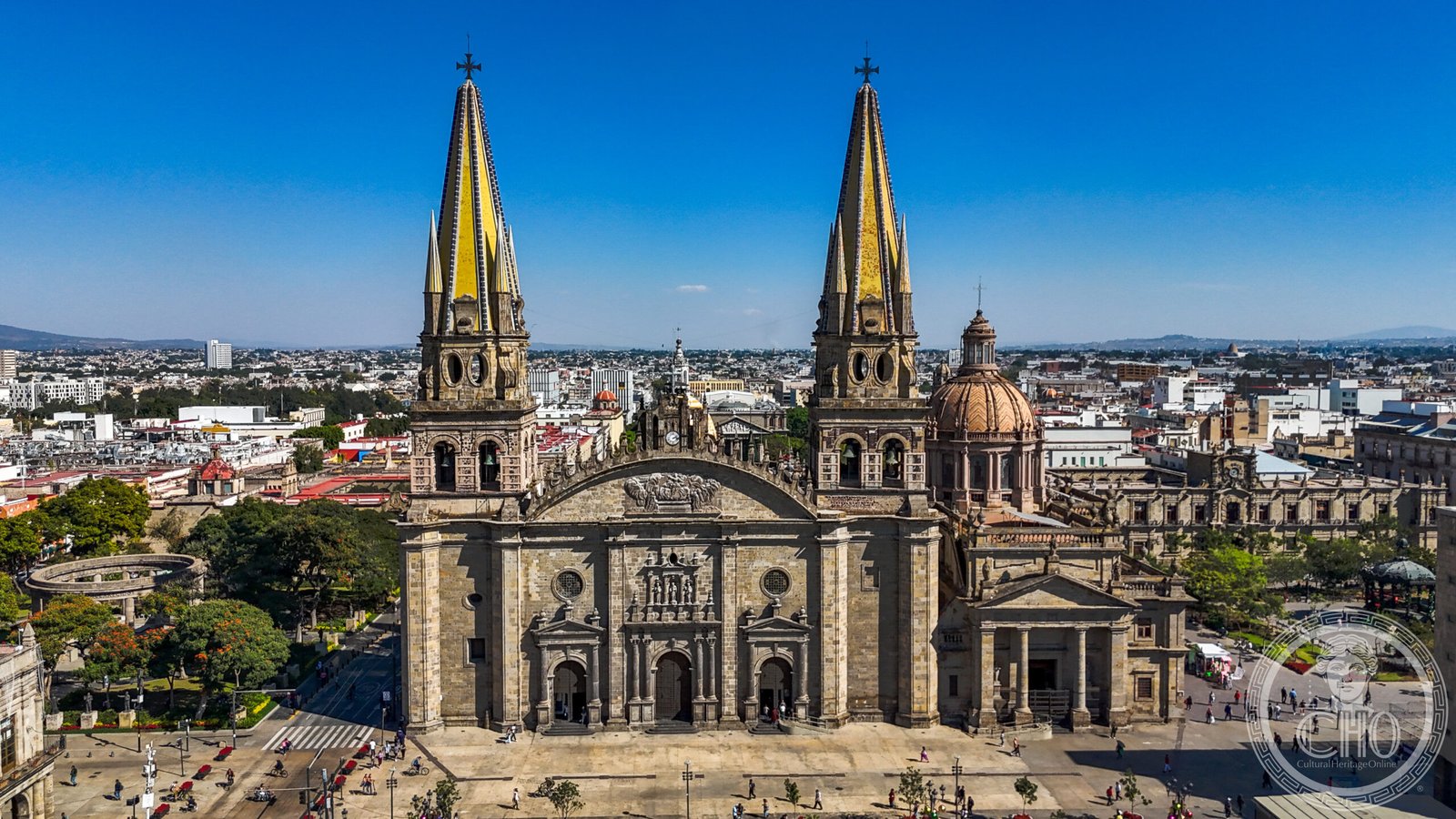
On the Plaza de Armas, in the historic center of Guadalajara, Mexico, the cathedral stands where a small adobe church dedicated to the Archangel Michael previously stood, destroyed by a fire on 30 May 1574. Philip II authorized the construction of the new cathedral by royal decree of 18 May 1561, and the foundation stone was blessed on 31 July of the same year by Bishop Pedro de Ayala. The actual work, however, began only in 1571, with the architect Martín Casillas responsible, from 1593, for the vaults and the roof. The building was completed in February 1618, but the formal consecration, with the dedication to the Assumption of Mary, took place only in October 1716, with sources disagreeing on the exact day, given variously as 12 or 22 October. On the night of 31 May 1818, an earthquake brought down the original towers and dome. The current twin neo-Gothic spires, covered in yellow and blue majolica tiles produced at Sayula, in the same state of Jalisco, were built between 1851 and 1854 by the architect Manuel Gómez Ibarra on the commission of Bishop Diego Aranda y Carpinteiro, using pumice stone to reduce their weight as an earthquake-resistant measure. A local legend, explicitly presented as such by the sources, tells that Bishop Aranda was inspired by the motif of two towers painted on the bottom of an English ceramic plate; the historian José Cornejo Franco instead proposed, in a study of his, a stylistic comparison with the towers of Bayeux Cathedral, in Normandy, without this implying a direct design link. A further earthquake, in 1875, damaged the dome of the choir, later rebuilt by the engineer Domingo Torres. In the sacristy is a painting, “La Purísima Concepción”, long attributed on a traditional basis to Bartolomé Esteban Murillo, although no source consulted confirms this attribution with a technical or connoisseurship study; this painting is to be distinguished from a different cycle of eleven canvases once attributed to Murillo, today kept at the Museo Regional de Guadalajara, whose attribution has instead been explicitly rejected by the most recent research, which assigns them to an anonymous Sevillian workshop. Also in the sacristy is kept the Baroque painting by Cristóbal de Villalpando, “La Iglesia Militante y Triunfante” (1687). In the crypt beneath the choir rest three cardinals, among them Juan Jesús Posadas Ocampo, assassinated in 1993 at Guadalajara airport. Contrary to what is sometimes repeated, neither the cathedral nor the historic center of Guadalajara appears on the UNESCO World Heritage List, which for the city includes only the Hospicio Cabañas, a separate building located elsewhere. On 30 January 1979, during his first trip to Mexico, Pope John Paul II visited the cathedral, meeting the cloistered nuns of the city; he does not appear to have returned to the building on his subsequent Mexican trips.
About the Cathedral
Guadalajara Cathedral, on the Plaza de Armas in Guadalajara, Mexico, was built between 1571 and 1618 and formally consecrated in 1716. Its distinctive twin neo-Gothic spires, covered in yellow tile, replaced towers brought down by an 1818 earthquake and were built between 1851 and 1854. It is not part of any UNESCO World Heritage listing.
Key facts
- 1561: construction authorized by royal decree; foundation stone laid 31 July, though building work did not actually begin until 1571.
- February 1618: the cathedral completed, under architect Martín Casillas from 1593 onward.
- October 1716: formal consecration, dedicated to the Assumption of Mary (exact day disputed between sources).
- 31 May 1818: an earthquake collapses the original towers and dome.
- 1851–1854: the current yellow-tiled neo-Gothic spires built by architect Manuel Gómez Ibarra.
- 21 December 1938: elevated to Minor Basilica status by Pope Pius XI.
History
Authorized in 1561 but not actually built until 1571-1618, Guadalajara Cathedral took on its present, most recognizable form only after an 1818 earthquake destroyed its original towers, prompting a mid-19th-century rebuild whose yellow-tiled neo-Gothic spires became the cathedral’s defining image. Consecrated in 1716 and elevated to a minor basilica in 1938, it has weathered further earthquakes since, and today houses the tomb of a cardinal murdered at Guadalajara’s own airport in 1993.
What you see
A late Spanish Renaissance exterior beneath Gothic-derived ribbed vaulting inside, crowned by neo-Gothic twin spires clad in yellow-and-blue majolica tile from Sayula, Jalisco; the original Baroque gilded retablos were replaced with Neoclassical ones in the 19th century, and the sacristy holds Baroque and traditionally-attributed paintings alongside a crypt housing several cardinals and colonial-era bishops.
Practical information
- Opening hours: generally open daily outside services; check current hours before visiting.
- Location: Plaza de Armas, Centro Histórico, Guadalajara, Jalisco, Mexico (street address varies between sources; the cathedral occupies a full block).
Getting there
The cathedral stands on the Plaza de Armas in the heart of Guadalajara’s historic center. GPS: 20.677°N, 103.347°W.
Nearby
- Rotonda de los Jaliscienses Ilustres — a monument to distinguished citizens of Jalisco, immediately beside the cathedral.
- Plaza de la Liberación and the Teatro Degollado — the historic center’s civic and cultural core, a short walk away.
Sources
- Wikipedia (English and Spanish) — “Guadalajara Cathedral” / “Catedral de Guadalajara”
- El Informador (Guadalajara) — cathedral history coverage.
- Instituto Nacional de Antropología e Historia (INAH) — federal cultural-property records.
- Anuario de Estudios Americanos (CSIC) — academic study on the cathedral’s construction.
Find it on the map
See this place and what’s around it →📷 Become a Cultural Heritage Online photographer
Share your photos of places: they stay published under your name as the author. The more they're seen, the more you get noticed — and soon a contest will reward the most appreciated photos.
Log in or sign up free to add a photo