
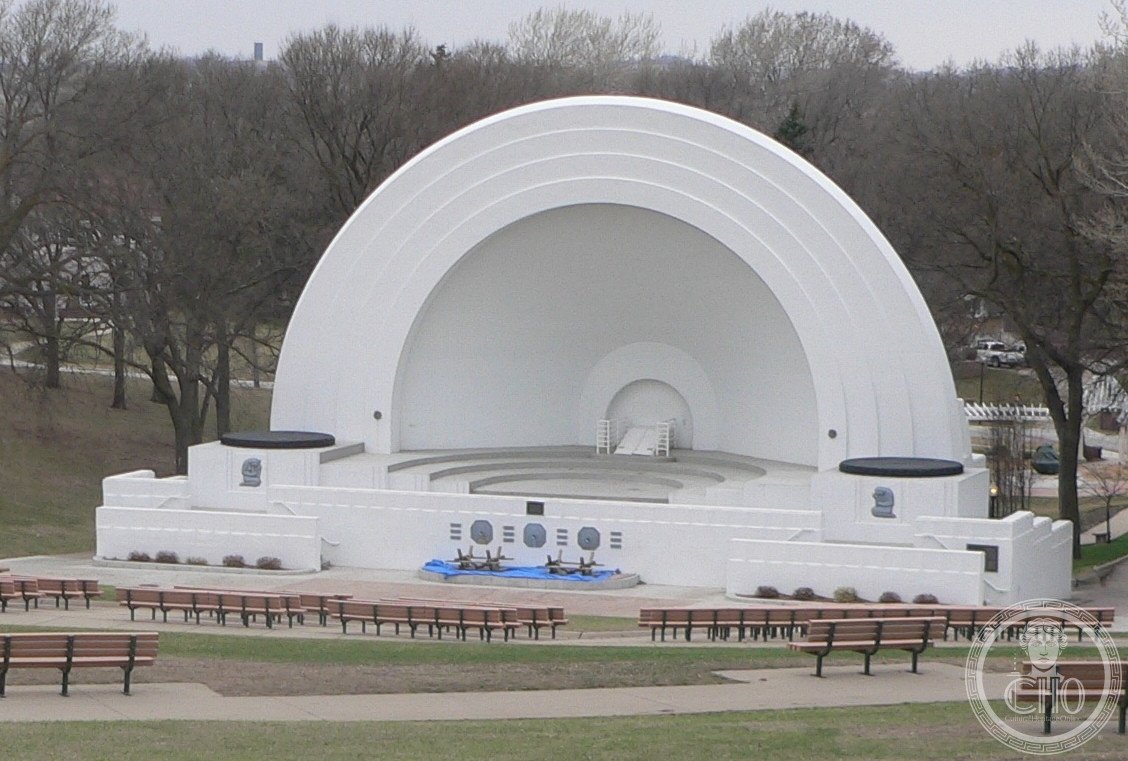
A Depression-era music shell built through New Deal funding, this amphitheater has hosted community performances for nearly a century.
At a glance
Grandview Park Music Pavilion is a federally funded performance venue completed in 1934 during Franklin D. Roosevelt’s Civil Works Administration. The structure seats 5,000 in a natural amphitheater and remains an active summer concert venue in Sioux City.
History
The Monahan Post Band began fundraising for a music shell in 1930, but initial designs prompted neighborhood objections and delayed the project. When President Roosevelt established the Civil Works Administration in 1933, Sioux City successfully applied for federal support.
Architect Henry L. Kamphoefner, then little known in the city, designed the pavilion. The CWA approved the project on February 26, 1934, as CWA Project Number 217. Construction required 52 tons of reinforcing steel and 4,200 bags of Portland cement, completing October 17, 1934. Sculptor Herschel Elarth contributed the front plaques. Total cost: $47,436 in federal relief and $3,800 in city materials. The pavilion was dedicated in spring 1935.
The Monahan Post Band performed here until 1948, when the ensemble became the Sioux City Municipal Band. Concerts continue each summer. The pavilion earned National Register listing in 2011.
What you see
The pavilion is a WPA-era performance structure designed for acoustic projection across a natural amphitheater. Sculptural plaques by Elarth ornament the front facade. The facility accommodates 5,000 spectators and reflects 1930s public-works aesthetics.
Cultural significance
The music pavilion exemplifies New Deal investment in community infrastructure and cultural life. It represents a period when federal programs directly supported municipal public spaces and local traditions. The continuous summer music tradition links Depression-era patronage to contemporary civic life.
Key facts
- Country: United States
- City: Sioux City, Iowa
- Completed: October 17, 1934
- Seating capacity: 5,000
- Architect: Henry L. Kamphoefner
- Sculptural plaques: Herschel Elarth
- Funding: Civil Works Administration (CWA Project 217)
- National Register of Historic Places: 2011
- Coordinates: 42.5167, −96.4097
Practical information & getting there
The pavilion is located in Grandview Park, Sioux City. Summer concerts by the Sioux City Municipal Band continue the tradition established by the Monahan Post Band. Contact Sioux City parks or the municipal band for current performance schedules and visitor information.
Sources & resources
Find it on the map
See this place and what’s around it →📷 Become a Cultural Heritage Online photographer
Share your photos of places: they stay published under your name as the author. The more they're seen, the more you get noticed — and soon a contest will reward the most appreciated photos.
Log in or sign up free to add a photoIs this page about you?
This page is read by travellers and heritage enthusiasts who find it on Google. Tell us how you are connected to this place and we will take it from there.