
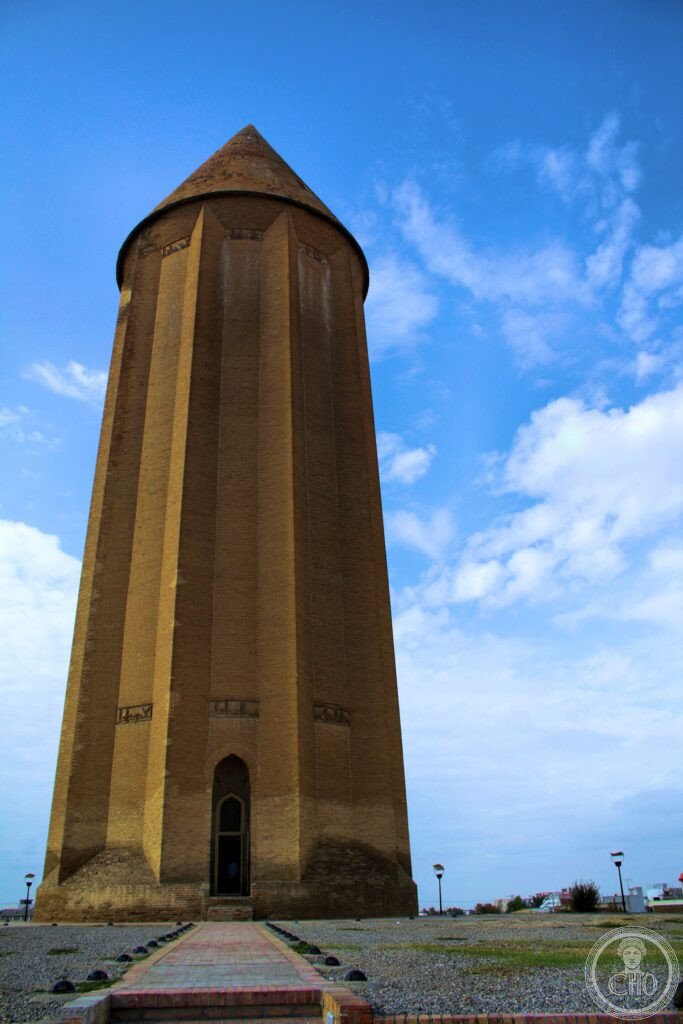
Si erge da mille anni sulla pianura del Gorgan: una torre di mattoni nudi, alta più di cinquanta metri, con dieci contrafforti che salgono fino al tetto conico. Costruita nel 1006 come tomba di un principe, Gonbad-e Qabus è un prodigio di geometria e ingegneria, e la più alta torre di mattoni del mondo.
At a glance
The tower of Gonbad-e Qabus, in north-eastern Iran, is a masterpiece of early Islamic Persian architecture. Built in 1006 as the tomb of the Ziyarid ruler Qabus, it is a slender cylinder of unglazed brick, over fifty metres tall, ringed by ten triangular buttresses rising to a conical roof. Of striking geometric purity and engineering daring, it is the tallest brick tower in the world and influenced tomb-tower architecture across the Islamic east. It was inscribed by UNESCO in 2012.
Key facts
- UNESCO: World Heritage since 2012 (Gonbad-e Qābus)
- Built: 1006, as the tomb of the Ziyarid ruler Qabus
- Tallest brick tower: over 50 m of unglazed fired brick
- Ten buttresses: triangular flanges rising to a conical roof
- Geometric purity: a landmark of mathematical design
- Influence: a model for later tomb towers in the Islamic east
History
Qabus ibn Wushmgir, the cultured Ziyarid ruler of a small Caspian principality and a patron of scholars such as the young Avicenna, had this tower built in 1006 as his own tomb. By tradition his coffin was suspended within the tower, which stands at the edge of his vanished capital on the Gorgan plain.
Built entirely of fired brick, the tower combines a perfect cylinder with ten sharp buttresses and a conical cap, its proportions following careful geometric ratios. It has survived a thousand years of earthquakes on the open plain, a testament to the skill of its builders, and stands as one of the earliest and finest of the Persian tomb towers.
What you see
The tower rises alone above a park on the plain, a tapering shaft of bare ochre brick flanged by ten buttresses that lead the eye up to the pointed conical roof. Two bands of brick inscription in Kufic script encircle it. The interior is a single bare space; the power of the monument is in its form and scale.
From a distance, the tower is visible across the flat Gorgan steppe, a thousand-year-old marker on the land.
Practical information
- Tower: set in a public park; freely viewed
- Time needed: under an hour
- Note: in the town named after the monument
- Setting: on the Gorgan plain in Golestan province
Getting there
Gonbad-e Qabus is a town in Golestan province, north-eastern Iran, near the Caspian Sea and the Turkmen border. It is reached by road from Gorgan. GPS: 37.258° N, 55.169° E.
Nearby
- Gorgan — the provincial city to the west
- Great Wall of Gorgan — an ancient defensive wall nearby
- Caspian coast — the sea and forests to the north
Sources
- UNESCO World Heritage Centre — “Gonbad-e Qābus” (ref. 1398)
- Iranian Cultural Heritage Organisation — official body
- Encyclopaedia Britannica — Ziyarid dynasty; Iranian architecture
Find it on the map
See this place and what’s around it →📷 Become a Cultural Heritage Online photographer
Share your photos of places: they stay published under your name as the author. The more they're seen, the more you get noticed — and soon a contest will reward the most appreciated photos.
Log in or sign up free to add a photoIs this page about you?
This page is read by travellers and heritage enthusiasts who find it on Google. Tell us how you are connected to this place and we will take it from there.