

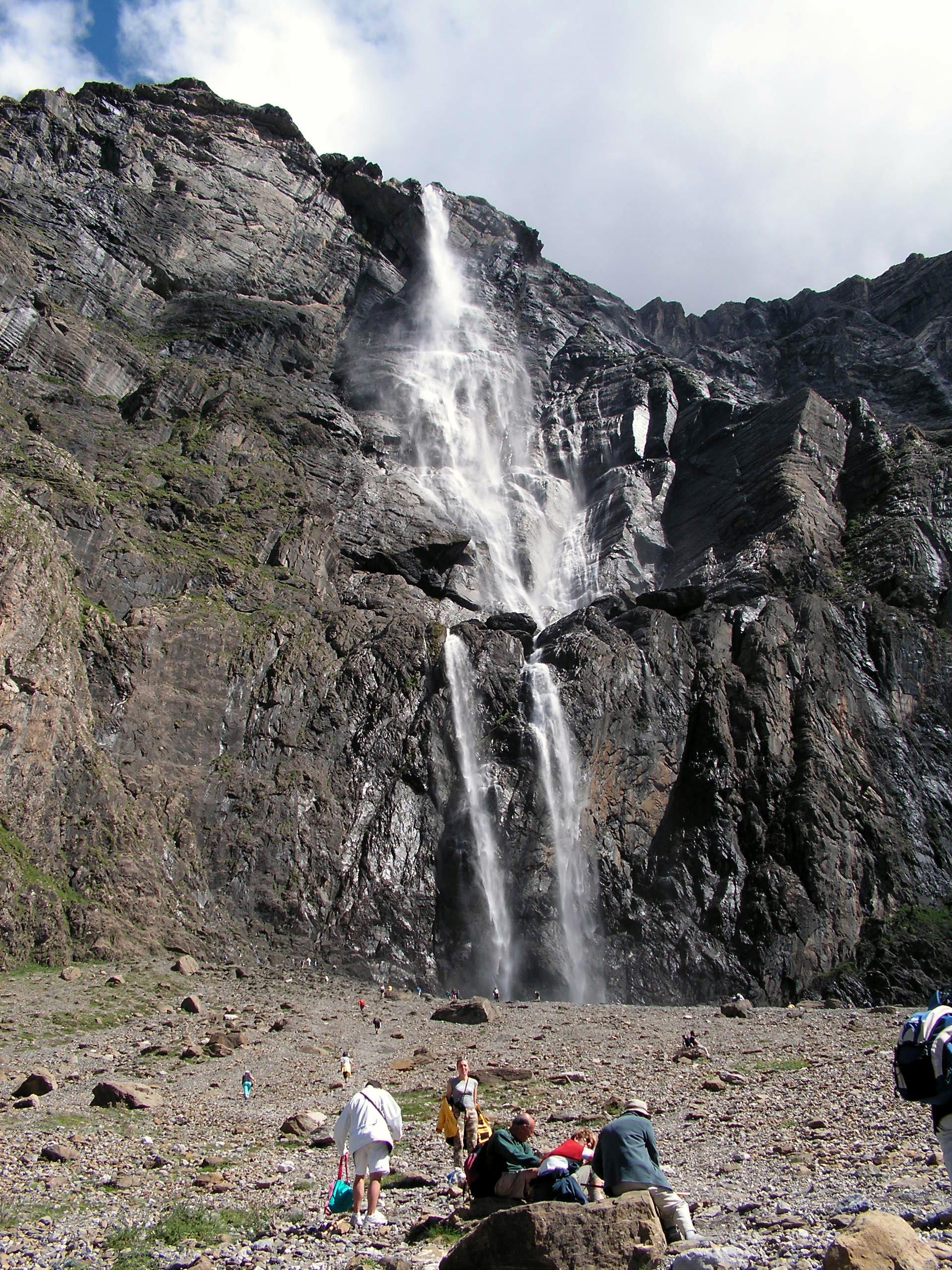
France’s highest waterfall plunges 422 metres down a dramatic amphitheatre of rock, fed by Spanish snow and glacier melt that transforms with the seasons.
At a glance
The Grande Cascade de Gavarnie is a tiered waterfall of exceptional height. It originates at the upper rim of the Cirque de Gavarnie, a natural stone amphitheatre near the village of Gavarnie in the Hautes-Pyrénées department. The falls form the source of the Gave de Pau stream.
History
The waterfall has long been a landmark in the Pyrenees, visible across the Cirque’s vast expanse. Its dramatic geology and scale have made it a focus for travellers and naturalists exploring the high Pyrenean landscape.
What you see
The cascade consists of 2–3 distinct tiers, with the single longest drop reaching 281 metres. Water appears at the upper rim of the waterfall after seeping underground from a small glacier and snowfield located across the Spanish border. The fall’s volume fluctuates dramatically: in summer, snowmelt can push flow to 200 cubic metres per second, while winter sometimes freezes the falls entirely. Average annual flow stands at 3 cubic metres per second.
Cultural significance
The Gavarnie Falls represent one of Europe’s most striking natural monuments. The waterfall’s sheer height and the architectural grandeur of the Cirque de Gavarnie have made the site an enduring symbol of Pyrenean wilderness and geological power.
Key facts
- Country: France
- Region: Hautes-Pyrénées
- Total drop: 422 metres (highest in mainland France)
- Longest single tier: 281 metres
- Coordinates: 42.69333, −0.00444
- Water source: glacier and snowmelt from Spain
Practical information & getting there
The falls are accessible via the village of Gavarnie. The site forms part of the Cirque de Gavarnie landscape and can be reached on foot from the village. Seasonal variations in water flow mean the waterfall’s appearance changes throughout the year—summer offers maximum volume, while winter may reveal frozen sections or reduced flow.
Sources & resources
Find it on the map
See this place and what’s around it →
📷 Become a Cultural Heritage Online photographer
Share your photos of places: they stay published under your name as the author. The more they're seen, the more you get noticed — and soon a contest will reward the most appreciated photos.
Log in or sign up free to add a photo