
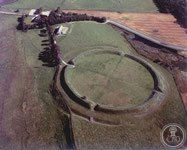
A Viking ring fortress built around 980 AD to command trade routes across Jutland, Fyrkat reveals the military architecture and territorial ambitions of Denmark’s early medieval kings.
At a glance
Fyrkat is a fortified ring castle near Hobro in Northern Jutland, strategically positioned on narrow land between a stream and swampy terrain. Its circular earthwork design exemplifies Viking-era defensive architecture and demonstrates royal control of the Aalborg–Aarhus trading corridor. The site was designated a UNESCO World Heritage property in 2023 as part of a five-castle ensemble representing the power of Denmark’s Jelling dynasty.
History
Fyrkat was likely constructed during the reign of Harald Gormsson or his son Sweyn Forkbeard, powerful monarchs who unified and fortified Denmark in the late 10th century. The fortress served either as military barracks or as a defensive stronghold—its exact purpose remains debated by scholars. Its location on a critical land-based trading route between Aalborg and Aarhus suggests it functioned as an instrument of royal authority, controlling commerce and movement across the peninsula.
The castle stood as testimony to the strategic power of the House of Knýtlinga, the Jelling dynasty that transformed Denmark into a coherent kingdom. Recognition by UNESCO links Fyrkat to four other Viking ring castles, acknowledging their collective significance to medieval Scandinavian history.
What you see
The site preserves the distinctive circular earthwork characteristic of Viking ring fortresses. Its architectural uniqueness lies in the strategic positioning on a narrow parcel of land, where natural defenses—a stream on one flank and marshy ground on the other—complemented the constructed ramparts. This integration of landscape and fortification reveals the sophisticated site selection employed by Viking-age builders.
Cultural significance
Fyrkat embodies the military and political sophistication of 10th-century Scandinavia, when Viking societies were consolidating into organized kingdoms. The fortress demonstrates how early medieval Danish rulers used architecture to project power, regulate trade, and control territory. Its inclusion in UNESCO’s World Heritage List recognizes the Viking ring castles as exceptional testimony to a transformative period in European history.
Key facts
- Country: Denmark
- Location: Near Hobro, Northern Jutland, Denmark
- Coordinates: 56.62°N, 9.77°E
- Date: c. 980 AD
- Patrons: Likely Harald Gormsson or Sweyn Forkbeard
- UNESCO World Heritage Site (inscribed 2023, as part of Viking Ring Castles ensemble)
Practical information & getting there
Fyrkat is located near the town of Hobro in Northern Jutland. Visitors can access the site from Aalborg or Aarhus via the main trading routes the fortress once guarded. For current visiting hours, facilities, and guided-tour information, contact local tourism boards in Hobro or Northern Jutland.
Sources & resources
Find it on the map
See this place and what’s around it →📷 Become a Cultural Heritage Online photographer
Share your photos of places: they stay published under your name as the author. The more they're seen, the more you get noticed — and soon a contest will reward the most appreciated photos.
Log in or sign up free to add a photo