
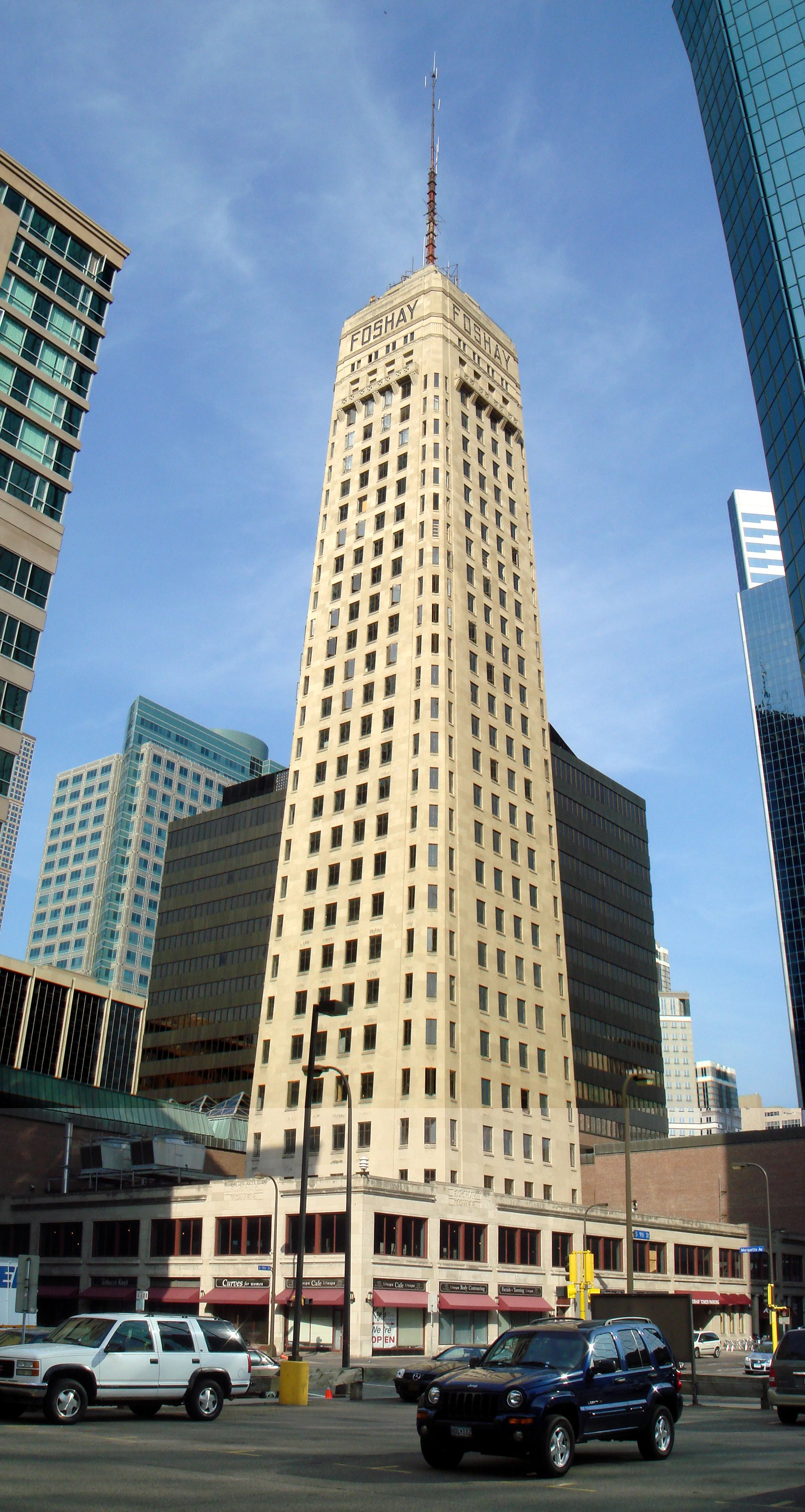

Completed in 1929 as Minneapolis’s first skyscraper, the Foshay Tower is an Art Deco obelisk modelled on the Washington Monument — 32 stories of Indiana limestone, ornate Deco detail, and a rooftop observation deck that remained the tallest structure in Minnesota for 43 years.
At a glance
Standing at 9th Street and Marquette Avenue in downtown Minneapolis, the Foshay Tower was completed in 1929 for utilities magnate Wilbur B. Foshay, who modelled it on the Washington Monument in Washington D.C. — with the vertical obelisk form translated into a 32-story Art Deco skyscraper with setbacks, ornamental bronze work, and a top-floor observation deck. Designed by the Minneapolis firm Magney & Tusler, with Léon Arnal as chief designer, the tower was the tallest structure in Minnesota from its 1929 opening until the 1972 completion of the IDS Center. Foshay’s empire collapsed just weeks after the tower’s lavish dedication party, and he was later imprisoned for mail fraud. The building was listed on the National Register of Historic Places in 1978 and is now a W Hotels property.
Key facts
- Completed: 1929
- Architects: Magney & Tusler (chief designer Léon Arnal)
- Style: Art Deco (Washington Monument-inspired obelisk form)
- Address: 821 Marquette Avenue, Minneapolis, MN 55402
- Height: 32 stories, 447 ft (136 m)
- NRHP: Listed 1978
- Current use: W Minneapolis hotel (since 2008)
- Signature feature: Obelisk profile with rooftop observation deck and original bronze Deco ornament
History
Wilbur B. Foshay made his fortune assembling a holding company of public utilities across the western United States and Canada in the 1920s. By 1928 his empire was large enough — or appeared to be — to commission the most ambitious skyscraper Minneapolis had ever seen. Foshay hired the Minneapolis firm Magney & Tusler, whose chief designer Léon Arnal was French-born, and gave him a single brief: design a building modelled on the Washington Monument. The result was a 32-story obelisk in Indiana limestone with Art Deco ornamental bronze at the base and crown, a rooftop observation deck open to the public, and Foshay’s name spelled out in illuminated letters on all four sides.
The tower’s dedication in August 1929 was one of the most extravagant events in Minneapolis history. Foshay flew in John Philip Sousa and his band to perform at the party, commissioning Sousa to write the “Foshay Tower Washington Memorial March” for the occasion — for which he reportedly never paid. The dedication took place just two months before the October 1929 stock market crash. Foshay’s utilities empire, built on overvalued stock and borrowed money, collapsed almost immediately. He was arrested, tried for mail fraud in 1932, and sentenced to fifteen years in federal prison at Leavenworth. His sentence was later commuted and he was released in the 1930s; a full presidential pardon was subsequently granted, restoring his civil rights.
The tower itself survived its builder’s downfall intact. It remained the tallest structure in Minneapolis and the state of Minnesota until 1972, when the IDS Center (at 775 ft / 236 m) surpassed it. Listed on the National Register of Historic Places in 1978, the Foshay Tower was converted into a W Hotels property in 2008, with the Sousa piece finally paid for — by the hotel company — to the Sousa estate. The observation deck on the 30th floor remains open to guests and visitors.
What you see
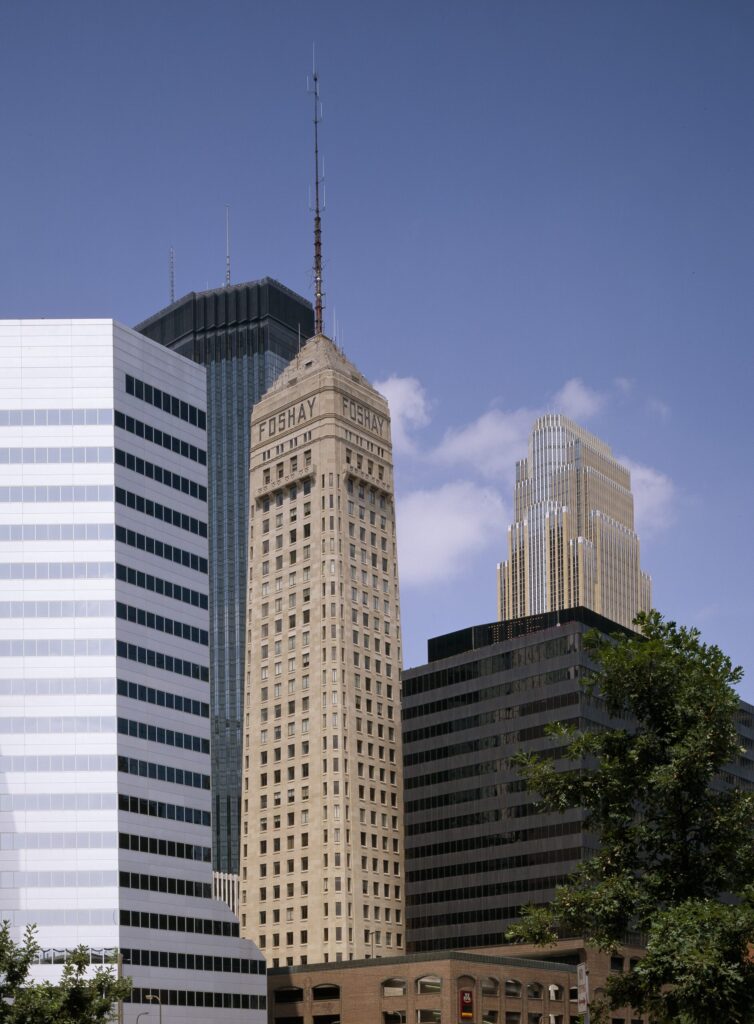
The Foshay Tower’s obelisk silhouette is unmistakable on the Minneapolis skyline: a tapering limestone shaft that reads from street level as a single unbroken vertical, despite the actual setbacks at the upper floors. The decision to model it on the Washington Monument was Foshay’s own; Arnal translated the classical obelisk form into Art Deco through the ornamental programme rather than the massing. At the base, the entrance facade on Marquette Avenue presents carved limestone, bronze door surrounds, and eagle-and-scroll ornament in the characteristic vocabulary of late 1920s American commercial Deco.
The lobby interior is among the most complete surviving Art Deco interiors in Minneapolis: marble walls, terrazzo floors, and bronze elevator doors with the geometric ornament that Arnal carried through the entire building. The 30th-floor observation deck — accessible via a dedicated elevator — offers panoramic views of the Minneapolis grid. The illuminated letters spelling “FOSHAY” on the upper tower facades, replaced and restored several times over the decades, remain lit at night as they were in 1929. The W hotel conversion preserved the historic fabric of the lobby and public floors, adding contemporary design on the guest room levels while maintaining the Deco envelope.
Practical information
- Observation deck: W Minneapolis lobby; admission charged; open daily (check W Hotels for current hours)
- Hotel guests: Full access including observation deck
- Best time: Clear day for observation deck views; evening for illuminated lettering
- Time needed: 45 minutes lobby + observation deck
- GPS: 44.9746° N, 93.2719° W
Getting there
The Foshay Tower stands at 821 Marquette Avenue, at the corner of 9th Street and Marquette Avenue in downtown Minneapolis. Minneapolis–Saint Paul International Airport is approximately 12 miles (19 km) south; light rail (Blue Line or Green Line) connects the airport to downtown Target Field Station in about 25 minutes. The tower is a 5-minute walk from Target Field and 3 minutes from the Nicollet Mall bus corridor.
Nearby
- Rand Tower (1929) — Holabird & Root’s Art Deco tower at 527 Marquette Avenue, 3 minutes’ walk north
- IDS Center (1972) — Philip Johnson’s modernist supertower that surpassed Foshay as Minnesota’s tallest, at 80 S 8th Street
- Minneapolis Armory (1936) — PWA Moderne civic venue at 500 6th Street S, 6 minutes’ walk east
Sources
- National Register of Historic Places, Foshay Tower nomination (1978) — nps.gov
- Minnesota Historical Society, Wilbur Foshay papers — mnhs.org
- W Minneapolis — The Foshay, hotel history page — marriott.com
- Millett, Larry. AIA Guide to the Twin Cities. Minnesota Historical Society Press, 2007
- Wikidata, Foshay Tower Q3748980 — wikidata.org
Gallery
Find it on the map
See this place and what’s around it →📷 Become a Cultural Heritage Online photographer
Share your photos of places: they stay published under your name as the author. The more they're seen, the more you get noticed — and soon a contest will reward the most appreciated photos.
Log in or sign up free to add a photoIs this page about you?
This page is read by travellers and heritage enthusiasts who find it on Google. Tell us how you are connected to this place and we will take it from there.