
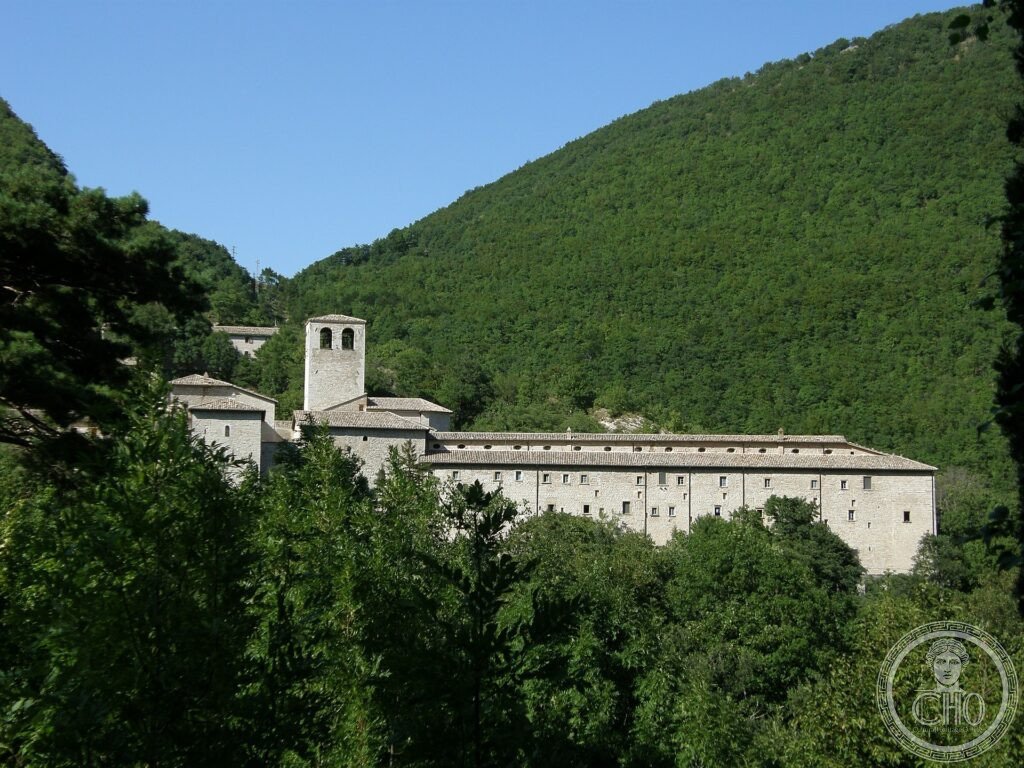
In the twenty-first canto of the Paradiso it is Peter Damian — prior at Fonte Avellana in the eleventh century — who points out to Dante the «ridge that is called Catria» and the hermitage «consecrated» beneath the mountain. Tradition has it that Dante himself, in exile, stayed here around 1317–18: a place of silence among the beeches of Monte Catria.
At a glance
The hermitage of Fonte Avellana stands on the south-eastern slope of Monte Catria, in the Marche Apennines near Cagli (Pesaro-Urbino province), at an altitude of 700 m. It was founded in the late 10th century (date uncertain, perhaps c. 980) by a small group of hermits seeking a more austere life than ordinary Benedictine monasticism offered. It became famous when Peter Damiani (1007–1072) — the greatest Italian reformer of the 11th century, cardinal and Doctor of the Church — became a monk there in 1035 and eventually prior. Damiani used Fonte Avellana as his base for a programme of monastic reform, correspondence with popes and emperors, and theological writing that made him the most influential ecclesiastic in Italy in the generation before Gregory VII. The monastery also hosted Dante Alighieri during his years of exile (c. 1317–18); the setting of Monte Catria and the Casentino-adjacent Apennines inspired the heaven of Saturn in Paradiso XXI, where Dante explicitly names Monte Catria. The monastery is still inhabited by a Camaldolese community.
Key facts
- Founded: c. 980 by a group of hermits; incorporated into the Camaldolese Congregation in the 11th century
- Peter Damiani: entered as a monk 1035; prior 1043–1057; created Cardinal of Ostia by Nicholas II, 1057; a Doctor of the Church; his letters (Epistolarium) contain key documentation of 11th-century Italian church and politics
- Dante: stayed at Fonte Avellana c. 1317–18 while writing the Paradiso; Monte Catria is named explicitly in Paradiso XXI, 37 (“'l eremo di Monte Catria”)
- Scriptorium: the 11th-century scriptorium under Peter Damiani produced manuscripts now in the Vatican Library and the Biblioteca Medicea Laurenziana
- Architecture: the romanesque church (11th c.) with an elegant facade; cloister; chapter house; scriptorium room still identified
- Today: active Camaldolese community; open to visitors; small museum; guesthouse for retreats
History
Peter Damiani arrived at Fonte Avellana in 1035 as a young man; he was already learned (he had taught rhetoric at Ravenna) but convinced that the reform of the Church required a return to the strict eremitic life of the early Desert Fathers. At Fonte Avellana he found a community small enough to return to that strictness: the hermits lived in individual cells, met only for the Divine Office, fasted rigorously, and practiced manual labour. Damiani became prior in 1043 and used the hermitage as a base for a broader programme: his letters to abbots, bishops, and popes argued for the reform of clerical celibacy, the abolition of simony, and the separation of spiritual from temporal power that would come to define the Gregorian Reform of the late 11th century.
Dante’s stay at Fonte Avellana during his Ravenna exile (the precise dates are uncertain) was the direct inspiration for the heaven of Saturn in Paradiso XXI — the sphere of the contemplatives. The great Benedictine tradition of contemplative monasticism, incarnated for Dante in Monte Catria and the hermitage, becomes in the poem the highest type of the active intellectual life, pointing toward the pure light of the Empyrean. The monastery was never suppressed during the Napoleonic period (it escaped by being too remote and too poor to attract the attentions of suppression commissioners) and has been continuously inhabited by Camaldolese monks from the 10th century to the present.
What you see
The setting of Fonte Avellana is among the most beautiful of any Italian monastery: a narrow valley on the limestone flank of Monte Catria, beech and oak forests on both sides, the rock walls of the mountain visible above. The monastery buildings — Romanesque church, 11th-century cloister, chapter house — are relatively modest in scale, which is part of their charm. The scriptorium room, where Peter Damiani and his monks copied manuscripts, is shown on guided visits; it is simply a vaulted stone room, lit by small windows, with stone desks along the walls. The church has a remarkable facade with blind arcading and a central rose window; the interior retains the austerity of its 11th-century origins despite later modifications. The cloister garden, with its central wellhead and carved capitals, is a space of exceptional tranquility.
Practical information
- Opening hours: Mon–Sat 09:00–12:00 and 15:00–18:00; closed Sunday morning (Liturgy of the Hours)
- Admission: free; donation appreciated
- Guided tours: scriptorium, cloister and library; arrange in advance
- Guesthouse: accommodation for spiritual retreats available (eremo.it)
- Time needed: 1.5 hours; longer for retreat visits
Getting there
By car from Fabriano (30 km north-east) or Gubbio (35 km south): SP3 to Serra Sant’Abbondio, then mountain road up to the hermitage. No public transport to the site. GPS: 43.5339° N, 12.6961° E.
Nearby
- Cagli — the Marche town with Palazzo Tiranni and medieval walls, 15 km north-west
- Urbino — the Montefeltro ducal city and UNESCO site (Palazzo Ducale, Piero della Francesca), 40 km north
- Monte Catria — the limestone peak (1702 m) above the hermitage; excellent hiking; protected Natura 2000 habitat
Sources
- Wikipedia — “Hermitage of Fonte Avellana” (en.wikipedia.org/wiki/Hermitage_of_Fonte_Avellana)
- Dante Alighieri, Paradiso XXII, 37 (primary source for the Monte Catria identification)
- Peter Damiani, Epistolarium (ed. Reindel, MGH, 1983) — primary source for life at Fonte Avellana
- Camaldolese community — eremo.it
Find it on the map
See this place and what’s around it →📷 Become a Cultural Heritage Online photographer
Share your photos of places: they stay published under your name as the author. The more they're seen, the more you get noticed — and soon a contest will reward the most appreciated photos.
Log in or sign up free to add a photoIs this page about you?
This page is read by travellers and heritage enthusiasts who find it on Google. Tell us how you are connected to this place and we will take it from there.