
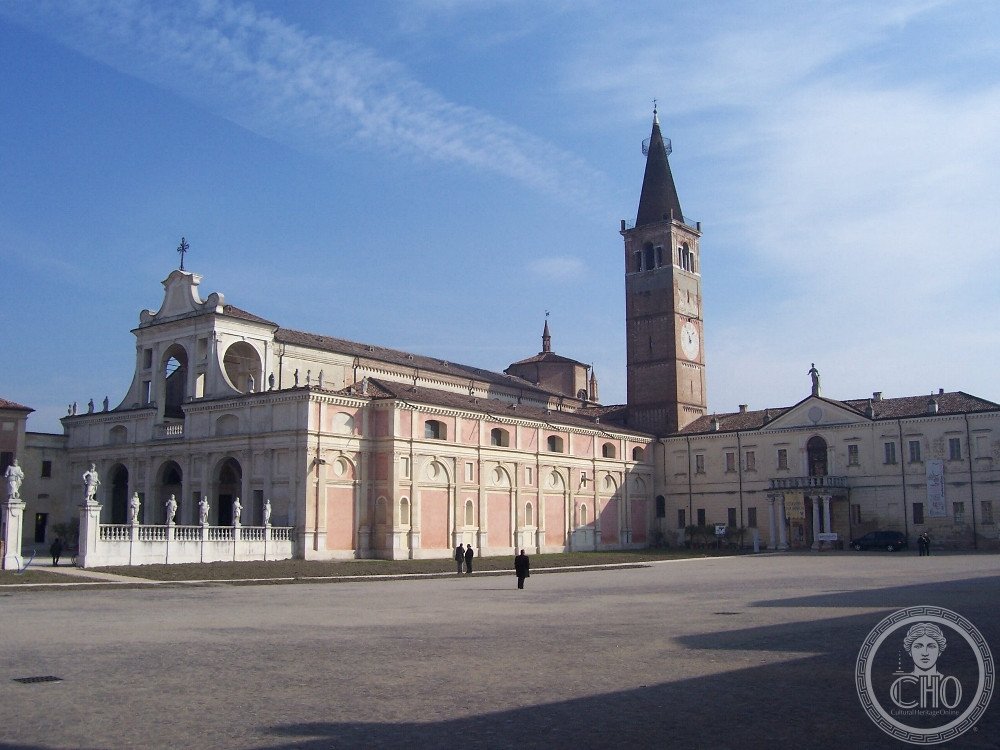
Founded in 1007 by Tedald of Canossa — Matilda’s grandfather — and reformed by Cluny in 1048, Polirone Abbey became the political and spiritual pivot of the great countess who held Pope Gregory VII against the Emperor: Matilda of Canossa is buried here, and the Gonzaga later made it their ducal chapel, with a refectory by Giulio Romano worthy of Rome.
At a glance
The Abbey of Polirone (or San Benedetto Polirone) stands in the town of San Benedetto Po, on the south bank of the Po river, 30 km south-east of Mantua. It was founded in 1007 by Tedaldo, Count of Canossa and grandfather of Matilda of Canossa, on an island in the Po marshes. Affiliated to the great French abbey of Cluny in 1048 (by Boniface II of Canossa and Beatrice of Lorraine, parents of Matilda), it became the most important Cluniac house in northern Italy and the spiritual base of the Canossa dynasty in its struggle with the Holy Roman Empire. Matilda of Canossa (1046–1115) — the most powerful lay ruler in 11th-century Italy and the supporter of Pope Gregory VII against Emperor Henry IV during the Investiture Controversy — is buried here; her tomb is now in St Peter’s Basilica, Rome (moved by Bernini’s order in 1634), but her heart is claimed to remain at Polirone. After the Canossa dynasty, the abbey passed to the Gonzaga lords of Mantua, who rebuilt much of it in the Renaissance; the magnificent refectory (1539–40) decorated by Giulio Romano’s workshop is the supreme monument of Gonzaga patronage at the abbey.
Key facts
- Founded: 1007 by Tedaldo di Canossa, grandfather of Matilda of Canossa; donated to Cluny 1048
- Matilda of Canossa: the countess (1046–1115) was buried at Polirone; her tomb was moved to St Peter’s Rome by Bernini (1634); an effigy remains at the abbey; her “heart” per tradition
- Giulio Romano: the Mantuan architect and painter (student of Raphael) decorated the refectory 1539–40 with a Feeding of the Five Thousand fresco (now deteriorated) and designed the architectural frame; also designed the church facade
- Gonzaga: the Gonzaga lords of Mantua used the abbey as their family necropolis and prestige project; multiple Gonzaga tombs in the church
- Museum: the Museo Civico Polironiano occupies the former monastic buildings; collections of Romanesque sculpture, Gonzaga metalwork, illuminated manuscripts, and liturgical objects
- Today: deconsecrated (no monastic community); Museo Civico open; church open daily
History
The foundation of Polirone by Tedaldo in 1007 was an act of dynastic piety and political positioning: the Canossa family, then the dominant power in the Po valley, needed a prestigious Benedictine house to legitimise their rule, serve as a burial place, and provide the spiritual infrastructure for their growing territory. Affiliation to Cluny in 1048 was the crucial step — it brought the abbey into the most powerful monastic network of the 11th century and gave the Canossa a direct connection to the reform movement that would bring Gregory VII and the Investiture Controversy. Matilda of Canossa, the most famous member of the dynasty, used Polirone as her principal religious foundation: she made numerous gifts of land, supported the building of the Romanesque church, and died in the monastery in 1115 while on her way to Rome.
After Matilda’s death (she had donated all her lands to the papacy), Polirone passed through a series of lords before coming to the Gonzaga in the 14th century. Under the Gonzaga, the abbey was rebuilt on a grand Renaissance scale: Giulio Romano, the leading architect and painter of Mantua under Federico II Gonzaga, designed the new church facade (never completed) and the refectory, where his workshop painted the Feeding of the Five Thousand — a vast illusionistic composition that made the refectory one of the most celebrated monastic interiors in northern Italy. The monastery was suppressed by Napoleon in 1797 and converted to secular uses; the church was reconsecrated as a parish in the 19th century.
What you see
The complex at San Benedetto Po is large: several cloisters of different periods, the main church, the refectory, and extensive monastic ranges now housing the museum and civic functions. The church is a 16th-century rebuilding in a severe classical style (Giulio Romano’s facade design was never executed; the present facade is 18th century). The interior has Gonzaga tombs along the nave walls and a remarkable set of 15th-century intarsia choir stalls. The refectory — the chief work of Giulio Romano at Polirone — is entered from the cloister; even in its damaged state, the architectural framework of pilasters, arches and barrel vault is impressive, and the ghost of the fresco programme is visible in the surviving fragments. The museum (Museo Civico Polironiano) contains an exceptional collection of Romanesque capitals from the 11th-century church, early medieval bronzes, and Gonzaga-period liturgical silver.
Practical information
- Opening hours: church daily 08:00–12:00 and 14:30–18:30; museum Tue–Sun 09:00–12:30 and 14:30–17:30 (check seasonal variations)
- Admission: church free; museum charged
- Time needed: 1.5–2 hours for church, cloisters, refectory and museum
Getting there
By car from Mantua (30 km south-east): SS482. By bus from Mantua (ATV bus, 50 min). GPS: 45.0272° N, 10.9219° E.
Nearby
- Mantua (Mantova) — the Gonzaga city with Palazzo Ducale and Camera degli Sposi (Mantegna), UNESCO heritage site, 30 km north-west
- Canossa Castle ruins — the symbolic site of Henry IV’s penance before Gregory VII (1077), 60 km south in the Apennines near Reggio Emilia
Sources
- Wikipedia — “Abbey of Polirone” (en.wikipedia.org/wiki/Abbey_of_Polirone)
- Filippo Trevisani (ed.), Giulio Romano, Electa, 1989 (Polirone section)
- Museo Civico Polironiano — polironiano.it
Find it on the map
See this place and what’s around it →📷 Become a Cultural Heritage Online photographer
Share your photos of places: they stay published under your name as the author. The more they're seen, the more you get noticed — and soon a contest will reward the most appreciated photos.
Log in or sign up free to add a photoIs this page about you?
This page is read by travellers and heritage enthusiasts who find it on Google. Tell us how you are connected to this place and we will take it from there.