

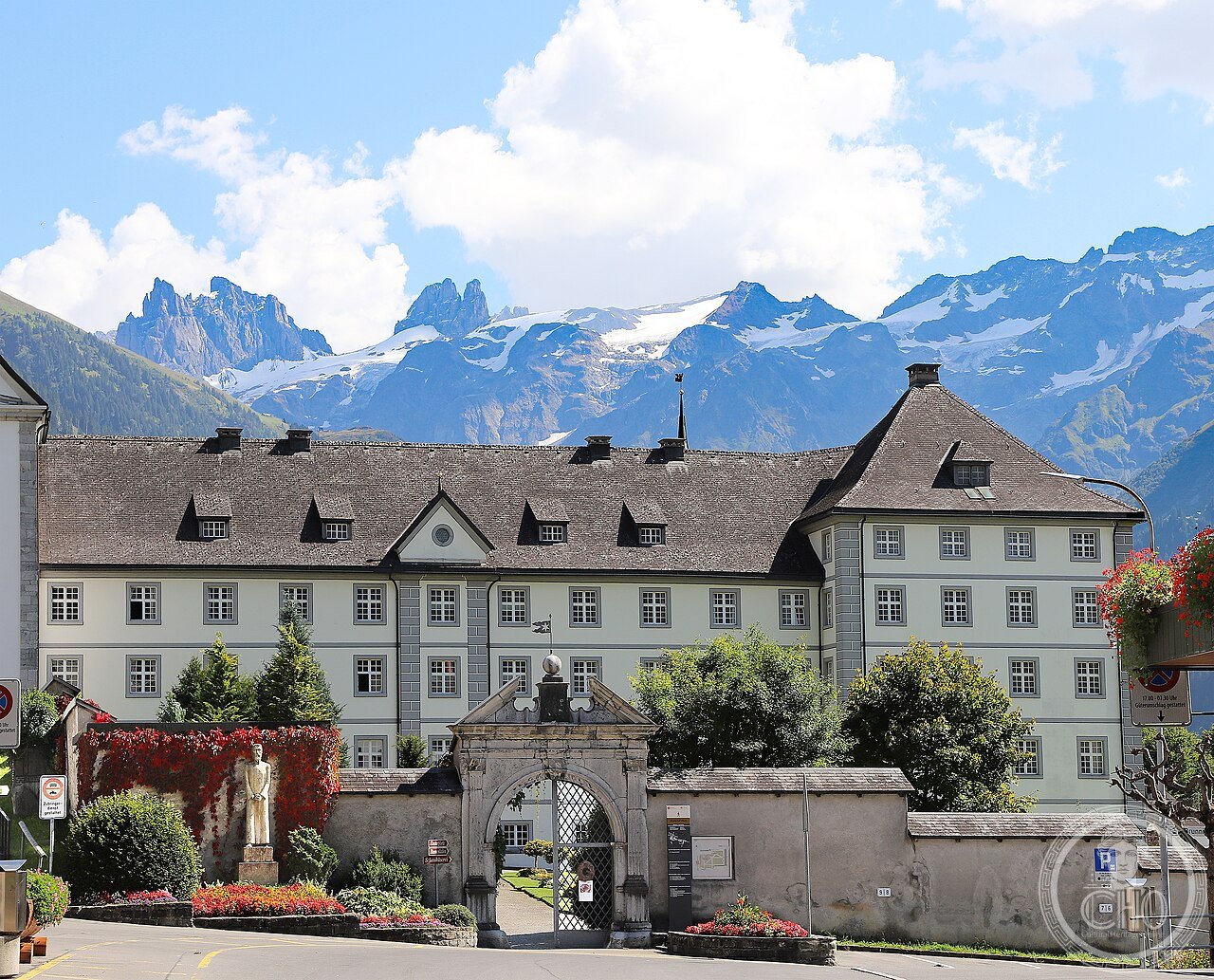
According to legend it was heavenly powers that pointed out the site on which it should rise: hence the Latin name Mons Angelorum, “mountain of angels”, and the German name Engelberg it still bears today. Founded in 1120 by Count Conrad of Sellenbüren as a double monastery of monks and nuns, the abbey would burn almost entirely in 1729, to be rebuilt afterwards by Abbot Emmanuel Crivelli.
About Engelberg Abbey
Engelberg Abbey was founded on 1 April 1120 by Count Conrad of Sellenbüren, with Adelhelm, a monk of Muri Abbey, installed as its first abbot; the foundation received official recognition from both Pope Callistus II and Emperor Henry IV in 1124. The abbey’s name derives from a founding legend: celestial forces were said to have pointed out the location, giving the site its Latin name Mons Angelorum (“Mount of Angels”), rendered in German as “Engelberg” — a name the town and abbey still carry today. The monastery sits in a mountain valley at the foot of Mount Titlis in central Switzerland, roughly thirty miles from Lucerne. Under Abbot Frowin, Engelberg became a double monastery, housing both monks and nuns together, and a scriptorium was founded that flourished under his direction; around 1200, the so-called Engelberger Meister (“Engelberg Master”) produced and illustrated several manuscripts from this workshop. A catastrophic fire on 29 August 1729 reduced both church and monastery to ashes; Abbot Emmanuel Crivelli (1731-1749) subsequently built the present church and reorganised monastic life at the rebuilt abbey.
Key facts
- Foundation: 1 April 1120, by Count Conrad of Sellenbüren; first abbot Adelhelm, from Muri Abbey
- Official recognition: 1124, by Pope Callistus II and Emperor Henry IV
- Name origin: Latin “Mons Angelorum” (“Mount of Angels”), from a founding legend of celestial guidance; German “Engelberg”
- Setting: at the foot of Mount Titlis, central Switzerland, roughly 30 miles from Lucerne
- Double monastery: under Abbot Frowin, housing both monks and nuns; scriptorium founded under his direction
- Engelberger Meister: c. 1200, produced and illustrated manuscripts from the abbey scriptorium
- 1729 fire: destroyed the church and monastery; rebuilt 1731-1749 under Abbot Emmanuel Crivelli
History
Engelberg’s founding legend of celestial forces indicating the site situates the abbey within a broader medieval tradition of monastic foundation narratives attributing a religious institution’s location to divine or angelic intervention rather than purely practical human decision — a pattern that gave newly founded monasteries an origin story carrying immediate spiritual authority independent of their founders’ more mundane territorial or political motivations. The abbey’s status as a double monastery under Abbot Frowin, housing both monks and nuns within a single institutional structure, reflects a specific and relatively less common medieval monastic arrangement, one that required careful institutional management to maintain appropriate separation while sharing core religious and economic resources.
The Engelberger Meister’s early-13th-century manuscript production situates Engelberg’s scriptorium within the broader tradition of significant medieval monastic centres of manuscript illumination, whose surviving works today provide art historians with valuable evidence of regional artistic style and technique from a period when few comparable secular workshops existed. The 1729 fire’s near-total destruction of the medieval abbey, followed by Abbot Crivelli’s substantial Baroque-era rebuilding through 1749, situates Engelberg within the broader pattern of Alpine monasteries whose visible present-day architecture often dates predominantly to 18th-century reconstruction following catastrophic fire loss of the original medieval fabric.
What you see
The Baroque abbey church, rebuilt under Abbot Emmanuel Crivelli between 1731 and 1749 following the 1729 fire, gives visitors the abbey’s present architectural core. The monastery’s dramatic mountain setting at the foot of Titlis offers a distinctive Alpine backdrop rarely matched among comparable Swiss monastic sites. The abbey’s continuing active Benedictine community and its associated cheese-making tradition extend Engelberg’s institutional life into the present day.
Practical information
- Opening hours: generally open daily, check current hours before visiting; free admission to the church
- Address: Klosterstrasse, 6390 Engelberg, Switzerland
Getting there
Engelberg has direct rail connections from Lucerne (approximately 1 hour). By car, Engelberg sits at the end of a valley road in the canton of Obwalden. GPS: 46.8202° N, 8.4103° E.
Nearby
- Mount Titlis — reachable by cable car, including the rotating Titlis Rotair, with glacier access
- Trübsee — an Alpine lake on the way up to Titlis
- Lucerne — approximately 1 hour away by train
Sources
- Wikipedia — “Engelberg Abbey” (en.wikipedia.org)
- Engelberg.ch — “Benediktine Monastery” (engelberg.ch)
- Catholic Encyclopedia — “Abbey of Engelberg” (newadvent.org)
Find it on the map
See this place and what’s around it →📷 Become a Cultural Heritage Online photographer
Share your photos of places: they stay published under your name as the author. The more they're seen, the more you get noticed — and soon a contest will reward the most appreciated photos.
Log in or sign up free to add a photo