
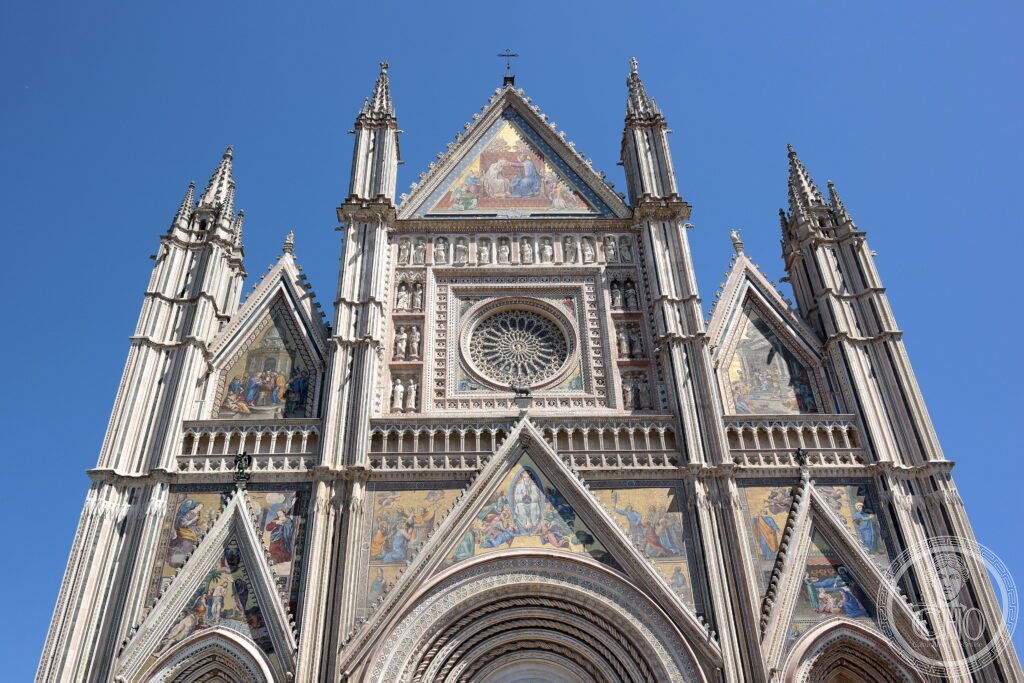
On the tufa crag of Orvieto, the black and white banded facade of the cathedral catches fire in gold at sunset: mosaics, reliefs and a rose window enclose the chapel where Luca Signorelli painted a Last Judgement that Michelangelo studied before the Sistine Chapel.
At a glance
Orvieto Cathedral, dedicated to the Assumption of the Virgin (Santa Maria Assunta), rises on the highest point of the city’s volcanic tufa outcrop, its striped Romanesque-Gothic body crowned by one of the most celebrated mosaic facades in Italy. Pope Nicholas IV laid the foundation stone in 1290, commissioning the building both to replace two older churches on the site and to house a relic recently arrived from nearby Bolsena: a blood-stained corporal cloth from a Eucharistic miracle of 1263. Construction passed through several architects over more than three centuries, but it was Lorenzo Maitani, appointed chief architect in 1310, who gave the cathedral its defining facade and structural stability. Inside, the Cappella di San Brizio holds one of the Italian Renaissance’s most influential fresco cycles, begun by Fra Angelico and completed by Luca Signorelli.
Key facts
- Founded: 1290, by Pope Nicholas IV, on the site of two earlier churches, to house the Corporal of Bolsena and serve growing pilgrim traffic
- Architects: possibly begun under Arnolfo di Cambio; Lorenzo Maitani took over as capomaestro in 1310 and designed the facade’s lower register and sculptural programme; later work continued into the 17th century
- Facade: banded black-and-white local stone body with a gilded mosaic upper facade (largely 17th-19th century replacements of earlier originals) and four monumental bronze-relief pilasters by Maitani’s workshop depicting biblical narrative from Creation to the Last Judgment
- Cappella di San Brizio: frescoes begun by Fra Angelico in 1447 (Christ in Judgment and prophets on the vault) and completed by Luca Signorelli, 1499-1504, whose Last Judgment cycle is widely cited as a direct influence on Michelangelo’s Sistine Chapel
- Chapel of the Corporal: houses the relic in a Gothic silver reliquary triptych by the Sienese goldsmith Ugolino di Vieri (1337-1338), decorated with 32 enamelled narrative scenes
History
The cathedral’s origin is tied directly to the Miracle of Bolsena: in 1263, a German priest on pilgrimage to Rome, doubting the doctrine of transubstantiation, is recorded to have seen a consecrated host bleed onto the altar cloth (corporal) during Mass at Bolsena, a town near Orvieto. Pope Urban IV, then resident in Orvieto, had the blood-stained corporal brought to the city, and the relic’s arrival is understood to have prompted Pope Nicholas IV’s decision, in 1290, to commission a cathedral grand enough to house it and to serve Orvieto’s status as a favoured papal residence during a period when several popes withdrew from a politically unstable Rome.
Construction proceeded through multiple building campaigns and architects over more than three centuries; Lorenzo Maitani’s appointment in 1310 marked the project’s decisive phase, both structurally (correcting problems with the building’s stability) and artistically, giving the lower facade its four great marble pilasters carved in relief with biblical narrative, framing the central rose window. The mosaic upper register was reworked repeatedly in subsequent centuries, meaning much of what glitters on the facade today reflects post-medieval restoration and replacement rather than 14th-century originals, a detail the cathedral’s own conservation documentation addresses directly. Inside, the Cappella di San Brizio’s fresco cycle was interrupted for decades after Fra Angelico’s initial 1447 campaign before Luca Signorelli resumed and completed it between 1499 and 1504, producing a Last Judgment whose anatomical intensity and dramatic composition are documented as a direct point of reference Michelangelo consulted before beginning the Sistine Chapel ceiling.
What you see
The facade divides into a lower register of deeply carved marble relief — Creation and the stories of Genesis on the leftmost pilaster, moving through Old Testament narrative, the Tree of Jesse, and New Testament scenes, to the Last Judgment on the rightmost pilaster — framing bronze statues of the Evangelist symbols and a rose window attributed to Andrea Orcagna’s circle, all set against the mosaic-covered gables above. The banded travertine-and-basalt striping of the flanks and interior nave, a hallmark of central Italian Romanesque-Gothic churches, continues the visual rhythm established at the facade into the building’s full length.
Inside, the Cappella di San Brizio (also called Cappella Nova), in the right transept, is the essential stop: Signorelli’s walls depict the Preaching and Fall of the Antichrist, the End of the World, the Resurrection of the Flesh, the Damned Consigned to Hell, and the Elect in Paradise, painted with an anatomical directness unusual for the period, while Fra Angelico’s earlier vault sections retain his characteristic luminous, more restrained figuration. The Cappella del Corporale, opposite in the left transept, holds Ugolino di Vieri’s silver reliquary and its own fresco cycle narrating the Bolsena miracle directly.
Practical information
- Opening hours: generally 9:30 to between 17:00 and 19:00 depending on season; reduced hours Sundays and holidays; check duomodiorvieto.it before visiting
- Tickets: nave entry is free; a combined ticket (around €8) covers the Cappella di San Brizio, Museo Emilio Greco, and the cathedral’s underground areas, purchasable at the ticket office in Piazza Duomo 25 or online
- Time needed: about 1-1.5 hours including the San Brizio chapel
Getting there
Orvieto sits directly on the Rome-Florence rail line; Orvieto Scalo station, in the valley, connects to the hilltop historic centre via a funicular railway or urban bus. By car, the A1 motorway (Florence-Rome) has an Orvieto exit; the E45 superstrada connects from Perugia and Todi. From Orvieto’s funicular terminus, the Duomo is roughly 800 metres on foot along Corso Cavour and Via del Duomo. GPS: 42.7170° N, 12.1136° E.
Nearby
- Pozzo di San Patrizio — a short walk from the Duomo; a monumental 16th-century double-helix well shaft, 62 metres deep, built for Pope Clement VII
- Orvieto Underground — guided tours of the tufa caves and tunnels beneath the historic centre, used since Etruscan times
- Basilica di Santa Cristina, Bolsena — about 30 minutes by car; the site of the 1263 Eucharistic miracle that prompted the Duomo’s foundation
Sources
- Opera del Duomo di Orvieto — official visitor and history portal (duomodiorvieto.it)
- Wikipedia — “Orvieto Cathedral” and “Cappella di San Brizio” (en.wikipedia.org, it.wikipedia.org)
- Umbria Tourism — regional visitor information (umbriatourism.it)
- Treccani — entries on Lorenzo Maitani and Luca Signorelli
Find it on the map
See this place and what’s around it →
📷 Become a Cultural Heritage Online photographer
Share your photos of places: they stay published under your name as the author. The more they're seen, the more you get noticed — and soon a contest will reward the most appreciated photos.
Log in or sign up free to add a photoIs this page about you?
This page is read by travellers and heritage enthusiasts who find it on Google. Tell us how you are connected to this place and we will take it from there.