

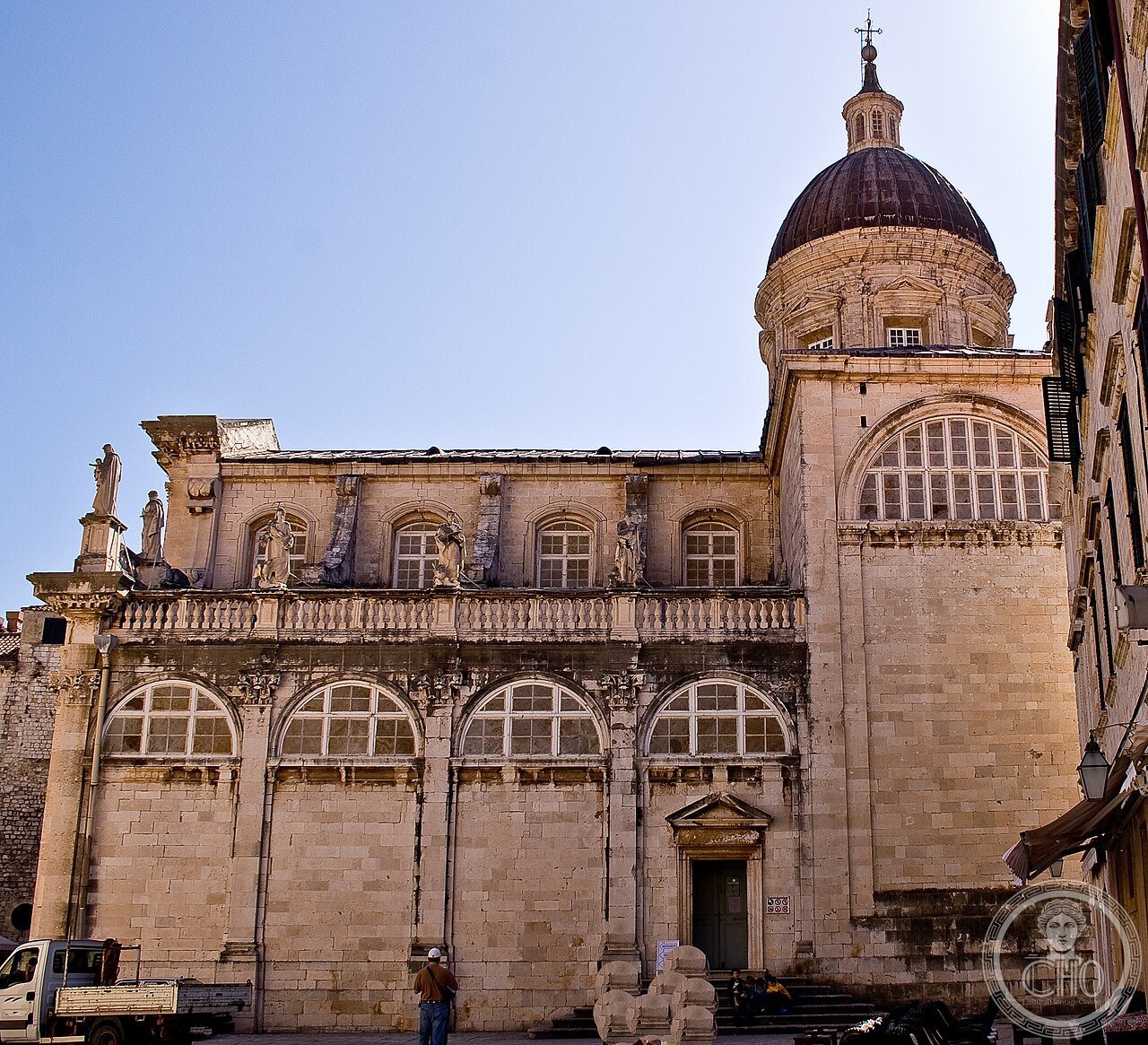
According to tradition, in 1192 Richard the Lionheart, returning from the Third Crusade, was caught in a violent storm in the Adriatic and was shipwrecked near the island of Lokrum, off Dubrovnik. During the storm the king is said to have vowed to build two churches to the Virgin Mary if he survived; part of the money promised went to fund Dubrovnik Cathedral itself, while the Benedictine monks of Lokrum, left without the church promised on their island, received in compensation the right to celebrate pontifical masses in the cathedral on Candlemas. The present Baroque building was rebuilt in the early eighteenth century on the ruins of earlier churches, destroyed by the devastating Dubrovnik earthquake of 1667. The cathedral treasury holds 182 reliquaries from the eleventh to the eighteenth century, the most important being the gilded skull of Saint Blaise, patron of the city, shaped like a Byzantine crown and set with precious stones, together with a relic of the True Cross and a triptych of the Assumption painted by Titian around 1552.
About Dubrovnik Cathedral
Archaeological excavations beneath Dubrovnik Cathedral have revealed the remains of an earlier Byzantine basilica, the oldest large-scale structure identified on the site, with the first known cathedral here dating back to the 7th century and successive structures built in the 10th and 11th centuries. Local tradition connects the site’s medieval reconstruction to a dramatic legend involving King Richard the Lionheart of England, who is said to have stopped over near Dubrovnik in 1192 while returning from the Third Crusade, becoming caught in a violent storm in the Adriatic and shipwrecked near the island of Lokrum. During the storm, Richard reportedly vowed to build two churches dedicated to the Blessed Virgin Mary if he survived; funds attributed to fulfilling this vow partially financed the construction of Dubrovnik’s cathedral, though the king ultimately did not build the promised church on Lokrum itself — as compensation, the Benedictine monks of Lokrum were instead granted the right to hold pontifical masses in Dubrovnik Cathedral on Candlemas day each year. The present cathedral building, constructed in the Baroque style during the early 18th century, stands on the site of these earlier churches, which were destroyed in the catastrophic Dubrovnik earthquake of 1667, one of the most devastating natural disasters in the city’s history. The cathedral’s treasury today holds 182 reliquaries spanning the 11th to 18th centuries, drawn from local craftsmen as well as Byzantine, Venetian, and Oriental sources; its single most important object is the gold-plated arm, leg, and skull of Saint Blaise, patron saint of Dubrovnik, the skull reliquary itself shaped like a Byzantine imperial crown and richly adorned with precious stones and enamelled medallions. The treasury additionally preserves a relic said to be a fragment of the True Cross, while the cathedral’s main altar displays a triptych depicting the Assumption of the Virgin Mary, attributed to the Venetian master Titian and probably dating from around 1552.
Key facts
- 7th century: first known cathedral on the site
- 1192: traditional date of Richard the Lionheart’s shipwreck near Lokrum and his vow
- 1667: earlier cathedral destroyed in the great Dubrovnik earthquake
- Early 18th century: present Baroque cathedral built on the earlier site
- Treasury: 182 reliquaries spanning the 11th to 18th centuries
- Most important relic: gold-plated skull, arm, and leg of Saint Blaise, patron of Dubrovnik
- Main altar: Assumption triptych attributed to Titian, c. 1552
History
The legend connecting Richard the Lionheart’s shipwreck and votive pledge to the cathedral’s construction, whatever its precise historical accuracy, reflects Dubrovnik’s long-standing self-image as a maritime republic deeply enmeshed in the crusading and pilgrimage networks connecting Western Europe to the eastern Mediterranean, with the city’s own religious architecture bearing the traces of these broader medieval connections. The cathedral’s near-total destruction in the 1667 earthquake, one of the most catastrophic events in Dubrovnik’s history, necessitated the wholesale Baroque reconstruction that gives the present building its distinctive character, layering an 18th-century architectural identity directly over foundations stretching back to the 7th century.
The elaborate treasury’s gold-plated reliquary of Saint Blaise, shaped deliberately in the form of a Byzantine imperial crown, situates Dubrovnik’s civic and religious identity within the wider Byzantine cultural sphere that shaped much of the medieval Adriatic and Dalmatian coast, while the presence of a genuine Titian altarpiece confirms the cathedral’s status as a significant patron of major Venetian Renaissance art during the height of Dubrovnik’s mercantile prosperity.
What you see
The Baroque cathedral, built in the early 18th century following the 1667 earthquake, presents a classically inspired facade characteristic of post-earthquake Dubrovnik reconstruction across the wider Old Town. Inside, the treasury displays its 182 reliquaries including the crown-shaped skull reliquary of Saint Blaise, while the main altar houses the Titian Assumption triptych, with archaeological remains of the earlier Byzantine basilica preserved beneath the present structure.
Practical information
- Opening hours: generally open daily with seasonal variation; treasury has separate admission; check current hours before visiting
- Address: Od Pustijerne 1, 20000 Dubrovnik, Croatia
Getting there
Dubrovnik Cathedral stands in the heart of Dubrovnik’s Old Town, on Croatia’s Dalmatian coast, easily reachable on foot within the city’s UNESCO-listed historic centre. GPS: 42.6399° N, 18.1104° E.
Nearby
- Rector’s Palace — former seat of the Republic of Ragusa, adjacent to the cathedral
- Church of Saint Blaise — Baroque church dedicated to Dubrovnik’s patron saint, nearby
- Lokrum Island — the island of Richard the Lionheart’s legendary shipwreck, a short boat ride away
Sources
- Wikipedia — “Dubrovnik Cathedral” (en.wikipedia.org)
- Dubrovnik Online — “Legend of Richard the Lionheart vow and Dubrovnik Cathedral” (dubrovnik-online.net)
- Tourist Board of Dubrovnik — “Cathedral” (tzdubrovnik.hr)
Find it on the map
See this place and what’s around it →📷 Become a Cultural Heritage Online photographer
Share your photos of places: they stay published under your name as the author. The more they're seen, the more you get noticed — and soon a contest will reward the most appreciated photos.
Log in or sign up free to add a photo