
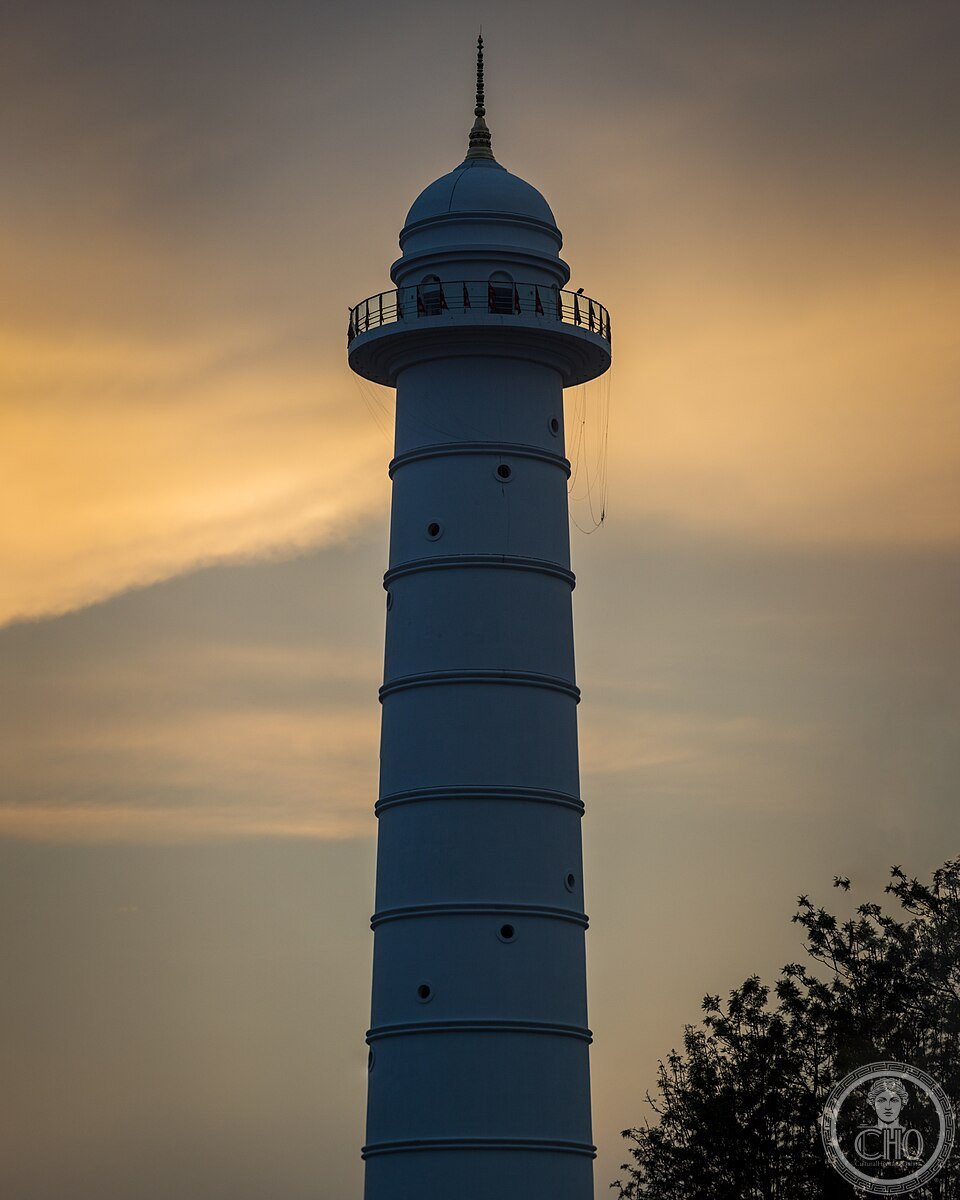
A 72-metre octagonal tower that has fallen and risen again — destroyed by earthquakes twice, rebuilt twice, and now carrying a memorial to the 180 people lost in its 2015 collapse.
At a glance
- Type
- Watchtower and national monument
- Period
- 1825; rebuilt 1832, 2021
- Style
- Mughal / Neoclassical
- Location
- Sundhara, Kathmandu, Nepal
- Coordinates
- 27.7011, 85.3131
- Builder
- Prime Minister Bhimsen Thapa
Overview
Dharahara Tower — also known as Bhimsen Tower — is Kathmandu’s most resilient urban landmark. The current 72-metre octagonal structure, completed in 2021, stands on the same ground where Prime Minister Bhimsen Thapa built the original watchtower in 1825. From its panoramic observation deck visitors command views across the Bagmati valley, the old city’s tiled rooftops, and the ring of Himalayan peaks that frames Kathmandu on clear winter days. The tower is the most visited city-centre monument in Nepal and serves simultaneously as an observation platform, a heritage memorial, and a symbol of Nepali national resilience.
History
Built in 1825 under Prime Minister Bhimsen Thapa as a military watchtower for the Bagmati valley, the original Dharahara was an eleven-storey structure that rose over 50 metres. The 1833 earthquake damaged it severely; it was rebuilt taller shortly after. On April 25, 2015, the 7.8-magnitude Gorkha earthquake — the worst to strike Nepal in 80 years — caused the tower to collapse in seconds while 180 visitors were inside. The collapse was filmed live and broadcast worldwide, becoming the defining image of a disaster that killed more than 9,000 people across Nepal. The Nepali government committed to rebuilding; construction began in 2019 and the new tower — 72 metres, nine storeys, earthquake-resistant reinforced concrete — was inaugurated in 2021. A permanent memorial on the ground floor honours the 180 victims.
Architecture and Design
The new Dharahara reinterprets the original’s octagonal plan at larger scale. Eight faces rise through nine storeys of progressively narrowing tiers, referencing the Mughal-influenced design of the 1825 original while incorporating modern seismic isolation technology required by Nepal’s updated building codes. The observation deck at the ninth storey is enclosed in glass to protect visitors during high winds. A copper-clad spire crowns the structure. The base incorporates the memorial garden, with engraved names of the 2015 victims in both Nepali and English. The ground level opens onto Sundhara square, where a traditional stone-spout water system — one of Kathmandu’s historic water infrastructure features — has been restored alongside the tower.
Cultural significance
Dharahara is simultaneously a symbol of Nepali sovereignty and of national trauma. Built during the Shah-Rana period when Nepal was asserting independence from British-Indian influence, the original tower was a statement of courtly power. After 2015, its collapse and reconstruction became a metaphor for Nepal’s recovery from the earthquake. The tower’s rebuilding was intensely political: completed faster than any other major heritage site, it signals the government’s commitment to restoring national identity after catastrophe. For Kathmandu residents the Dharahara is the city’s clock tower equivalent — the reference point by which the city centre is navigated and described.
Visiting today
The tower is open daily. An entrance fee grants access to the observation deck via lift and staircase. The memorial floor is free to enter. The surrounding Sundhara square, with its traditional dhara (stone water spout), is pleasant to walk in the early morning before tourist crowds arrive. The best Himalayan views occur from November through February when skies are clearest. Photography from the observation deck is permitted.
Getting there
Dharahara stands in Sundhara, in central Kathmandu, roughly 800 metres south of Thamel and 400 metres north of Basantapur Durbar Square. It is walkable from both tourist hubs. Taxis from Tribhuvan International Airport take 20-40 minutes depending on traffic. No metro exists in Kathmandu; local microbuses and taxis are the primary transport options. The nearest landmark junction is Ratnapark, served by many city routes.
Sources and resources
Find it on the map
See this place and what’s around it →📷 Become a Cultural Heritage Online photographer
Share your photos of places: they stay published under your name as the author. The more they're seen, the more you get noticed — and soon a contest will reward the most appreciated photos.
Log in or sign up free to add a photoIs this page about you?
This page is read by travellers and heritage enthusiasts who find it on Google. Tell us how you are connected to this place and we will take it from there.