
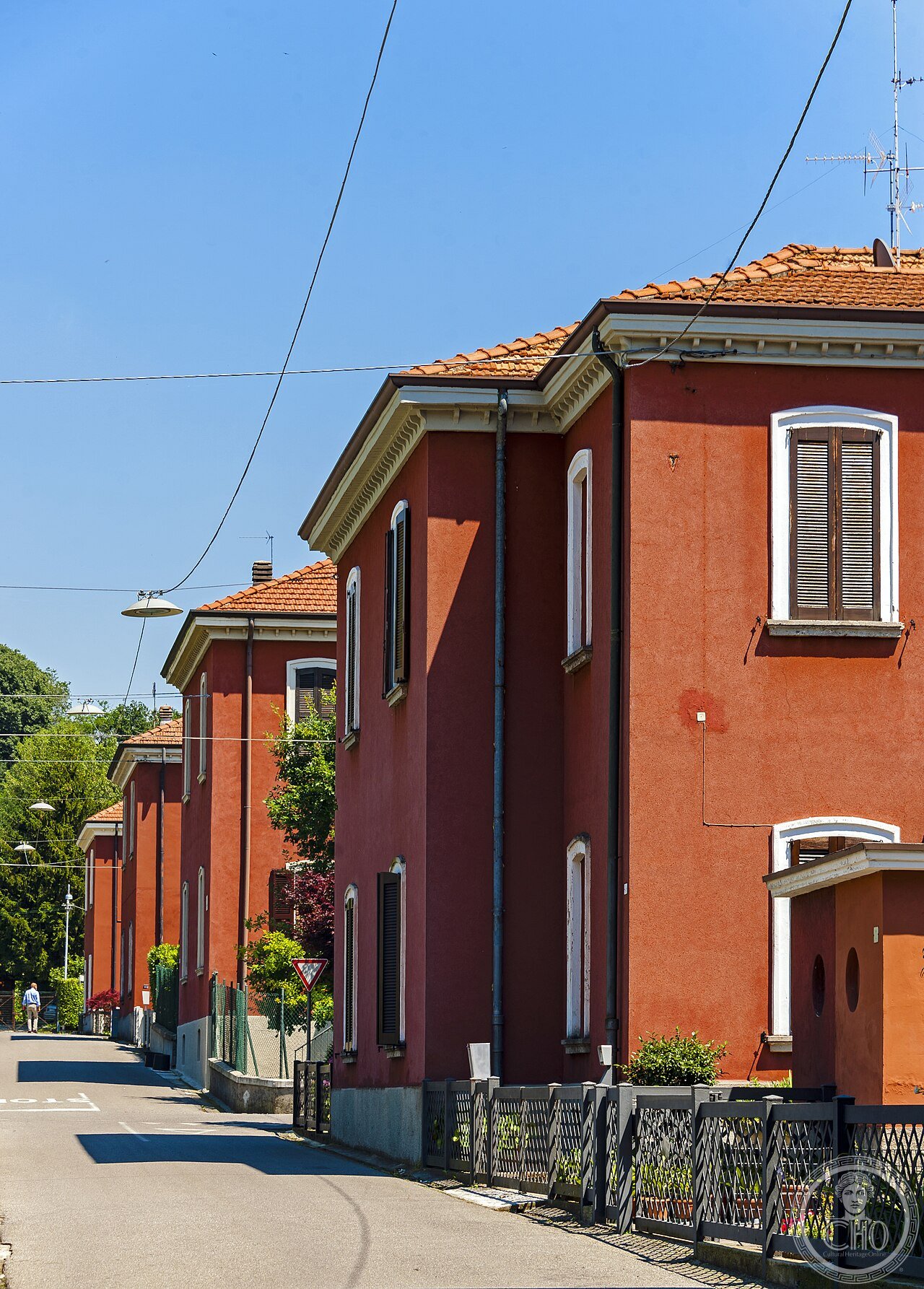
Cristoforo Benigno Crespi built a whole town for his cotton workers on the Adda from 1878 — mill, houses, church, school and castle — and it survives so complete that UNESCO listed it in 1995.
At a glance
Crespi d’Adda is, in UNESCO’s words, one of the best-preserved company towns in southern Europe, built by the Crespi family around their cotton mill on a bend of the river Adda. Begun in 1878 by Cristoforo Benigno Crespi and extended by his son Silvio, it gave workers houses, a church, a school, a hospital and baths in a paternalistic order. UNESCO inscribed it as a World Heritage Site in 1995.
Key facts
- Built: from 1878 into the 1920s
- Founders: Cristoforo Benigno Crespi and his son Silvio Crespi
- Designers: architect Ernesto Pirovano and engineer Pietro Brunati; cemetery by Gaetano Moretti (1905–1908)
- Components: cotton mill (1878), worker housing, church (1891–1893), school, hospital, baths, the owners’ castle
- UNESCO World Heritage Site: 1995
History
The company town was a nineteenth-century idea — house your workers beside the factory and order their lives — and Crespi d’Adda is one of its most complete Italian examples. Cristoforo Benigno Crespi bought land on the Adda in 1877 and opened his cotton mill in 1878, then built a town around it.
The architect Ernesto Pirovano gave the village its buildings, from the workers’ terraces to the Crespi family’s neo-medieval castle; the engineer Pietro Brunati laid out the works, and Gaetano Moretti designed the monumental cemetery between 1905 and 1908. By the 1920s the town had reached its final form.
The mill closed in 2003, but the town survives almost intact — a rare physical record of industrial paternalism — and has been a UNESCO World Heritage Site since 1995.
What you see
A grid of brick worker houses with gardens, the mill stretched along the river, the church — a copy of a sanctuary at Busto Arsizio — facing the owners’ castle across the main axis. The hierarchy of the place is written into its plan.
To the south the monumental cemetery, with the Crespi mausoleum, closes the town.
Practical information
- A living village and UNESCO site; the streets are freely walkable
- The mill interior is not generally open; the village and cemetery are the experience
- On the Adda, in Capriate San Gervasio
- Allow 1–2 hours
Getting there
Crespi d’Adda is in the comune of Capriate San Gervasio, between Milan and Bergamo. By car, leave the A4 motorway at Capriate; there is no station in the village — buses serve Capriate from Bergamo.
Nearby
- The Adda river park (Parco Adda Nord)
- Bergamo Alta
- The ferry at Imbersago (after a Leonardo design)
Sources
- UNESCO World Heritage Centre
- Comune di Capriate San Gervasio
- Villaggio Crespi — heritage association
Find it on the map
See this place and what’s around it →📷 Become a Cultural Heritage Online photographer
Share your photos of places: they stay published under your name as the author. The more they're seen, the more you get noticed — and soon a contest will reward the most appreciated photos.
Log in or sign up free to add a photo