
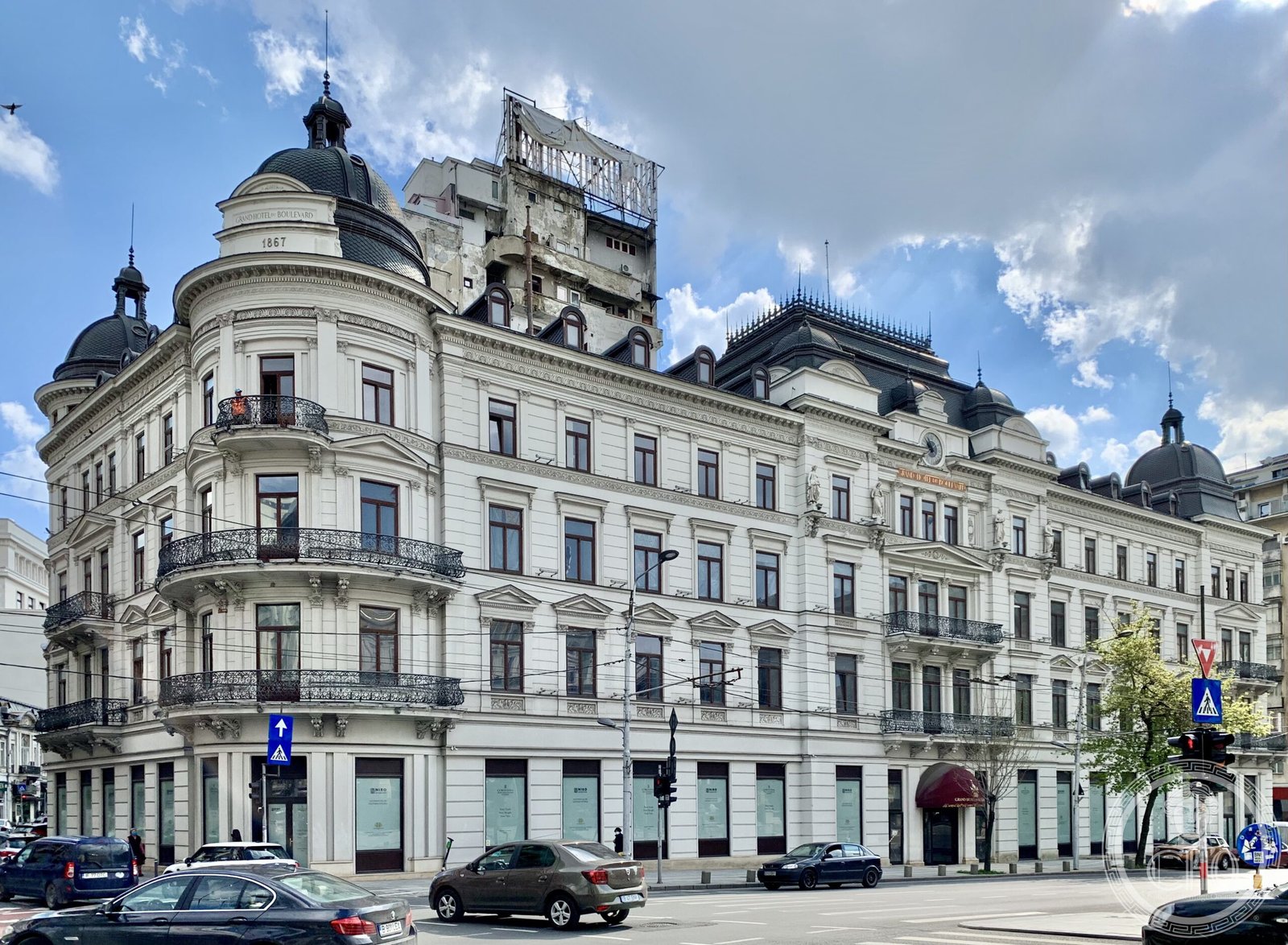
Alexandru Orăscu’s Neoclassical composition on Bulevardul Regina Elisabeta has been Bucharest’s most storied hotel address since 1873 — the city’s first to offer electric light and an elevator — and reopened under the Corinthia flag in March 2025.
At a glance
The Grand Hôtel du Boulevard is Romania’s oldest surviving grand hotel, designed by Alexandru Orăscu (1817–1894) — the architect also responsible for the University of Bucharest — in the Neoclassical and Renaissance Revival idiom that defined mid-nineteenth-century Bucharest. Listed as a Category A Historic Monument (code B-II-m-A-18678), the building now operates as the Corinthia Grand Hotel du Boulevard, an intimate luxury property of 30 suites that opened on 24 March 2025 following several years of careful restoration.
Key facts
- Built: 1865–1871 by Alexandru Orăscu (1817–1894)
- Style: Neoclassical and Renaissance Revival
- Status: Luxury hotel — 30 suites; operated by Corinthia Hotels
- Address: 21 Bulevardul Regina Elisabeta, District 5, Bucharest, Romania
- GPS: 44.4346, 26.0979 — Open in Google Maps
- Listed: Romanian Historic Monument Category A — B-II-m-A-18678
History
The story begins with Jacques Herdan, a prosperous Bucharest bread-factory owner who commissioned Orăscu to design a hotel befitting the capital’s ambitions. Construction ran from 1865 to 1871, and the building opened as the Hotel Herdan before being renamed Grand Hôtel du Boulevard in 1877. From its earliest years it set the pace for Romanian hospitality: it was the first hotel in Bucharest to supply in-room running water, and by 1904 it had installed electric lighting and an elevator — firsts in the city. International recognition followed with gold medals at the 1906 Milan Exhibition and the 1911 Turin Exhibition.
The twentieth century brought repeated reversals of fortune. During World War Two, from 1941 to 1944, the building served as the headquarters of the German military command in Bucharest. After the war it was absorbed into the communist state apparatus and used as a government office from 1950 to 1974, stripped of its hotel function for a quarter century. A management agreement for restoration was signed in March 2018, and after years of meticulous conservation work the hotel welcomed its first guests under the Corinthia brand on 24 March 2025.
The reopened property — just 30 suites, making it one of the most intimate luxury addresses in central Europe — is now managed by the Corinthia Hotels group. Its Boulevard 73 restaurant occupies the original grand ballroom, preserving the spatial hierarchy that Orăscu envisioned for the building’s ceremonial rooms.
What you see
Orăscu articulated the boulevard façade with the restrained authority of a trained Berlin and Munich classicist: a rusticated base, piano nobile with pedimented windows, and a cornice line that holds its own against Bucharest’s later, more exuberant Eclectic neighbours. The proportions are deliberate and unhurried. Pilasters divide the elevation into bays, and carved stone garlands above the principal windows are among the few concessions to ornamental warmth.
Inside, the restoration has recovered the double-height grand ballroom — now the Boulevard 73 dining room — with its coffered ceiling and original decorative plasterwork. The suite interiors blend nineteenth-century spatial generosity with contemporary furnishing, while the retained staircase balustrading and marble floor patterns anchor the public circulation route firmly in Orăscu’s original intent.
Practical information
- Open to hotel guests and restaurant diners; the Boulevard 73 restaurant is open to non-residents
- Year-round destination; spring and autumn offer the most pleasant walking weather in this part of the city centre
- Guided heritage tours: not a standard offering; enquire with the hotel concierge
- Estimated visit time: 1–2 hours including the restaurant; overnight for the full experience
Getting there
Henri Coandă International Airport is approximately 16 km away; a taxi or the 783 express bus reaches the city centre in around 30 minutes. The hotel stands on Bulevardul Regina Elisabeta near its junction with Calea Victoriei, within easy walking distance of Izvor metro station (M3 line, roughly 5 minutes on foot) and Piața Universității interchange (10 minutes on foot eastward). The nearby George Enescu Philharmonia and Romanian Opera are both under 10 minutes on foot.
Nearby
- Cișmigiu Gardens — Bucharest’s oldest public park, laid out in the 1840s, a 5-minute walk to the west along the boulevard.
- Hotel Cișmigiu — The 1912 Eclectic landmark by Arghir Culina, a short walk along Bulevardul Regina Elisabeta, now a 4-star apart-hotel.
- CEC Palace — The ornate savings-bank palace on Calea Victoriei (1897–1900), a 10-minute walk north-east, featuring a glass-and-steel dome by Paul Gottereau.
- Romanian Athenaeum — The city’s concert hall masterpiece, designed by Albert Galleron and opened in 1888, set on Revolution Square roughly 15 minutes on foot north-east.
Sources
Find it on the map
See this place and what’s around it →📷 Become a Cultural Heritage Online photographer
Share your photos of places: they stay published under your name as the author. The more they're seen, the more you get noticed — and soon a contest will reward the most appreciated photos.
Log in or sign up free to add a photoIs this page about you?
This page is read by travellers and heritage enthusiasts who find it on Google. Tell us how you are connected to this place and we will take it from there.