

The Athens of the Maya world
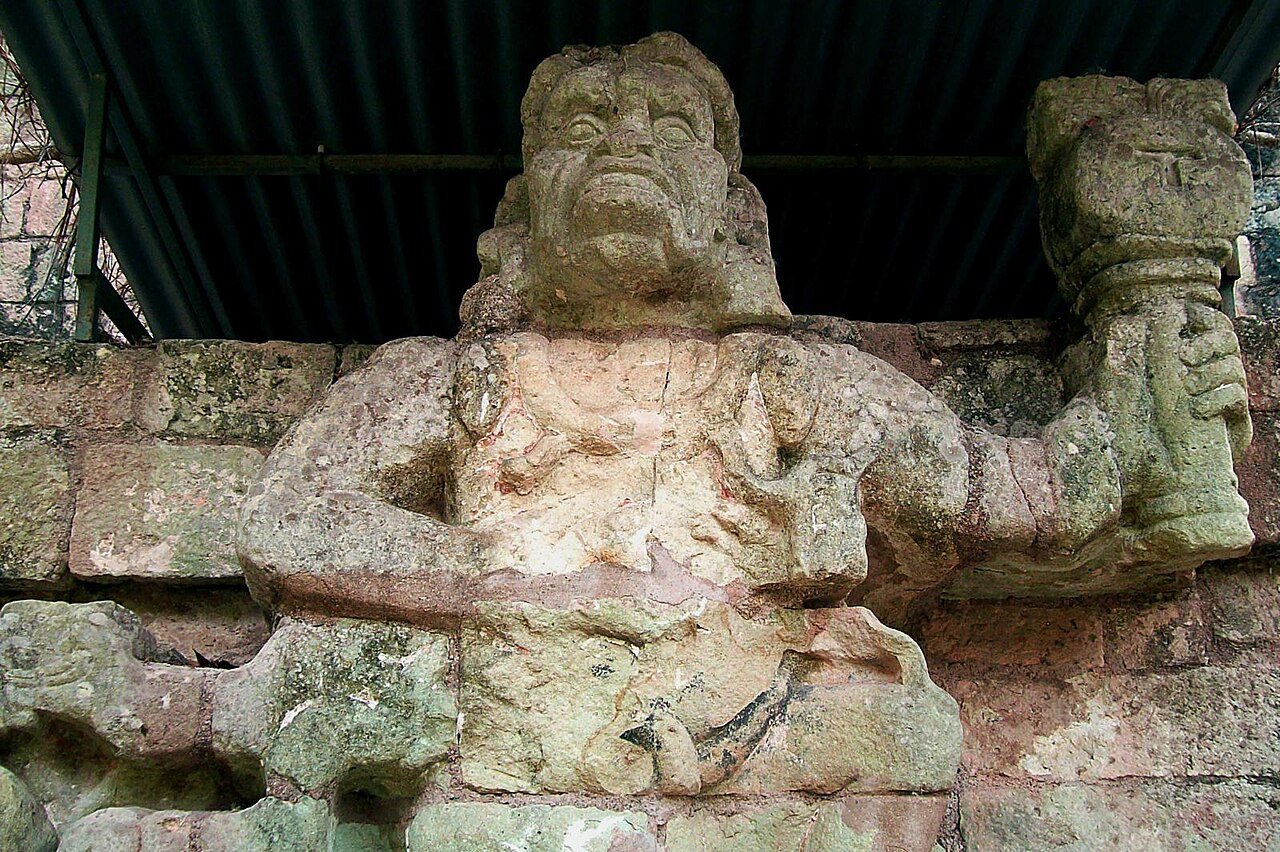
Copán — called by scholars the “Athens of the Maya” for the extraordinary sophistication of its art and writing — was the capital of a major Maya kingdom that flourished between 426 and 900 CE in the Copán Valley of western Honduras. Its ruins contain some of the finest sculptural work in the ancient Americas: elaborately carved stelae, zoomorphic altars, and a hieroglyphic stairway that encodes the longest known Maya inscription.
UNESCO recognition: Maya genius in stone
Inscribed in 1980, Copán was recognised by UNESCO together with the nature reserve of Río Plátano as one of Honduras’s dual World Heritage Sites. The citation emphasises the site’s outstanding universal value for its uniquely elaborate Maya sculptural programme and the hieroglyphic monuments that document the dynastic history of the kingdom across four centuries.
The Great Plaza and the Hieroglyphic Stairway
Copán’s Great Plaza is one of the most beautiful open spaces in the ancient Americas — a broad esplanade dominated by ten elaborately carved stelae depicting the kings of the dynasty in full regalia. The Hieroglyphic Stairway (Structure 26) climbs 22 metres on 63 steps, each bearing glyphs that together constitute an account of the dynasty’s history. It is the longest known Maya text, containing approximately 2,200 glyphs.
The Acropolis: throne room of the sky
Rising dramatically above the Copán River, the Acropolis is a massive artificial platform containing temples, palaces, and plazas built in superimposed layers across six centuries. Tunnels excavated by archaeologists have revealed an almost complete series of earlier buildings inside the Acropolis — including the intact Rosalila Temple, buried but perfectly preserved under later construction.
A dynasty of sixteen kings: the House of K’inich Yax K’uk’ Mo’
Copán’s ruling dynasty traced its origins to K’inich Yax K’uk’ Mo’ (Great Sun First Quetzal Macaw), who founded the kingdom around 426 CE after arriving from Teotihuacan, according to royal texts. Over the next four centuries, sixteen kings expanded the city and its sculptural programme. The dynasty’s greatest patron of the arts was 18-Rabbit (Uaxaclajuun Ub’aah K’awiil, r. 695–738), who commissioned most of the great stelae.
Ball court and altar Q: power and sacrifice
Copán’s Ball Court is one of the best-preserved in Mesoamerica — a narrow playing alley framed by sloping walls with macaw-head markers. Altar Q, commissioned by the sixteenth king Yax Pasaj Chan Yopaat (r. 763–820), depicts all sixteen rulers of the dynasty seated around its four sides, the last receiving the sceptre from the dynasty’s founder — an image of political legitimacy encoded in stone.
Collapse and rediscovery: from jungle to UNESCO
The Copán kingdom collapsed around 900 CE, possibly from a combination of overpopulation, drought, and political fragmentation. The city was gradually reclaimed by the forest. John Lloyd Stephens and Frederick Catherwood published the first illustrated record of the ruins in 1841, sparking worldwide interest. Systematic excavation began in 1891 and continues today; the site’s tunnels have transformed understanding of Maya dynastic architecture.
Visiting Copán Ruinas today
The ruins lie 1 kilometre from the town of Copán Ruinas, a pleasant base for exploration. The site museum (Museo de Escultura Maya) houses the original Rosalila Temple replica and hundreds of sculptural fragments. The tunnels beneath the Acropolis can be visited on guided tours. The setting in a fertile valley near the Guatemalan border makes Copán one of the most atmospherically rewarding archaeological sites in Central America.
Find it on the map
See this place and what’s around it →📷 Become a Cultural Heritage Online photographer
Share your photos of places: they stay published under your name as the author. The more they're seen, the more you get noticed — and soon a contest will reward the most appreciated photos.
Log in or sign up free to add a photo