
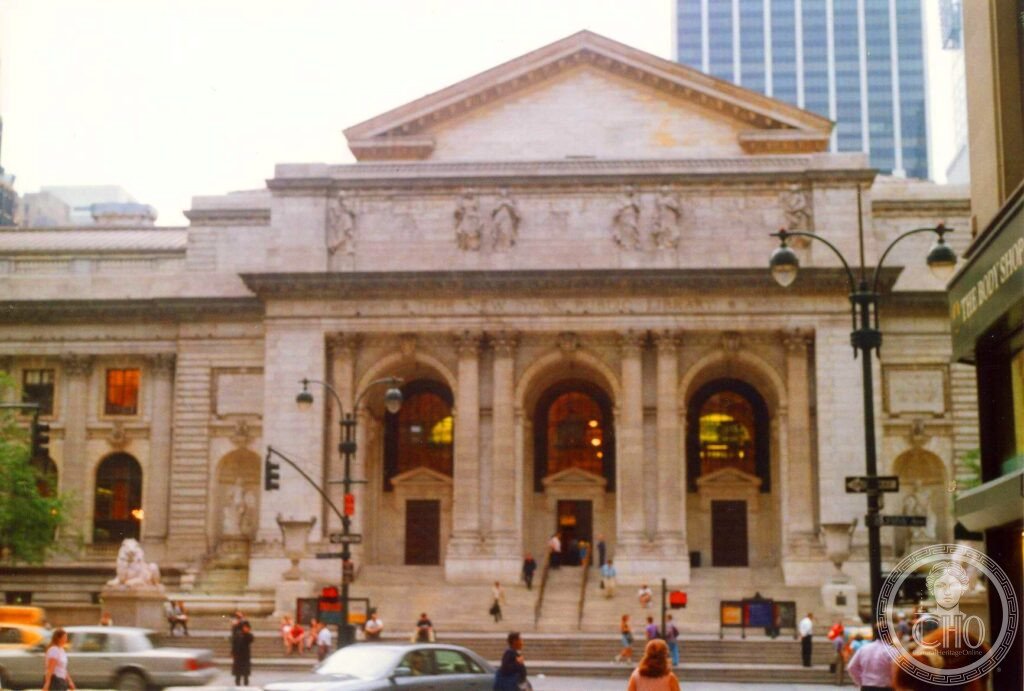
Carrère and Hastings’s 1911 Beaux-Arts marble palace on Fifth Avenue — guarded by the marble lions Patience and Fortitude, housing the Rose Main Reading Room’s painted ceiling over ninety metres of golden oak — is the public interior that best represents what American civic ambition looked like at its height.
At a glance
The New York Public Library’s main research building stands on the west side of Fifth Avenue between 40th and 42nd Streets in Midtown Manhattan, its Vermont marble facade and pair of crouching marble lions forming one of the most immediately recognisable entrances in New York. Designed by Carrère and Hastings and opened on 23 May 1911 in the presence of President William Howard Taft, the building was conceived as a free public research library — open to all without payment, card, or credential — and has operated on that basis ever since. The interior’s centrepiece is the Rose Main Reading Room: a 297-foot-long hall 78 feet wide with a 52-foot-painted ceiling, golden oak tables, and 54 bronze chandeliers, one of the most magnificent public rooms in America. Since 2008 the building bears the name of philanthropist Stephen A. Schwarzman.
Key facts
- Architects: Carrère and Hastings (John Merven Carrère, 1858–1911; Thomas Hastings, 1860–1929); Prix de Rome alumni; also designed the House and Senate Office Buildings in Washington DC
- Opened: 23 May 1911; President William Howard Taft presided at the dedication
- Style: Beaux-Arts; Vermont marble; three-arched main portal; double staircase approach
- Lions: “Patience” and “Fortitude” (named by Mayor Fiorello La Guardia in the 1930s); Adolph A. Weinman, sculptor, 1911; pink Tennessee marble
- Rose Main Reading Room: 297 feet × 78 feet; ceiling paintings by Edward Laning (added 1940s); restored 2016
- Heritage: New York City Landmark (1967); National Historic Landmark (1991)
- GPS: 40.7527° N, 73.9821° W
History
The New York Public Library was created in 1895 through the consolidation of two private collections: the Astor Library (1849, John Jacob Astor’s bequest) and the Lenox Library (1870, James Lenox’s collection). A site on Fifth Avenue occupied by the former Croton Reservoir was donated by the City of New York; a $5.2 million grant from former governor Samuel Tilden’s estate funded the construction. The design competition was won by Carrère and Hastings, who had trained at the École des Beaux-Arts in Paris and worked for McKim, Mead & White before establishing their own practice. Construction began in 1902; the building opened in 1911 after nine years of work.
The building’s programme was explicitly democratic: a research library that anyone could enter without payment or credential. Andrew Carnegie, who had just funded 65 branch libraries across New York’s boroughs, attended the 1911 opening. The collections were immediately accessible to the public; writers from Trotsky (who researched The History of the Russian Revolution in the reading rooms during his 1917 exile in New York) to E.L. Doctorow have worked here. The stacks, originally occupying seven floors of the building’s plinth, held approximately 700 miles of shelving at opening; books were delivered to readers via a pneumatic tube system that still exists beneath the floor.
A comprehensive restoration of the Rose Main Reading Room, completed in 2016 after a two-year closure, repaired water damage to the 1940s ceiling paintings by Edward Laning and returned the room’s original warmth. The building remains a free, unrestricted public space; the lions Patience and Fortitude — named by Mayor La Guardia during the Depression as qualities New Yorkers would need — continue to flank the entrance on Fifth Avenue.
What you see
The Fifth Avenue facade presents a broad double staircase ascending to a three-arched main portal flanked by Corinthian columns; the attic storey carries sculptural groups representing Truth, Beauty, Knowledge, and Wisdom. The Vermont marble is a slightly warm white that ages gracefully in the New York climate. The lions — carved from Tennessee pink marble by Adolph Weinman, each weighing 11 tonnes — sit on granite pedestals at the base of the main stair, their calm monumental presence contrasting with the energy of the Midtown street behind them.
Inside, the entrance hall leads through a series of vaulted corridors to the Rose Main Reading Room on the third floor. The room itself, 297 feet long and 78 feet wide, is lit by three arched windows at each end and by the 54 bronze chandeliers. The ceiling — a painted simulation of a clouded sky with allegorical figures by Edward Laning — runs the full length. Golden oak tables, angled reading lamps, and the smell of old paper contribute to a sensory environment that has not substantially changed since 1911. The experience of working in the room’s afternoon light, surrounded by other readers and the accumulated weight of the collections above and below, is one of the genuine pleasures of New York City.
Practical information
- Address: 476 Fifth Avenue at 42nd Street, New York, NY 10018
- Hours: Monday–Thursday 10 am–6 pm; Friday–Saturday 10 am–6 pm; Sunday 1–5 pm (hours vary by season)
- Admission: free; no card or registration required for general public areas and exhibits
- Research access: card required for the research collections; register at the library
- Guided tours: free tours of the building available on most days; check schedule at nypl.org
- Time needed: 30 minutes for a quick visit; 2–3 hours to appreciate the reading rooms and exhibitions properly
Getting there
The library is on Fifth Avenue between 40th and 42nd Streets in Midtown Manhattan. Subway: 42nd Street-Bryant Park (B/D/F/M lines) and 5th Avenue-42nd Street (7 line) are adjacent. JFK Airport is 25 km south-east; AirTrain and subway connect in 60 minutes. Newark Airport is 30 km south-west. GPS: 40.7527, -73.9821.
Nearby
- Bryant Park — the public park directly behind the library; free WiFi, seasonal ice rink and reading room
- Grand Central Terminal — the 1913 Beaux-Arts railway station, ten minutes east on foot; free self-guided tour available
- Empire State Building — the 1931 Art Deco skyscraper, ten minutes south on foot on Fifth Avenue
- Times Square — New York’s neon crossroads, five minutes north-west on foot
Sources
- Wikipedia, New York Public Library, accessed June 2026
- Official library website: nypl.org
- Phyllis Dain, The New York Public Library: A History of Its Founding and Early Years, NYPL, 1972
- National Historic Landmark designation documentation, 1991
Gallery
Photographs by Luigi De Marchi.
Find it on the map
See this place and what’s around it →📷 Become a Cultural Heritage Online photographer
Share your photos of places: they stay published under your name as the author. The more they're seen, the more you get noticed — and soon a contest will reward the most appreciated photos.
Log in or sign up free to add a photoIs this page about you?
This page is read by travellers and heritage enthusiasts who find it on Google. Tell us how you are connected to this place and we will take it from there.