
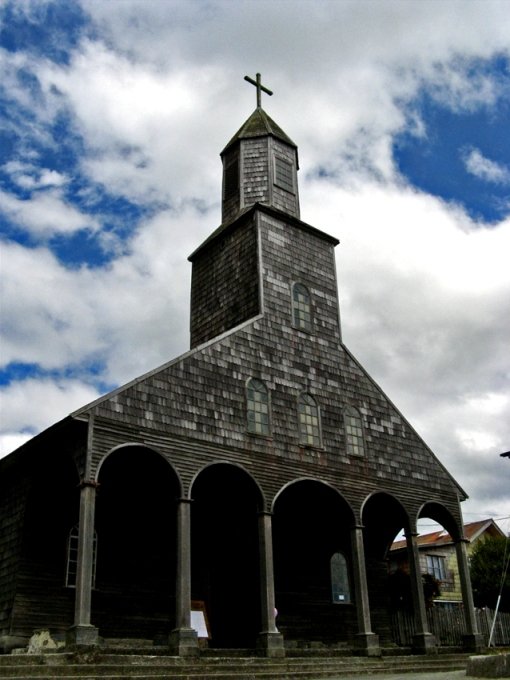
Sixteen extraordinary wooden churches of the Chiloé Archipelago built by Jesuit missionaries and indigenous Huilliche craftsmen using shipbuilding joinery and native timber, in a tradition of communal worship unlike anything else in the Americas.
At a glance
The Churches of Chiloé are sixteen surviving wooden churches scattered across the Chiloé Archipelago in southern Chile, about 1,000 km south of Santiago. Born from the encounter between European Catholic missionaries and indigenous Huilliche craftsmen in the late 17th century, they are unlike any other Catholic church in the Americas. UNESCO inscribed them in 2000, recognising both their architectural originality and the living communal maintenance tradition known as la minga de iglesia.
Key facts
- UNESCO inscription: 2000
- Inscribed churches: 16
- Oldest church: Achao (Quinchao Island, 1706)
- Materials: mañío, alerce, Chiloé cypress; no iron nails
- Technique: Shipbuilding joinery, mortice-and-tenon joints, wooden pegs
- Style: Chilote Gothic: projecting bell tower, open narthex porch, painted planks
- Tradition: La minga de iglesia: annual community repair gatherings
- Location: Isla Grande de Chiloé, Los Lagos, southern Chile
History
The Chiloé Archipelago was one of the last territories in South America settled by Spanish missionaries. The Jesuits arrived in the late 17th century and developed the misión circular: a small team of priests visiting each island community by boat once or twice a year. The local Huilliche people were not passive recipients — they became the builders and custodians of the churches, blending their knowledge of working wet Patagonian timber with the Catholic architectural programme the missionaries brought.
The Franciscans replaced the Jesuits after 1767 and continued building through the 19th century. The minga — the Huilliche practice of collective work — became the mechanism by which communities maintained their buildings across generations, a practice UNESCO expressly recognised in its inscription.
What you see
The characteristic Chilote Gothic form: a long timber nave preceded by a wide open narthex porch where islanders sheltered from rain. Above rises a projecting bell tower, typically octagonal, capped with a pointed spire. Exterior walls are clad in milled planks painted in vivid colours — yellow, cobalt blue, sea green, candy pink — derived from natural pigments. Inside: barrel-vaulted ceilings of pale timber, whitewashed walls, a gilded wooden altar. The entire structure is held by mortice-and-tenon joints and wooden pegs: no iron nails, no masonry foundations. The most architecturally complete church is San Francisco in Castro; the most atmospheric is Achao on Quinchao Island (1706), the oldest intact survivor.
Practical information
- Access: Most churches on Isla Grande de Chiloé, reachable by ferry from Puerto Montt or Pargua to Chacao. Smaller island churches require additional ferry crossings
- Opening hours: Vary by church; most open mornings; several Sunday Mass only. Check locally in Castro or Ancud
- Guided tours: Available from Castro and Ancud
- Best season: December-March (Austral summer); heavy rainfall year-round
- Clothing: Waterproof gear essential; rubber boots useful
- Admission: Most churches free
Getting there
Main gateway: Castro, connected by daily bus from Puerto Montt (3 hours via Chacao ferry). From Santiago: flights to Puerto Montt (1.5 hours). Island churches — Achao, Dalcahue, Chonchi, Tenaún — by local ferry (20 min to 1.5 hours from Castro or Dalcahue). A hired vehicle allows visiting 4-6 churches on Isla Grande in a single day.
Nearby
Castro palafitos (painted stilted houses on the tidal foreshore) share the same Chilote vernacular tradition. Chiloé National Park on the Pacific coast of Isla Grande protects temperate rainforest and nesting grounds of the black-necked swan. The archipelago ferry network connects to the Carretera Austral towards Patagonia.
Sources
- UNESCO World Heritage Centre — Churches of Chiloé (whc.unesco.org, 2000)
- Wikipedia — Churches of Chiloé (en.wikipedia.org)
- SERNATUR Chile — Chiloé Archipelago visitor information
Find it on the map
See this place and what’s around it →📷 Become a Cultural Heritage Online photographer
Share your photos of places: they stay published under your name as the author. The more they're seen, the more you get noticed — and soon a contest will reward the most appreciated photos.
Log in or sign up free to add a photo