
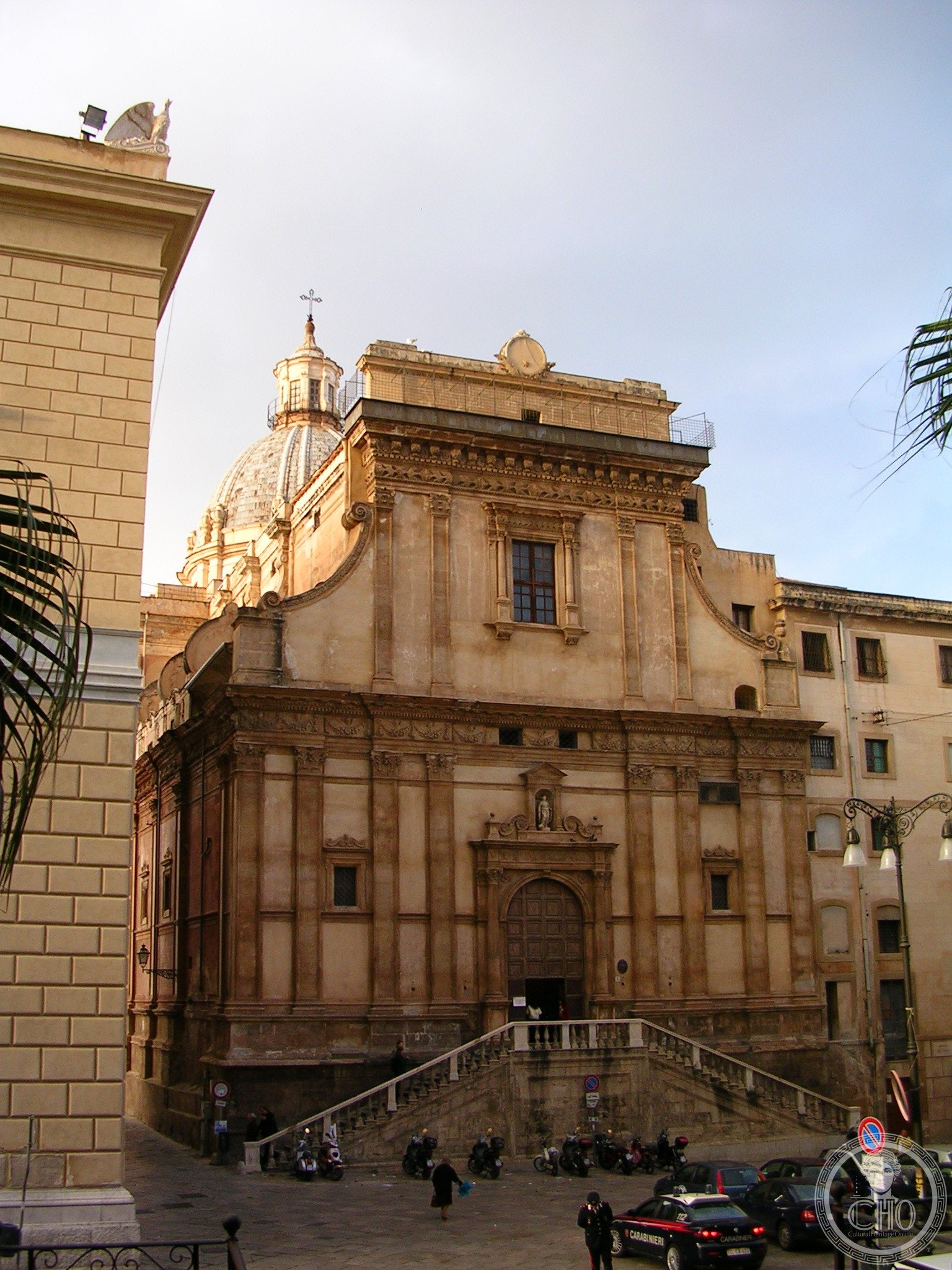
The Church of Saint Catherine of Alexandria (Santa Caterina d’Alessandria) is a Dominican conventual church in central Palermo, facing the Piazza Bellini alongside San Cataldo and Santa Maria dell’Ammiraglio. Founded by endowment in 1310, it was substantially rebuilt between 1566 and 1596, and is celebrated for a sober Renaissance exterior that conceals one of Palermo’s most lavish Baroque interiors: a single nave entirely clad in polychrome marble, gilded stucco, frescoes, and paintings by leading Sicilian Baroque masters.
At a glance
- Type
- Dominican conventual church
- Period
- Founded 1310; rebuilt 1566–1596; consecrated 1664; dome completed 1750
- Style
- Renaissance exterior; Baroque and Rococo interior
- Location
- Piazza Bellini, Palermo, Sicily, Italy
- Coordinates
- 38.1153° N, 13.3607° E
Overview
Santa Caterina d’Alessandria occupies a prime position on Piazza Bellini in Palermo’s historic Kalsa district, where it shares the square with two of the city’s finest Norman-era churches. The contrast between its austere Corinthian-pilastered facade and the dazzling interior — a compendium of polychrome marble, gilded stucco, and narrative frescoes — has made it one of Sicily’s most visited Baroque monuments since its reopening to the public in 2014. The adjacent cloister and the terrace over the transept roofline offer unusual views over central Palermo.
History
The Dominican convent was established in 1310 through an endowment by Benvenuta Mastrangelo, built on land that had belonged to the Norman admiral George of Antioch. Major reconstruction directed by architects Francesco Camilliani and Antonio Muttone ran from 1566 to 1596 under the supervision of Mother Prioress Maria del Carretto; the church was inaugurated on 24 November 1596 and formally consecrated on 16 March 1664. The dome was completed in 1750 by Francesco Ferrigno, and Vito D’Anna frescoed it by 1751. The church suffered damage during the uprisings of 1820–21, 1848, 1860, and 1866, and remained closed to the public for much of the twentieth century before restoration work enabled its reopening.
What you see
The single nave is flanked by six numbered chapels — three on each side — each containing significant artworks, including works attributed to followers of Jusepe de Ribera and a cycle on Saint Dominic. The main altar is inlaid with porphyry and lapis lazuli, and four statues of Dominican saints by Giovanni Battista Ragusa stand in the presbytery. A metal-grated choir above the narthex, used by cloistered nuns, survives intact, as do small sculptural portraits of venerated Dominican sisters including Agnes of Montepulciano and Catherine of Siena. A statue of Saint Catherine by Antonello Gagini — crowned, holding a palm and positioned beside a wheel — is among the church’s most admired individual works.
Cultural significance
Santa Caterina represents the apex of the Sicilian Baroque decorative tradition, concentrating within a single interior the skills of stuccatori, marmorists, fresco painters, and sculptors active in Palermo from the late sixteenth to mid-eighteenth century. Together with the Norman-era San Cataldo and the Martorana (Santa Maria dell’Ammiraglio) directly opposite, it anchors Piazza Bellini as one of the most concentrated ensembles of sacred architecture in the Mediterranean world.
Practical information
- Address
- Piazza Bellini, 90134 Palermo PA, Italy
- Hours
- Check official website; the church reopened to visitors in 2014 after restoration
Getting there
Piazza Bellini lies in the pedestrianised heart of Palermo’s historic centre, a five-minute walk from the Quattro Canti (intersection of Via Maqueda and Corso Vittorio Emanuele). The nearest train terminus is Palermo Centrale, approximately 15 minutes on foot or a short ride on lines 101, 102, or 107. Palermo Falcone–Borsellino Airport is 35 km west, connected by Prestia e Comandé bus or train to Palermo Centrale.
Sources & resources
See the place
Find it on the map
See this place and what’s around it →📷 Become a Cultural Heritage Online photographer
Share your photos of places: they stay published under your name as the author. The more they're seen, the more you get noticed — and soon a contest will reward the most appreciated photos.
Log in or sign up free to add a photoIs this page about you?
This page is read by travellers and heritage enthusiasts who find it on Google. Tell us how you are connected to this place and we will take it from there.