
Church of Gesù Nuovo
The Church of Gesù Nuovo is one of the most striking Baroque churches in Naples, distinguished by its extraordinary rusticated ashlar diamond-pointed facade — the only surviving element of the fifteenth-century Palazzo Sanseverino on whose site it was built. Constructed by the Jesuits between 1584 and 1601 to designs by Giuseppe Valeriano, the church faces the Piazza del Gesù Nuovo, one of the great public squares of the Neapolitan historic centre, alongside the Church of Santa Chiara and the Guglia dell’Immacolata. Inside, its richly decorated interior houses the chapel and tomb of San Giuseppe Moscati, the physician saint canonised in 1987.
At a glance
- Type
- Roman Catholic church, former Jesuit
- Period
- Built 1584–1601; facade from the 1470 Palazzo Sanseverino
- Style
- Neapolitan Baroque interior; Renaissance diamond-rusticated facade
- Location
- Piazza del Gesù Nuovo, historic centre of Naples, Campania, Italy
- Coordinates
- 40.8474° N, 14.2498° E
- Architects
- Giuseppe Valeriano (Jesuit architect), with later Baroque interventions
- Address
- Piazza del Gesù Nuovo, 80134 Napoli NA
Overview
The Church of Gesù Nuovo is named for the “New Jesus” — distinguishing it from the earlier Gesù Vecchio church already present in the city when the Jesuits acquired this site. It stands on the piazza of the same name, surrounded by monuments that together form one of the grandest Baroque ensembles in southern Italy: the Gothic-Baroque Church of Santa Chiara with its cloister of majolica-clad pillars, and the soaring marble Guglia dell’Immacolata obelisk erected in 1750. The Gesù Nuovo church itself is remarkable for the unique visual paradox of its exterior — the rough geometric fury of diamond-cut stone masonry framing a sumptuous Baroque interior world.
History
The site was originally occupied by the palace of Roberto Sanseverino, Prince of Salerno, built around 1470. Political misfortune led to the Sanseverino property being confiscated by the Spanish Crown following a failed baronial revolt, and in the 1580s it was sold to the Society of Jesus for 45,000 ducats. The Jesuits, already present in Naples at the nearby Gesù Vecchio, commissioned the architect Giuseppe Valeriano to transform the palace into a great church, retaining the spectacular rusticated facade. Construction ran from 1584 to 1601, with interior decoration continuing for most of the seventeenth century. When the Jesuits were expelled from Naples in 1767 by King Ferdinand IV, the church passed to secular clergy and later to the Frati Minori Conventuali, who administer it today. A devastating earthquake in 1688 and further Baroque renovation campaigns added most of the interior’s current painted decoration.
What you see
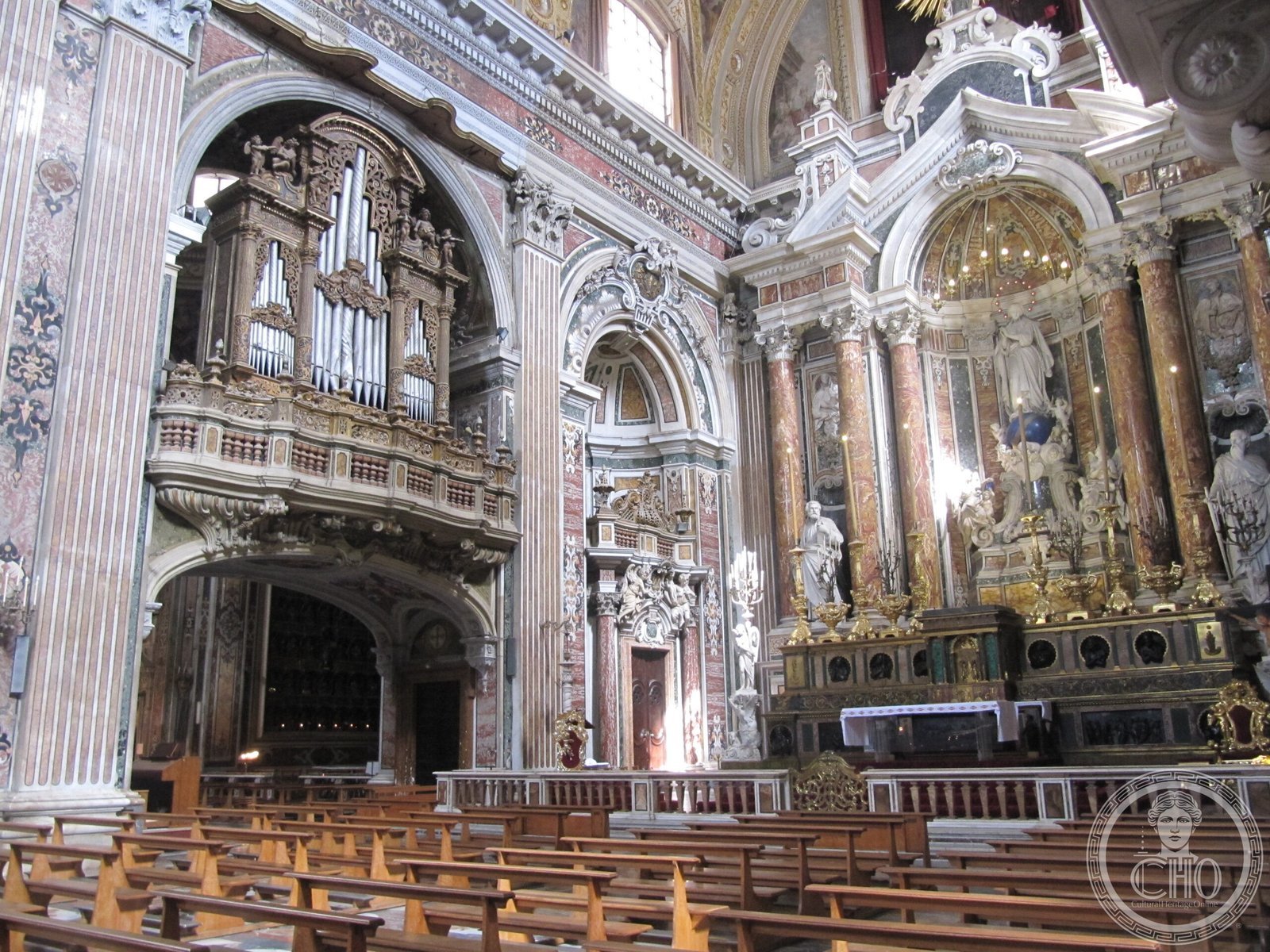
The facade — the church’s most iconic feature — is covered entirely in diamond-pointed rusticated stone blocks of grey piperno, a volcanic tuff quarried near Naples, creating a bristling geometric texture unique among European church exteriors. This decorative motif, derived from the Palazzo dei Diamanti in Ferrara, was never intended for a religious building; its reuse here gives the church an uncanny visual presence unlike any other. The interior is a dazzling counterpoint: a Greek-cross plan lavishly frescoed by Luca Giordano, Francesco Solimena, and other leading Neapolitan Baroque masters, with polychrome marble inlay covering the pilasters and altars. The chapel of San Giuseppe Moscati, the twentieth-century physician-saint who worked in Naples and was canonised in 1987, is a major devotional focus and contains a bronze statue and relics venerated by thousands of visitors each year.
Cultural significance
The Gesù Nuovo is a cornerstone of the UNESCO World Heritage Site encompassing the historic centre of Naples, inscribed in 1995. Its diamond-rusticated facade is one of the most reproduced images of Neapolitan architecture, recognised internationally as a symbol of the city’s eccentric and inventive relationship with architectural heritage. The church also plays an important living role in Neapolitan religious culture through the cult of San Giuseppe Moscati, making it simultaneously a monument of European art history and an active centre of popular Catholic devotion.
Practical information
- Address
- Piazza del Gesù Nuovo, 80134 Napoli NA, Italy
- Opening hours
- Generally open daily; check the church’s official contacts for exact times
- Admission
- Free entry
- Note
- The church is an active place of worship; respectful dress code required
Getting there
The Piazza del Gesù Nuovo lies in the heart of the UNESCO historic centre of Naples, easily walkable from the Metro Line 1 station Dante (approximately 5 minutes). From Naples Centrale (Piazza Garibaldi), take Metro Line 1 towards Piscinola and alight at Dante. Buses along the via Toledo axis also stop within walking distance. The square is pedestrianised and the church is immediately visible from its distinctive facade as you approach from any direction through the centro storico.
Sources & resources
- Gesù Nuovo historical overview — Wikipedia: Gesù Nuovo
- UNESCO Naples Historic Centre — UNESCO World Heritage entry 726
- Cultural Heritage Online — culturalheritageonline.com
Find it on the map
See this place and what’s around it →Historical events at this place (2)
📷 Diventa un fotografo di Cultural Heritage Online
Condividi le tue foto dei luoghi: restano pubblicate con la tua firma come autore. Più vengono viste, più ti fai conoscere — e presto un concorso premierà le foto più apprezzate.
Accedi o registrati gratis per aggiungere una foto