
_004.jpg)
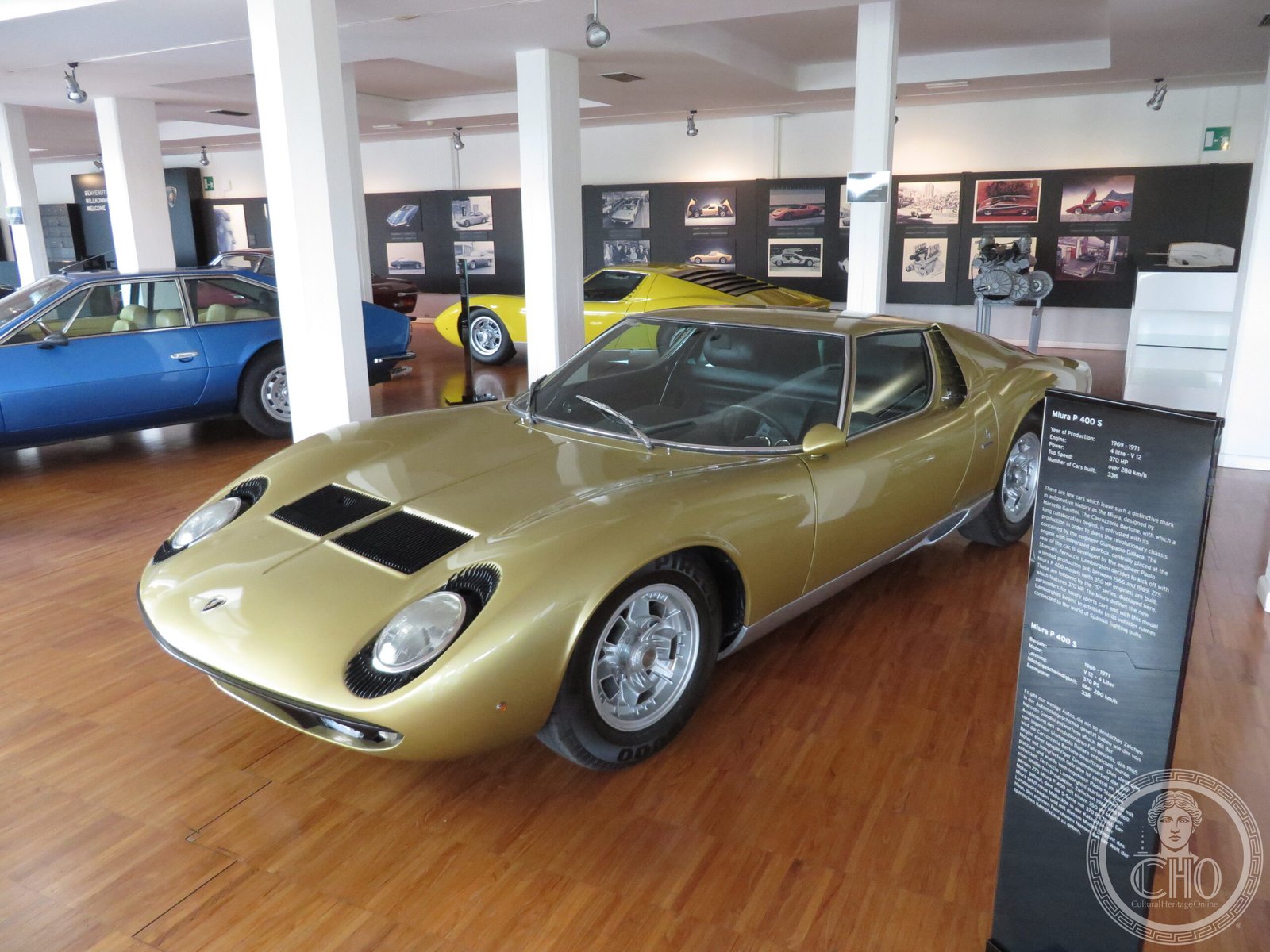
At the factory in the Po plain where Ferruccio Lamborghini built his first V12 in 1963, MUDETEC holds the complete line of Lamborghini supercars from the 350 GT to the present — including the Miura that redefined what a road car could be and the Countach that made a poster of it.
At a glance
MUDETEC — Museo Lamborghini opened its current form in 2019, extending and renaming the original museum that had operated at the Sant'Agata Bolognese factory since 2001. The 2,000-square-metre expansion added a dedicated technology area alongside the historic vehicle collection, tracing Lamborghini's evolution from a tractor manufacturer's vanity project into a supercar brand under Volkswagen Group ownership. The museum integrates with the factory: visitors to the adjacent Sant'Agata plant see production of the Huracan and Urus in a facility that has occupied the same Po plain site since Ferruccio Lamborghini chose it in 1963 for its flat land and proximity to the suppliers of the Emilian industrial district.
Key facts
- Opened: 2001 (original museum); renamed MUDETEC and expanded 2019
- Exhibition area: 2,000 m² (new building, 2019)
- Address: Via Modena 12, 40011 Sant'Agata Bolognese (BO)
- GPS: 44.6591, 11.1258
- Key exhibits: Lamborghini 350 GT (1963), Miura (1966), Countach (1974), Diablo, Murciélago, Aventador, Huracan
- Website: lamborghini.com/mudetec
- Renovated: June 2016, for the fiftieth anniversary of the Miura
History
Ferruccio Lamborghini was a tractor manufacturer from Renazzo di Cento who became one of Italy's wealthiest industrialists in the 1950s by supplying mechanised agriculture to the post-war land reform. The founding story of Automobili Lamborghini — that Ferruccio complained to Enzo Ferrari about the clutch on his 250 GT and was told to go back to his tractors — is probably legend, but the competitive dynamic it names is genuine: Lamborghini intended, from the start, to make a road car that was better than a Ferrari.
The 350 GT, introduced at the Geneva Motor Show in 1964 with a V12 engine designed by Giotto Bizzarrini (who had been dismissed from Ferrari in 1961 during the “Palace Revolution” that also expelled many of Ferrari's best engineers), met that ambition. The Miura of 1966 — with its mid-mounted transverse V12 designed by Gian Paolo Dallara — exceeded it: the car was faster, more radical, and more beautiful than anything Ferrari was then making. Bertone's Marcello Gandini designed the body; the Miura became the template for every mid-engine supercar that followed.
Lamborghini sold the company in 1972 following the financial crisis triggered by the Bolivian agricultural crash (Ferruccio's tractors were the country's main agricultural machinery). The brand passed through several owners — Chrysler, an Indonesian investment group — before Audi (VW Group) acquired it in 1998. Under VW Group ownership Lamborghini expanded significantly, adding the Urus SUV in 2017 (the company's best-selling model) while maintaining the Sant'Agata factory as its sole production site.
What you see
The MUDETEC building is a purpose-built museum structure integrated into the factory campus: a contemporary industrial shed with a controlled climate and lighting system designed for vehicle display, replacing the older showroom-style exhibition that predated the 2019 expansion. The collection is organised around both chronology and technology — the historic cars sit alongside their engines, gearboxes, and chassis drawings, creating a context that automotive museums without factory access cannot replicate.
The technology section introduced in 2019 focuses on Lamborghini's carbon fibre expertise (the company's Advanced Composite Structures Laboratory developed the carbon monocoque for the Aventador and produces components for aerospace clients) and the hybrid systems being introduced in the successor models. The juxtaposition of the Miura (1966) — essentially a handmade racing car for the road — and the Urus hybrid testbed illustrates the technological distance of 60 years without breaking the formal thread of the V12 engine that has run through every pure Lamborghini since the first.
Practical information
- Opening hours: Check lamborghini.com/mudetec for booking (factory tours typically Monday–Friday)
- Admission: Combined museum + factory tour; advance booking required
- Time needed: 1.5–2.5 hours (museum alone); 3–4 hours with factory tour
- Highlights: Miura P400 (1966), Countach LP400 (1974), Espada, Diablo GT, Murciélago LP640, Aventador SVJ
Getting there
Sant'Agata Bolognese is 30 km north-west of Bologna. By car: A14 autostrada toward Milan, exit Altedo / Bentivoglio, then SP568 toward Sant'Agata. Public transport is limited; most visitors combine the Lamborghini museum with the nearby Ducati (35 km east) or Ferrari (50 km south) in a day route from Bologna. A private shuttle from Bologna is available on request from Lamborghini for organised groups.
Nearby
- Museo Ducati, Bologna — 35 km east, motorcycle heritage at the Borgo Panigale factory
- Galleria Ferrari, Maranello — 50 km south, Ferrari museum in the factory town
- Museo Ferrari, Modena — 30 km south, birthplace of Enzo Ferrari
- Ferrara — 45 km north-east, UNESCO Renaissance city, Salone del Restauro venue
Sources
- Wikipedia (English): Lamborghini museum
- Lamborghini official: lamborghini.com/mudetec
- Wikipedia (Italian): Ferruccio Lamborghini
- Wikimedia Commons: File:Museo Lamborghini (Sant’Agata Bolognese) 004.jpg, CC BY-SA 4.0
- Nominatim / OpenStreetMap: GPS 44.6591, 11.1258
Find it on the map
See this place and what’s around it →📷 Become a Cultural Heritage Online photographer
Share your photos of places: they stay published under your name as the author. The more they're seen, the more you get noticed — and soon a contest will reward the most appreciated photos.
Log in or sign up free to add a photoIs this page about you?
This page is read by travellers and heritage enthusiasts who find it on Google. Tell us how you are connected to this place and we will take it from there.