
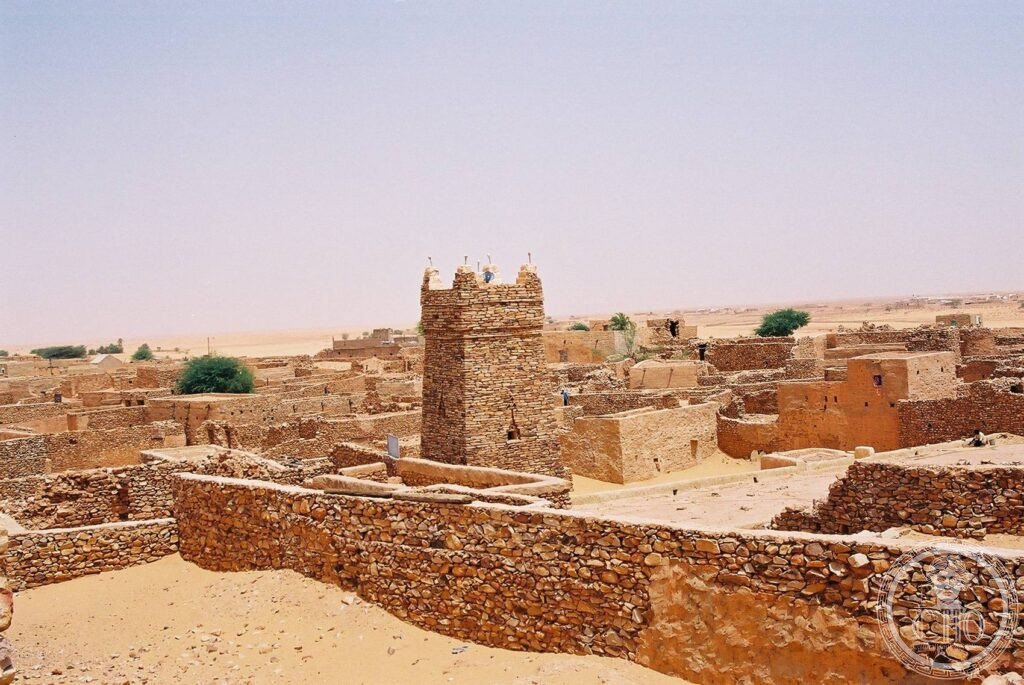
In the heart of the Mauritanian Sahara, Chinguetti was once the great gathering point for West African pilgrims setting out for Mecca, and Sufi tradition still ranks it as the seventh holiest city in Islam. Its mud-brick mosque, its scattered manuscript libraries and its sand-choked old town survive together, though the desert is slowly burying them.
At a glance
Chinguetti grew up in the 13th century as a caravan city on the edge of the Sahara, at the point where trade routes from the Mediterranean met the road east to Mecca. It became known as the gateway to Mecca for West Africa, and Sufi tradition counts it among the holiest cities of Islam, ranked seventh after Mecca, Medina, Jerusalem, Hebron and Cairo.
The town’s five private libraries still hold a large body of Islamic manuscripts, kept by the descendants of the scholars who copied and collected them. The collections cover Quranic commentary, astronomy, medicine, law, history and poetry, some dating back to the 13th century.
Key facts
- Friday Mosque: a square mud-brick minaret, rebuilt several times over the centuries, with ostrich eggs set into each corner of its five levels, a Saharan symbol of the divine that also acts as a lightning conductor.
- Heritage status: inscribed as a UNESCO World Heritage Site in 1996, together with the other ancient caravan cities of Ouadane, Tichitt and Oualata; all four were placed on the UNESCO Danger List in 2007 because of the advancing desert.
- Manuscript libraries: five family-run collections, including the Bibliothèque Habrott, the Bibliothèque de l’Habott and the Bibliothèque Mohamed Mahmoud, holding several thousand Islamic manuscripts.
- Trade routes: Chinguetti stood where the north-south route linking Morocco and Spain to sub-Saharan Africa, carrying gold, slaves and ivory north and salt, cloth and dates south, crossed the east-west pilgrim road to Mecca.
- Coordinates: 20.4627° N, 12.3720° W.
History
The region around Chinguetti is linked to the Almoravid dynasty, the Islamic reform movement of Sanhaja Berbers that went on to conquer Morocco and southern Spain and to build Marrakesh. The movement’s original religious retreat, a ribat, stood in this part of the Mauritanian Sahara, placing Chinguetti within the Almoravids’ historic homeland.
Mauritania came under French colonial rule from 1900, established by the officer Xavier Coppolani, who was assassinated in 1905. French administrators and scholars who followed were the first to bring Chinguetti’s manuscripts to wider Western attention. Mauritania became independent in 1960.
What you see
The Vieux Ksar, the old medieval quarter, is now partly abandoned as sand has buried its lower streets and doorways; in places it reaches to the first floor of the houses. The surviving architecture, built in mud brick with wooden shutters and carved doors, and streets laid out to channel cooling breezes, gives a clear picture of a traditional Saharan town.
Chinguetti sits in one of the most remote inhabited stretches of the Sahara, with little light pollution and consequently very dark night skies. The town’s medieval manuscripts include astronomical tables, suggesting its reputation for clear desert nights goes back centuries.
Practical information
- Access to the mosque: modest dress is expected and a donation is customary; check current arrangements with the local authorities before visiting.
- Manuscript libraries: visits must be arranged in advance with the guardian families, usually through a local guide.
- Time on site: a visit typically covers the old city and mosque on one day and an excursion into the surrounding dunes on another; plan with a local guide or agency.
Getting there
The nearest airport is at Atar, from where onward travel to Chinguetti is by 4×4 along a dirt track; a two-wheel-drive vehicle can sometimes manage the route in the dry season but this is unreliable. Most visitors arrange a 4×4 with driver in Atar or through a travel agency in Nouakchott. The drive between Atar and Chinguetti crosses sandstone plateaux and passes ancient ksar ruins.
Nearby
- Ouadane — to the northeast by 4×4 piste; a UNESCO World Heritage caravan city founded in the 12th century, its old town largely abandoned but architecturally more intact than Chinguetti’s, with the ruins of a great mosque and merchant houses set dramatically on a cliff above a valley.
- Atar — to the southwest by 4×4; the main town of the Adrar region, with a lively weekly market and the usual base for expeditions to Chinguetti, Ouadane and the Adrar Plateau, known for prehistoric rock art and desert canyons.
Sources
- Wikipedia
- UNESCO World Heritage Centre
Find it on the map
See this place and what’s around it →📷 Become a Cultural Heritage Online photographer
Share your photos of places: they stay published under your name as the author. The more they're seen, the more you get noticed — and soon a contest will reward the most appreciated photos.
Log in or sign up free to add a photo