
A City of a Hundred Churches
Pskov, one of the oldest cities in Russia, sits at the confluence of the Pskov and Velikaya rivers in the northwestern corner of the country, barely 30 kilometres from the Estonian border. In the Middle Ages it was a powerful independent republic and a key trading city of the Hanseatic network. Over five centuries — from the 12th to the 17th — Pskov's master builders developed a highly distinctive local tradition of church architecture that UNESCO recognised in 2019 by inscribing ten representative examples as a World Heritage property. These churches, white and compact against the Russian sky, represent one of the most coherent regional architectural schools in the Orthodox world.
Origins of the Pskov Style
Pskov architecture evolved from Byzantine and early Novgorodian traditions but quickly departed from them, driven by local building materials (local limestone rather than brick), the practical needs of a prosperous merchant city, and the aesthetic preferences of a fiercely independent civic culture. By the 13th century a distinctly Pskovian vocabulary had emerged: massively thick white-washed limestone walls, small windows splayed deeply into the masonry, single-nave interiors of austere power, and the idiosyncratic asymmetric bell towers — often detached or abutted at an angle — that give Pskov's skyline its unmistakable silhouette.
The Ten Inscribed Churches
The ten monuments inscribed by UNESCO span the city and its immediate surroundings, collectively illustrating the development of the Pskov school from its formative period to its mature expression. They include the Cathedral of the Nativity of the Virgin at Snetogorsky Monastery (1310s, with exceptional fresco cycles), the Church of the Dormition at Paromenya (15th century), the ensemble of the Mirozhsky Monastery with its unique 12th-century Byzantine-influenced frescoes, and the Church of the Epiphany with Bell Tower on Zapskovye (17th century). Together they read as chapters in a continuous architectural narrative.
Mirozhsky Monastery and Its Byzantine Frescoes
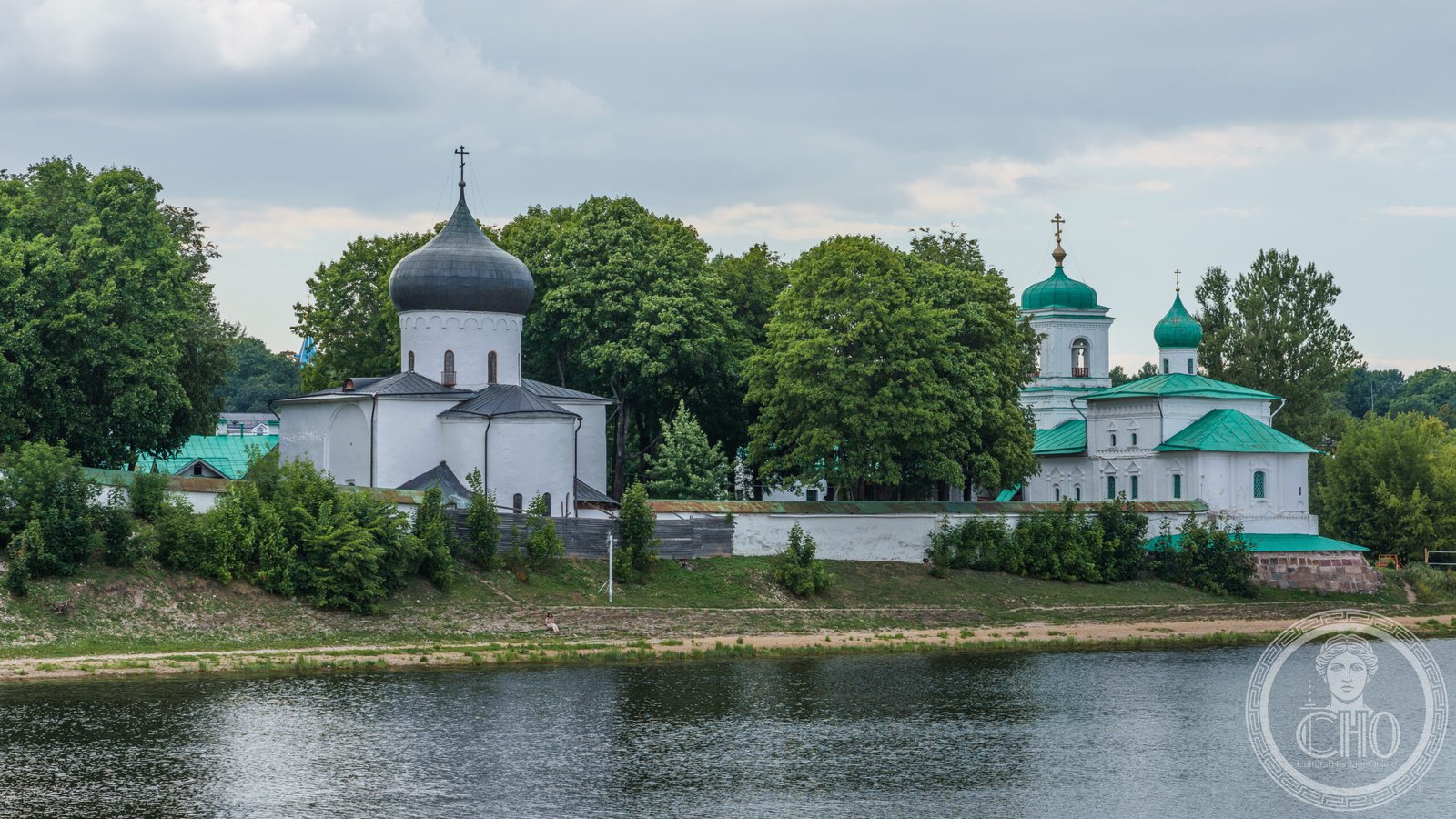
The Saviour-Transfiguration Cathedral of the Mirozhsky Monastery, founded in the 1130s, contains the most complete ensemble of 12th-century Byzantine frescoes in Russia — approximately 80 percent of the original painted surface survives intact. Executed by Greek masters brought from Constantinople, the frescoes cover walls, vaults, and the drum of the dome with a comprehensive Christological programme of exceptional quality. Their survival through seven centuries of Russian history — including the Livonian War, the Time of Troubles, and two World Wars — is remarkable.
Architectural Features: Reading a Pskov Church
A Pskov church rewards close looking. The walls are built in random-coursed limestone rubble, plastered and lime-washed to a gleaming white that contrasts with the grey Russian sky. Facades are articulated by blind arcading or simple pilaster strips, but decoration is deliberately restrained — the Pskov ideal was architectural purity rather than sculptural exuberance. Apse semi-circles cluster at the east end; the drum supporting the dome is often octagonal, a Pskov signature; and the covered porch (priter, or trapeznaya) that extends the west façade was added to most churches in the 15th–17th centuries to accommodate growing congregations.
Influence on Russian Architecture
When Moscow began its rapid architectural expansion under Ivan III in the late 15th century, Pskovian master builders were among the craftsmen summoned to the Kremlin. Their contribution is traceable in the Cathedral of the Annunciation within the Moscow Kremlin and in several other early Moscow churches, making the Pskov school a formative influence on the development of Russian national architecture at its most politically significant moment. The Pskov style's legacy extended to Novgorod, Tver, and beyond, carrying its distinctive aesthetic logic into a wider tradition.
Conservation History and Condition
The monuments of the Pskov school have experienced a complicated conservation history. Soviet-era restorations in the 1950s–1970s followed the then-dominant methodology of stripping later accretions to reveal the “original” medieval fabric — a process that sometimes destroyed significant post-medieval additions of historical value. More recent conservation work under Russian federal programmes and with UNESCO technical guidance has been more sensitive, prioritising consolidation, fresco stabilisation, and reversible interventions. All ten inscribed monuments remain in active religious use as Orthodox churches, which both motivates their maintenance and creates challenges for the controlled management of visitor access.
Visiting Pskov
Pskov is reached by overnight train from Moscow (approximately 13 hours) or by a shorter train or bus journey from Saint Petersburg (3–4 hours). The city's compact historic centre allows most inscribed monuments to be visited on foot or by bicycle in two days. The Mirozhsky Monastery and the Pskov Kremlin (Krom) are the essential starting points; the outlying monasteries of Snetogorsky and Elizarova require a short taxi or bus journey. Pskov receives relatively few international tourists, which gives it an authenticity and accessibility that more celebrated Russian heritage cities have largely lost.
Find it on the map
See this place and what’s around it →📷 Become a Cultural Heritage Online photographer
Share your photos of places: they stay published under your name as the author. The more they're seen, the more you get noticed — and soon a contest will reward the most appreciated photos.
Log in or sign up free to add a photoIs this page about you?
This page is read by travellers and heritage enthusiasts who find it on Google. Tell us how you are connected to this place and we will take it from there.