
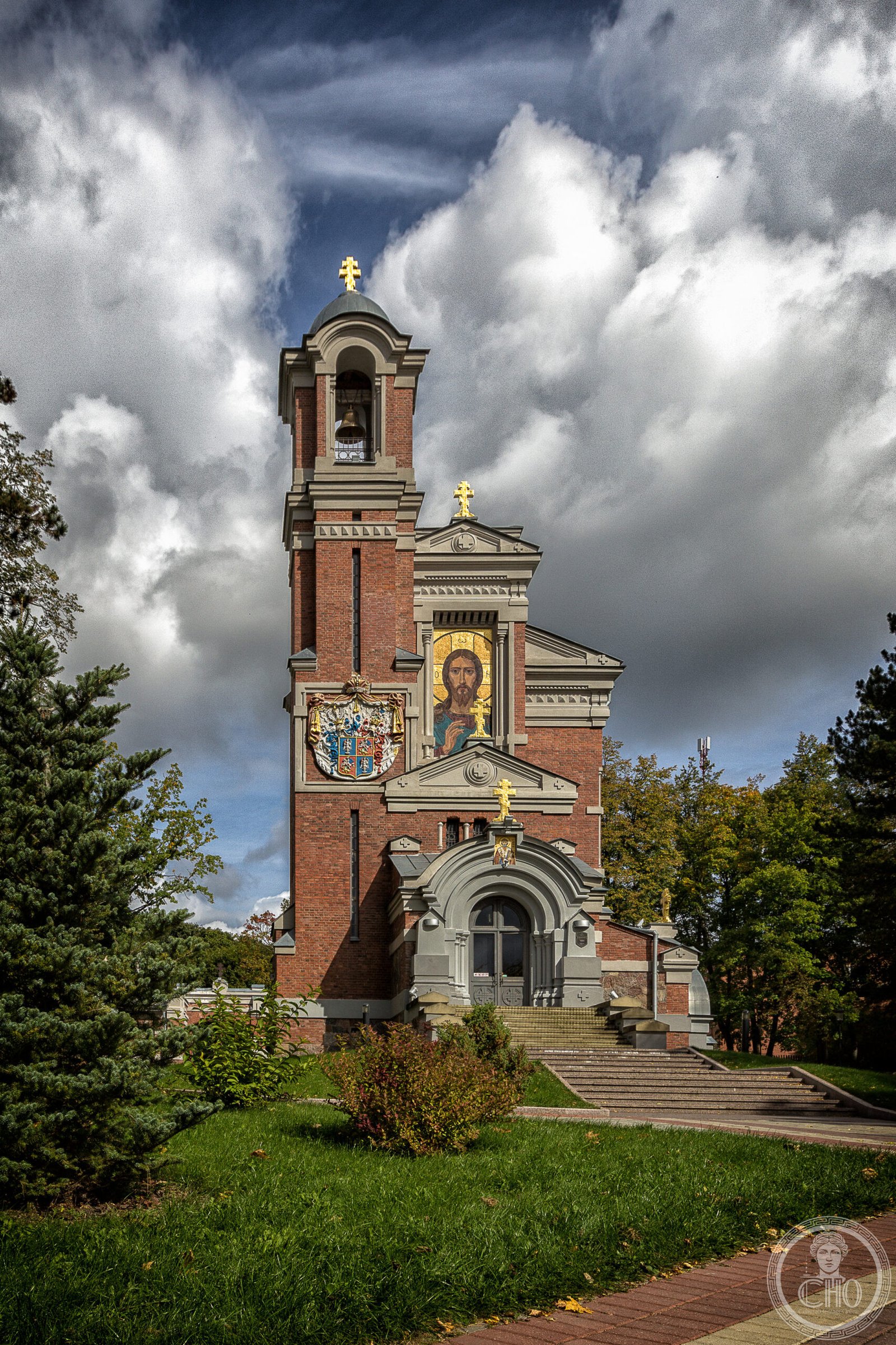
An Art Nouveau family chapel and tomb near Mir Castle, designed by Robert Marfeld and housing six members of the prominent Svyatopolk-Mirsky family in its crypt.
At a glance
Built between 1904 and 1910, this chapel-tomb combines European Art Nouveau with Orthodox sacred purpose. Its bold asymmetrical design and soaring bell tower dominate the English-style park surrounding Mir Castle. A large mosaic depicting Christ Pantocrator—itself recognized by Belarus as a historical and cultural treasure—commands the chapel’s eastern facade.
History
The chapel was constructed at the behest of Cleopatra Svyatopolk-Mirskaya, following designs by architect Robert Marfeld. Consecrated in honor of Nicholas the Wonderworker, it became the burial place for six family members. During the Second Polish Republic, Prince Mikhail Svyatopolk-Mirsky enriched the surrounding park with rare conifers and roses.
Soviet occupation brought looting; religious objects were removed to a nearby church. The chapel later served as grain storage for a distillery, falling into decay. Restoration began in 2004 and was completed by December 1, 2008. Services resumed in 2014 with a memorial service and Divine Liturgy.
What you see
The chapel exemplifies Art Nouveau in its dynamically asymmetrical composition—innovative for its era. The plan comprises a narthex, chapel hall, and apse, topped by a tall bell tower that serves as the structure’s dominant visual feature. The exterior is plastically and coloristically rich, adorned with the Svyatopolk-Mirsky family cartouche.
The monumental mosaic panel of Christ Pantocrator forms the chapel’s visual heart. Inside, two levels—crypt and service hall—serve both burial and liturgical functions, while the chapel itself acts as a minor architectural accent within Mirsky Park’s broader composition.
Cultural significance
The chapel is integral to the Mir Castle and Park Complex, a UNESCO World Heritage site inscribed in 2000. The Christ Pantocrator mosaic panel is separately listed in the State List of Historical and Cultural Values of the Republic of Belarus, affirming its status as a national treasure.
Key facts
- Country: Belarus
- City: Mir, Karelichy District, Grodno Region
- Coordinates: 53.2705°N, 26.2831°E
- Architect: Robert Marfeld
- Construction: 1904–1910
- Style: Art Nouveau
- UNESCO status: Part of Mir Castle and Park Complex (World Heritage List, 2000)
Practical information & getting there
The chapel reopened to visitors on December 1, 2008, following comprehensive restoration. It is located in the urban settlement of Mir within an English-style park established at the turn of the 20th century. The chapel functions as both a monument and an active place of worship. For current visiting hours and access arrangements, contact local heritage authorities.
Sources & resources
Find it on the map
See this place and what’s around it →📷 Become a Cultural Heritage Online photographer
Share your photos of places: they stay published under your name as the author. The more they're seen, the more you get noticed — and soon a contest will reward the most appreciated photos.
Log in or sign up free to add a photoIs this page about you?
This page is read by travellers and heritage enthusiasts who find it on Google. Tell us how you are connected to this place and we will take it from there.