
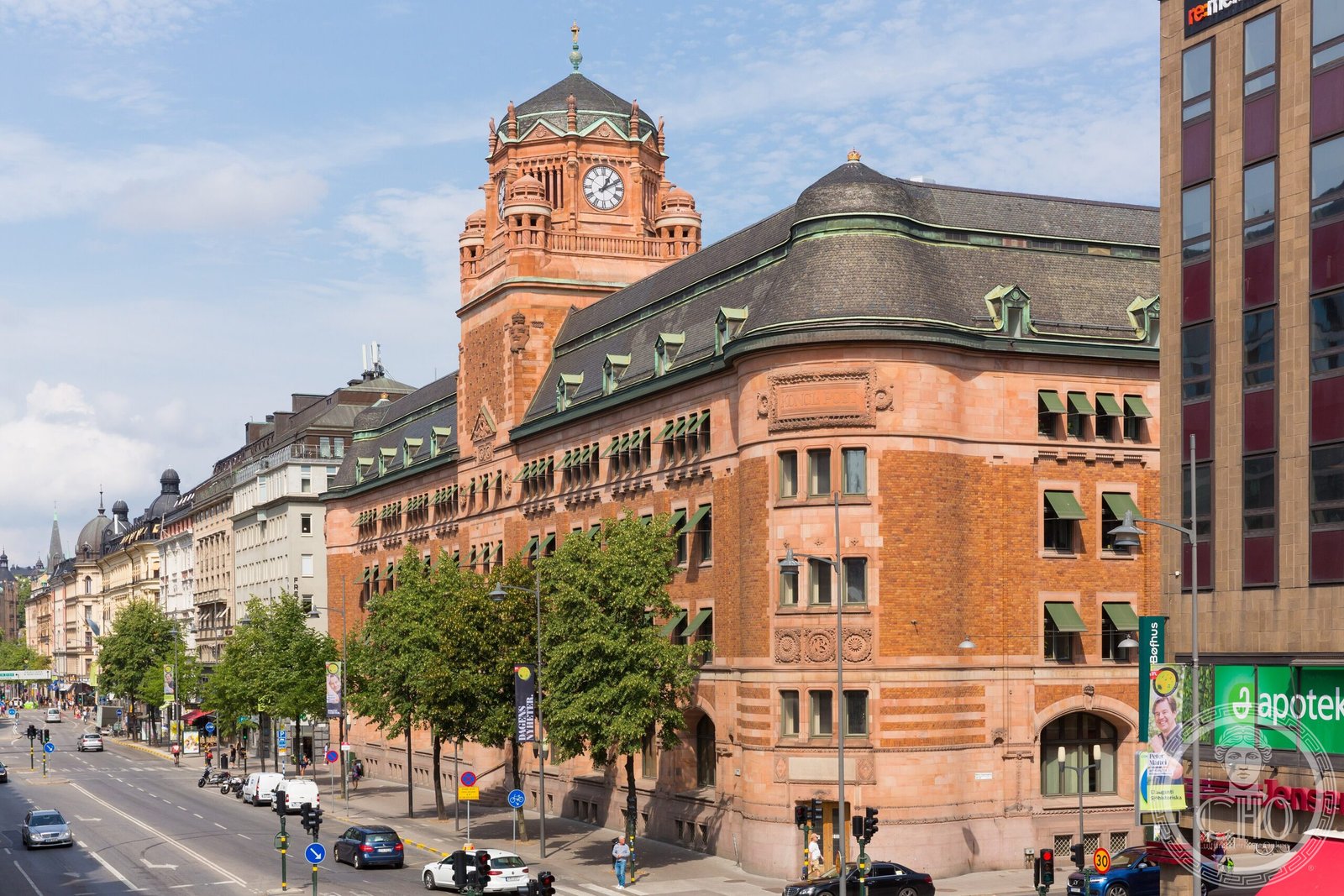
A landmark of early 20th-century Swedish architecture, this monumental office building anchors central Stockholm with the prestige and solidity of the postal age.
At a glance
Completed in 1903 and designed by Ferdinand Boberg, the Central Post Office Building stands at 28–34 Vasagatan in the heart of Stockholm. For a century, it served as the nerve centre of Sweden’s national postal service before being repurposed as government offices.
History
The building was inaugurated in 1903 as the headquarters of Posten, Sweden’s postal service. It held this role for exactly one hundred years, until 2003, when postal operations relocated. In April 2008, an extensive rebuild transformed the interior, and the building reopened as office space for the Ministry of Enterprise and functions of the Government Offices.
What you see
Ferdinand Boberg (1860–1945), one of Sweden’s leading architects of the period, designed a building that conveys institutional importance through scale and material presence. The structure occupies a commanding streetfront position on Vasagatan, one of Stockholm’s principal thoroughfares.
Cultural significance
The building exemplifies the architectural confidence of Sweden’s industrial era, when infrastructure—especially postal networks—defined national identity. Its longevity as a working administrative centre underscores the durability of Boberg’s design and the continuity of Swedish governance.
Key facts
- Location: 28–34 Vasagatan, Stockholm, Sweden
- Completed: 1903
- Architect: Ferdinand Boberg (1860–1945)
- Coordinates: 59.3323, 18.0582
- Current use: Ministry of Enterprise and Government Offices
Practical information & getting there
The building is located on Vasagatan in central Stockholm and remains an active government office. Exterior viewing is always possible from the street; interior access depends on official business and current government protocols.
Sources & resources
Find it on the map
See this place and what’s around it →📷 Become a Cultural Heritage Online photographer
Share your photos of places: they stay published under your name as the author. The more they're seen, the more you get noticed — and soon a contest will reward the most appreciated photos.
Log in or sign up free to add a photoIs this page about you?
This page is read by travellers and heritage enthusiasts who find it on Google. Tell us how you are connected to this place and we will take it from there.