
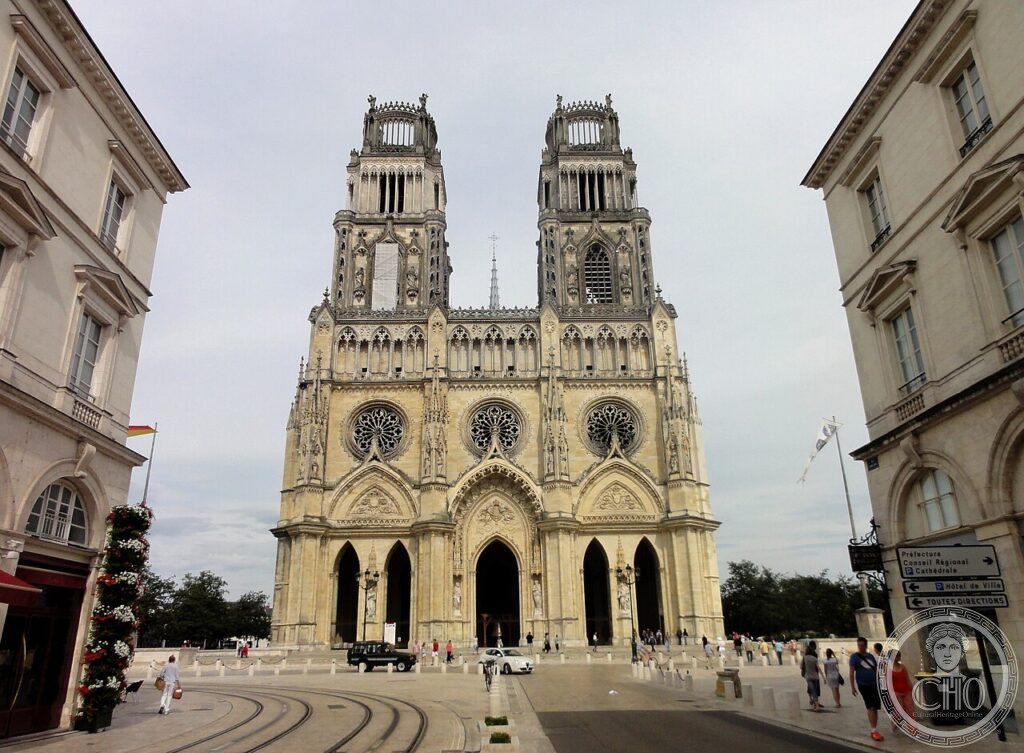
On the night of 23–24 February 1568, a band of Huguenots blew up the four piers of the transept crossing. Thirty-three years later Henry IV and Marie de’ Medici laid the first stone of the rebuilding — completed only in 1829, exactly four centuries after Joan of Arc had come here to pray, having freed the city.
At a glance
Orléans Cathedral (Cathédrale Sainte-Croix) carries a direct historical connection to Joan of Arc: on 8 May 1429, after defeating the besieging English forces and lifting the Siege of Orléans, she came to pray in the cathedral, an episode still central to the building’s identity today, commemorated in a 19th-century series of ten stained-glass windows depicting key moments of her life. The cathedral’s physical fabric, however, was largely destroyed within living memory of that visit’s importance to French national memory: during the Wars of Religion, a small group of Huguenot militants broke into the cathedral on the night of 23-24 February 1568 and blew up the four crossing pillars supporting the transept, causing extensive structural collapse. Reconstruction did not begin until 1601, when King Henri IV and Marie de Médicis laid the first stone, and work continued in phases through to the French Revolution and beyond, with the building only formally inaugurated by King Charles X on 8 May 1829 — deliberately chosen as the 400th anniversary of Joan of Arc’s lifting of the siege.
Key facts
- Joan of Arc, 8 May 1429: after lifting the Siege of Orléans, Joan of Arc came to pray in the cathedral — an episode central to the building’s identity, commemorated in a 19th-century cycle of ten stained-glass windows
- 1568 destruction: Huguenot militants blew up the four crossing pillars of the transept on the night of 23-24 February 1568, causing extensive structural collapse during the Wars of Religion
- Reconstruction: begun 1601 under Henri IV and Marie de Médicis; continued through the north and south transepts, west portal, and the two towers (replacing the earlier Romanesque facade) up to the French Revolution
- Completion: formally inaugurated 8 May 1829 by Charles X — the 400th anniversary of the lifting of the Siege of Orléans by Joan of Arc
- Towers: visitors can climb 241 steps across the two towers for a 360-degree view over Orléans and the Loire, bookable through the tourist office
History
The gap between Orléans Cathedral’s 1568 destruction and the start of its reconstruction in 1601 — some thirty-three years — reflects the broader disruption the French Wars of Religion (1562-1598) inflicted on ecclesiastical building projects across the country. Major rebuilding only became practically and politically feasible once Henri IV’s Edict of Nantes (1598) had brought a measure of stability to the religious conflict. Henri IV’s own personal involvement in laying the cathedral’s first reconstruction stone in 1601, alongside his wife Marie de Médicis, carried clear symbolic weight for a king who had himself converted from Protestantism to Catholicism to secure the French throne. It made Orléans Cathedral’s rebuilding a visible statement of restored royal and Catholic authority in the aftermath of the wars.
The building’s remarkably long completion timeline — construction continuing in phases from 1601 through the French Revolution and into the early 19th century, with formal inauguration only in 1829 — meant the project outlasted not only Henri IV himself (assassinated in 1610) but the entire Ancien Régime, surviving the Revolution’s frequently hostile treatment of religious buildings to reach completion under the restored Bourbon monarchy. Charles X’s deliberate choice of 8 May 1829 for the inauguration, precisely 400 years after Joan of Arc’s prayer in the earlier cathedral following the siege’s lifting, made an explicit and calculated link between the newly completed building and the specific historical episode that had already made Orléans nationally significant — a connection reinforced later in the 19th century by the addition of the ten-window Joan of Arc stained-glass cycle, which gives the completed cathedral a decorative programme directly tied to the city’s most famous historical moment.
What you see
The west facade and twin towers, built as part of the post-1601 reconstruction to replace the destroyed Romanesque original, present a Gothic Revival architectural character reflecting the building’s unusual position as a Gothic-style structure substantially built across the 17th to 19th centuries rather than in the medieval period the style originally belongs to. The ten-window Joan of Arc stained-glass cycle, a 19th-century addition, narrates the key episodes of her life and campaign in vivid colour, giving visitors a dedicated visual account of the historical connection underlying the cathedral’s identity. The towers, reached by 241 steps, offer a 360-degree panorama over Orléans and the Loire river for visitors booking the climb through the tourist office.
Practical information
- Opening hours: November-March 9:00-18:00; April-October 9:00-19:00; free admission
- Free guided tours: every Wednesday (outside school holidays), 12:20, 20 minutes, departing from the Accueil-boutique
- Tower climb: 241 steps, 360-degree view, €9 per person, booking required via Orléans tourist office (tel. 02 38 24 05 05)
- Address: Place Sainte-Croix, 45000 Orléans
Getting there
Orléans has direct train connections from Paris Gare d’Austerlitz, taking approximately 1-1.5 hours, making it a practical day trip from the French capital. By car, Orléans sits on the A10 and A71 motorways. The cathedral stands in the historic centre on Place Sainte-Croix, walkable from Orléans station in approximately 15-20 minutes. GPS: 47.9019° N, 1.9104° E.
Nearby
- Musée des Beaux-Arts, Orléans — near the cathedral; a significant regional fine art collection
- Maison de Jeanne d’Arc — in the historic centre; a reconstructed house on the site where Joan of Arc reportedly stayed during the siege
- Château de Chambord and other Loire Valley châteaux — within roughly 1 hour by car; Orléans marks the eastern gateway to the Loire Valley château region
Sources
- Cathédrale Sainte-Croix d’Orléans — official visitor portal (cathedrale-orleans.fr)
- Tourisme Loiret — regional visitor information (tourismeloiret.com)
- Val de Loire tourism — “La cathédrale Sainte-Croix à Orléans” (my-loire-valley.com)
- Wikipedia — “Orléans Cathedral” (en.wikipedia.org)
Find it on the map
See this place and what’s around it →📷 Become a Cultural Heritage Online photographer
Share your photos of places: they stay published under your name as the author. The more they're seen, the more you get noticed — and soon a contest will reward the most appreciated photos.
Log in or sign up free to add a photoIs this page about you?
This page is read by travellers and heritage enthusiasts who find it on Google. Tell us how you are connected to this place and we will take it from there.