
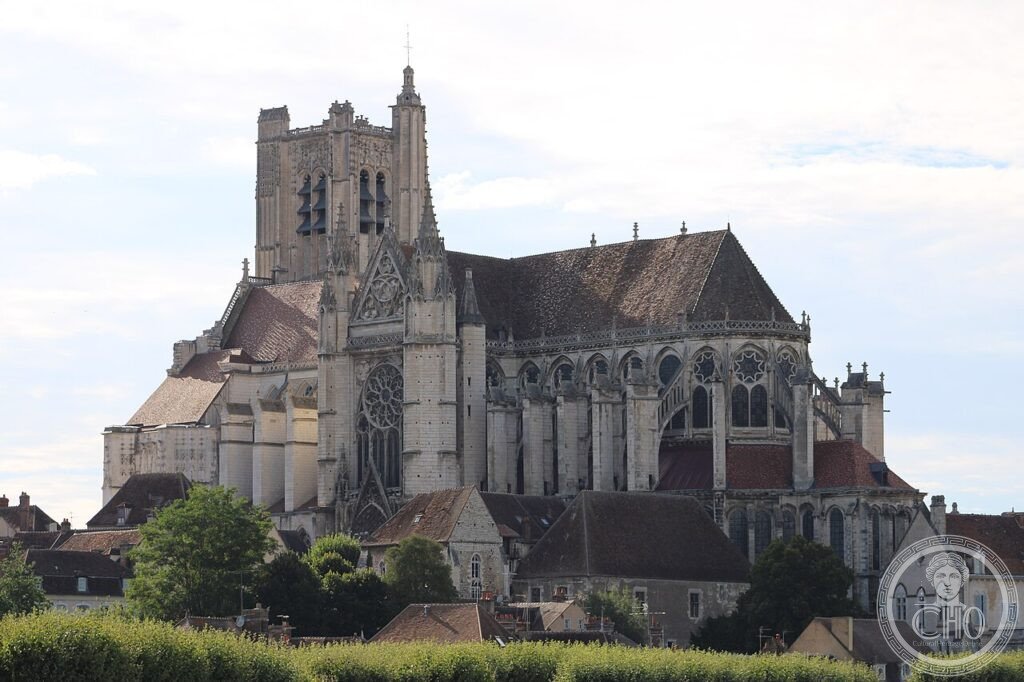
Beneath the Gothic nave the crypt of the eleventh-century Romanesque cathedral survives intact, never intended to hold relics. On its vault, a fresco of the late eleventh or early twelfth century shows Christ mounted on a white horse, flanked by four mounted angels: an iconography with no equivalent anywhere else in France.
At a glance
Auxerre Cathedral (Cathédrale Saint-Étienne) preserves beneath its Gothic nave the large crypt of an earlier Romanesque cathedral, built 1023-1035 following a fire that destroyed the previous building in 1023. The crypt, notably never used to house relics despite its scale, is the sole surviving element of the 11th-century cathedral, comprising a triple nave ending in an apse surrounded by an ambulatory opening onto an axial chapel. Its exceptional Romanesque frescoes make it a significant art-historical site in its own right: the vault fresco of Christ mounted on a white horse, flanked by four angel horsemen representing the armies of heaven, painted in the late 11th or early 12th century under Bishop Humbaud, is unique in French Romanesque art — no other surviving depiction shows Christ specifically as a mounted horseman in this way. Further frescoes include a fragmentary Saint Michael fighting the dragon on the chapel’s south wall and a late-13th-century Christ in Majesty in the apse conch.
Key facts
- Romanesque crypt: built 1023-1035, following the 1023 fire that destroyed the earlier cathedral; the only surviving element of the 11th-century building; never used to house relics
- Christ on horseback fresco: late 11th/early 12th century, under Bishop Humbaud; Christ mounted on a white horse at the centre of a great cross, flanked by four angel horsemen — a unique iconographic composition in French Romanesque art
- Saint Michael fresco: fragmentary, on the south wall of the axial chapel, depicting Saint Michael fighting the dragon
- Christ in Majesty: late 13th century, in the apse conch of the crypt
- Later cathedral: Gothic nave and upper structure built above the crypt from the 13th through 16th centuries, incorporating the earlier Romanesque substructure rather than replacing it
History
Auxerre’s Romanesque cathedral, destroyed by fire in 1023 after presumably standing for some earlier period, was rebuilt with unusual speed and ambition over the following twelve years, and the crypt that survives from this rebuilding — never repurposed to house saints’ relics despite its considerable scale and the ambulatory-and-radiating-chapel plan typical of relic-display crypts elsewhere — represents one of the more architecturally complete Romanesque crypts to survive in Burgundy. When Gothic reconstruction of the cathedral proper began in the 13th century and continued in phases through the 16th, the builders preserved rather than demolished the earlier Romanesque crypt, incorporating it as a substructure beneath the new Gothic nave — a pattern of preservation-through-incorporation that, while not unique to Auxerre, here produced an exceptionally well-preserved result, particularly given the survival of the crypt’s original painted decoration across multiple distinct campaigns spanning from the late 11th to the late 13th century.
The Christ-on-horseback fresco, dated to the late 11th or early 12th century under Bishop Humbaud, remains the crypt’s single most art-historically significant work precisely because of its iconographic rarity: while depictions of Christ in Majesty, Christ enthroned, or Christ crucified are common throughout Romanesque religious art, a specifically equestrian Christ — mounted, in this case, on a white horse and flanked by four angelic horsemen understood to represent the armies of heaven — has no directly comparable surviving parallel elsewhere in French Romanesque painting, making the Auxerre fresco a genuinely singular work whose precise iconographic sources and intended theological meaning continue to attract scholarly discussion.
What you see
The Romanesque crypt, accessible via a separate paid entrance from the main Gothic nave above, is the essential destination, its triple-nave, ambulatory-and-chapel plan giving a clear sense of 11th-century Burgundian ecclesiastical architecture largely undisturbed by the later Gothic building campaigns above. The Christ-on-horseback fresco, on the vault of the crypt’s central bay, rewards deliberate, slow viewing given its iconographic rarity, while the further fresco fragments — Saint Michael and the dragon, and the later Christ in Majesty in the apse — extend the crypt’s painted decoration across roughly two centuries of work. The Gothic cathedral above, including its west facade’s Last Judgment portal and stained-glass collection, forms a separate but complementary visit built directly atop this earlier structure.
Practical information
- Cathedral opening hours: Palm Sunday-All Saints, 9:00-18:00 daily except Sunday mornings; All Saints-Palm Sunday, 10:00-17:00, closed Sundays; free admission to the nave
- Crypt and treasury: separate paid admission, €2-4 depending on season
- Guided tours: Tuesday-Saturday, 9 July-29 August, 14:00, 15:00, 16:00 (closed 15 August)
- Address: Place Saint-Étienne, 89000 Auxerre
Getting there
Auxerre has direct rail connections from Paris Gare de Bercy, taking approximately 1.5-2 hours. By car, Auxerre sits on the A6 motorway (Paris-Lyon). The cathedral stands in the historic centre; local SETUB bus lines 1-7 pass nearby. GPS: 47.7978° N, 3.5728° E.
Nearby
- Abbaye Saint-Germain d’Auxerre — a short walk from the cathedral; holds Carolingian crypt frescoes among the oldest surviving in France
- Auxerre historic centre — immediately surrounding the cathedral; a well-preserved riverside old town on the Yonne
- Chablis vineyard region — approximately 20 minutes by car; the source of Chablis white wine, with tasting cellars open to visitors
Sources
- Cathédrale Saint-Étienne d’Auxerre — official visitor portal (cathedrale-auxerre.com)
- Ville d’Auxerre — “La cathédrale Saint-Etienne” (auxerre.fr)
- Bourgogne Romane — architectural and historical documentation (bourgogneromane.com)
- Wikipedia — “Cathédrale Saint-Étienne d’Auxerre” (fr.wikipedia.org)
Find it on the map
See this place and what’s around it →📷 Become a Cultural Heritage Online photographer
Share your photos of places: they stay published under your name as the author. The more they're seen, the more you get noticed — and soon a contest will reward the most appreciated photos.
Log in or sign up free to add a photoIs this page about you?
This page is read by travellers and heritage enthusiasts who find it on Google. Tell us how you are connected to this place and we will take it from there.