
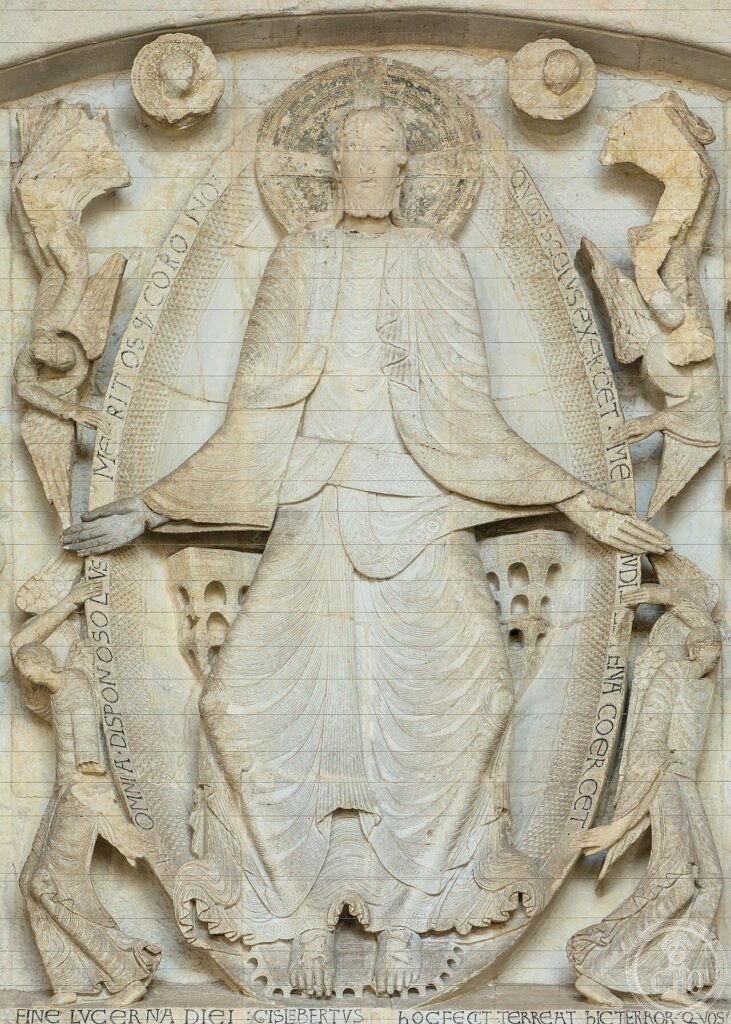
“Gislebertus hoc fecit” — Gislebertus made this — carved beneath the feet of the enthroned Christ: one of the rare sculptors’ signatures to survive from the twelfth century, on a tympanum that in the eighteenth was thought too crude and hidden under plaster and brick for almost a hundred years.
At a glance
Autun Cathedral (Cathédrale Saint-Lazare) was built between roughly 1120 and 1146 to house the relics of Saint Lazarus and to accommodate the growing crowds of pilgrims the earlier church of Saint-Nazaire could no longer hold. Its lasting fame rests overwhelmingly on the tympanum above the west portal: a Last Judgment scene completed by 1146, carved with a dynamism and expressive intensity that art historians treat as one of the peaks of French Romanesque sculpture, and signed by its sculptor — “Gislebertus hoc fecit,” Gislebertus made this — in an inscription beneath Christ’s feet, one of the very few surviving Romanesque sculptural signatures anywhere. The tympanum’s own history is almost as dramatic as its imagery: judged unfashionable and “barbaric” by 18th-century church authorities, it was plastered over and partly destroyed around 1766, only to be rediscovered intact behind the plaster in 1837.
Key facts
- Construction: c. 1120-1146, to house relics of Saint Lazarus and relieve pilgrim pressure on the earlier church of Saint-Nazaire; the tympanum was in place by 1146, at the time of the relics’ translation.
- Gislebertus: the tympanum’s sculptor, known only from his own signed inscription — one of the rare instances of an identified individual artist’s signature surviving from Romanesque France.
- Tympanum subject: the Last Judgment — Christ in Majesty at the centre, the Elect welcomed by Saint Peter to his right, the Archangel Michael weighing souls opposite a demonic tempter to his left, framed by a zodiac band alternating signs with seasonal peasant labours.
- 1766 mutilation: church canons, considering the sculpture crude by contemporary Neoclassical taste, had it plastered and partly chiselled over, including Christ’s head, which was removed entirely.
- Rediscovery: the plaster was removed in 1837, revealing the tympanum largely intact; the separated head of Christ, held in the Musée Rolin from 1895, was formally identified and reinstalled on the tympanum only in 1948.
History
Autun’s cathedral project responded to a specific practical problem: the city’s existing church of Saint-Nazaire held the relics of Saint Lazarus, whose cult had grown into a significant pilgrimage draw, but the building could no longer accommodate the crowds arriving to venerate them. The new church, dedicated to Saint Lazarus himself, was built over roughly two and a half decades from around 1120, with the west portal’s tympanum — the building’s single most ambitious sculptural undertaking — completed in time for the ceremonial translation of the relics in 1146. Gislebertus’s work on the tympanum, and on numerous historiated capitals throughout the building’s interior, represents one of the most extensive and stylistically unified single-sculptor sculptural programmes to survive from Romanesque France, distinguished by an elongated, expressive figural style and dynamic compositional energy that later influenced assessments of Burgundian Romanesque sculpture as a distinct regional school.
The tympanum’s near-destruction in 1766 reflects a broader pattern in the 18th century, when Gothic and Romanesque sculpture, associated by Enlightenment-era taste with a “barbaric” medieval past, were frequently modified, removed, or concealed in favour of more fashionable Neoclassical decoration; Autun’s canons had the tympanum plastered over and its most prominent projecting elements, including the head of Christ, physically chiselled away to make the concealment flush with the surrounding wall. The plaster remained in place for roughly seventy years until its removal in 1837 revealed that the great majority of the tympanum had survived intact beneath it, sparking renewed scholarly and public interest in Gislebertus’s work; the detached head of Christ, meanwhile, had entered the collection of Autun’s Musée Rolin by 1895, where it took over five decades of scholarship to positively identify it as the tympanum’s missing element and arrange its return to the building in 1948 — reuniting, after nearly two centuries, one of French Romanesque sculpture’s most significant single works.
What you see
The west portal tympanum remains the essential reason to visit: Christ in Majesty, held within an almond-shaped mandorla, dominates the centre, his elongated, weightless figure contrasting deliberately with the more agitated, twisting bodies of the souls being judged around him — an intentional stylistic choice art historians read as visually reinforcing Christ’s calm, transcendent authority against the visible anxiety of human judgment. Saint Michael the Archangel, to the right, weighs souls on a scale against the efforts of a grotesque demon attempting to tip the balance, while the surrounding band of zodiac signs paired with corresponding seasonal peasant labours situates the cosmic drama of judgment within the recognisable rhythm of the agricultural year. Inside, further historiated capitals by Gislebertus and his workshop, distributed throughout the nave and now partly displayed in the adjoining Salle Capitulaire to protect them from further wear, depict biblical narrative scenes with the same expressive, dynamic carving style as the tympanum.
Practical information
- Opening hours: 1 Jan-31 Mar and 1 Nov-31 Dec, 10:00-17:00 (closed Sunday mornings); 1 Apr-31 Oct, Mon-Sat 10:00-18:00, Sun 14:00-17:00 (closed 25 August and 1 September).
- Admission: free access to the cathedral year-round outside services; the Trésor (treasury) requires a separate paid ticket.
- Time needed: 2-3 hours for the full cathedral and treasury visit; less for the essentials.
- Address: Place du Terreau / Place Saint-Louis, 71400 Autun.
Getting there
Autun lies just under 60 km from Dijon; TER regional trains connect Dijon to Autun directly. By car, Autun is reachable via the A6 and A38 motorways from Paris (roughly 3.5 hours) or Lyon (roughly 2 hours). The cathedral stands in the upper part of the historic town, on Place du Terreau/Place Saint-Louis. GPS: 46.9450° N, 4.2991° E.
Nearby
- Musée Rolin, Autun — a short walk from the cathedral; holds further Gislebertus sculptures, including the celebrated Eve relief, and the cathedral’s own detached Christ head until its 1948 reinstallation.
- Roman ruins of Augustodunum — scattered through Autun, including the Porte Saint-André gate and a large Roman theatre, reflecting the city’s origin as a major Gallo-Roman settlement.
- Abbaye de Fontenay — approximately 1.5 hours by car; a UNESCO-listed, exceptionally well-preserved Cistercian abbey.
Sources
- Cathédrale d’Autun — official visitor and history portal, “Le tympan” (cathedrale.autun-art-et-histoire.fr).
- Bourgogne Tourisme — regional visitor information (bourgogne-tourisme.com).
- Trésor de la Cathédrale d’Autun — practical visitor information (tresor-cathedrale-autun.fr).
- Wikipedia — “Autun Cathedral” and “Gislebertus” (en.wikipedia.org).
Find it on the map
See this place and what’s around it →📷 Become a Cultural Heritage Online photographer
Share your photos of places: they stay published under your name as the author. The more they're seen, the more you get noticed — and soon a contest will reward the most appreciated photos.
Log in or sign up free to add a photoIs this page about you?
This page is read by travellers and heritage enthusiasts who find it on Google. Tell us how you are connected to this place and we will take it from there.