
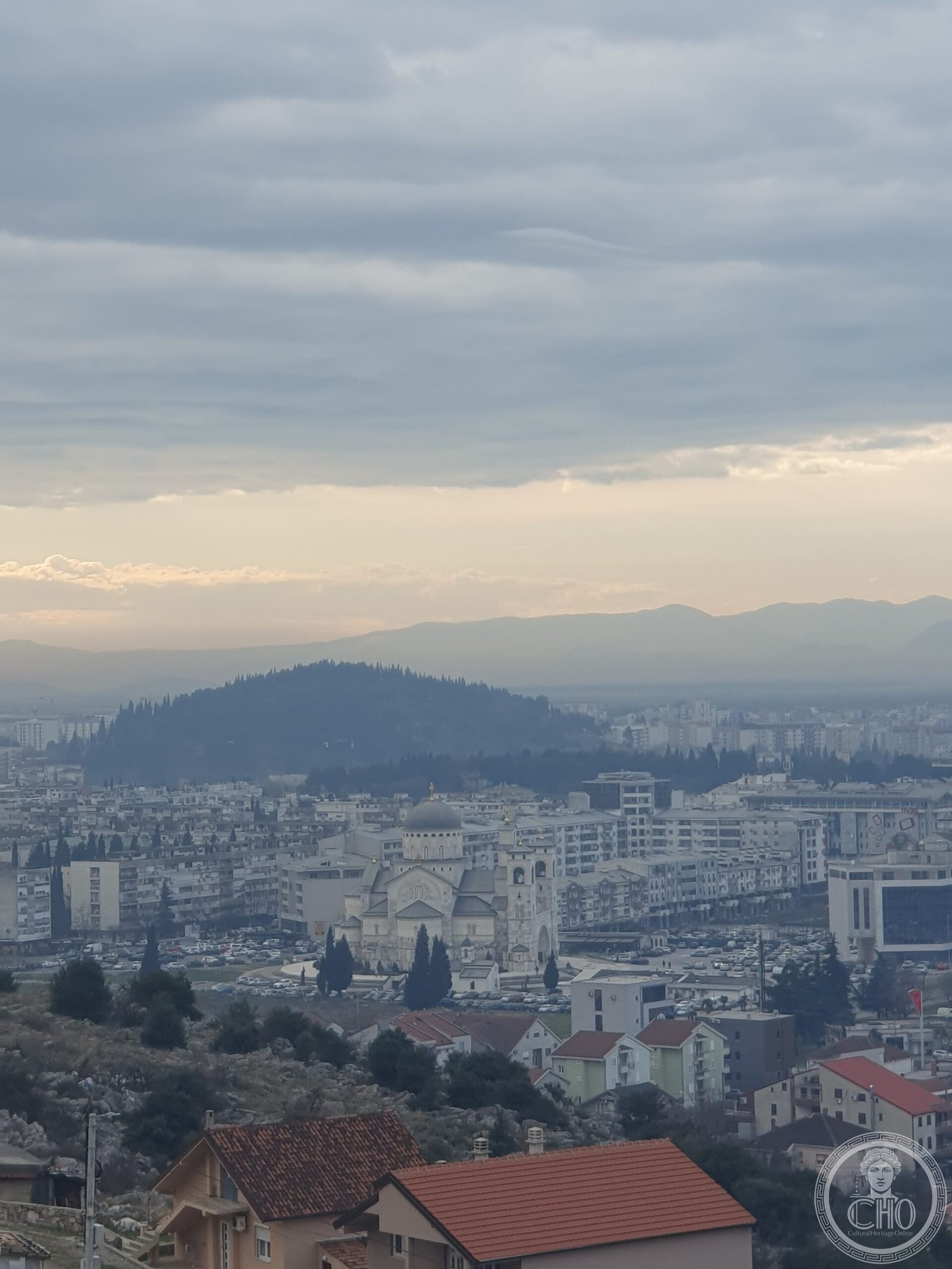
In Podgorica, capital of Montenegro, the cathedral of the Resurrection of Christ is the mother church of the Metropolitanate of Montenegro and the Littoral of the Serbian Orthodox Church. It rose in the district of Momišići, on the western bank of the river Morača, on land which, according to Serbian encyclopedic sources, had belonged to the Church since before the Second World War, when a first cathedral project was cut short by the conflict, and which the communist authorities are said to have confiscated, returning it only in the nineties. That account, however, is documented only by online encyclopedic sources and not by a primary one, and there is no evidence, contrary to a widespread rumour, that the building stands on the site of a Partisan cemetery of the Second World War. The first stone was blessed on 9 August 1993 by the metropolitan Amfilohije Radović, head of the metropolitanate from 1990 to 2020 and a key figure of the whole project, later buried in the crypt of the cathedral. The central dome, with its gilded cross, was completed on 18 November 1999, while the crypt was consecrated on the Sunday of All Saints in 2013 and the cathedral as a whole on 7 October 2013, on the one thousand seven hundredth anniversary of the Edict of Milan. Four Orthodox patriarchs were present: the Serbian patriarch Irinej, the ecumenical patriarch of Constantinople Bartholomew I, the patriarch of Jerusalem Theophilos III and the patriarch of Moscow Kirill, an event well documented by concordant sources in several languages. The architect Predrag Ristić signed the design, in a style described as Serbo-Byzantine, although architecture critics call it an eclectic hybrid drawing also on the medieval cathedral of Saint Tryphon at Kotor. The building is 41.5 metres tall and has two twin bell towers of 26.7 metres holding seventeen bells, with an interior of gilded frescoes, marble floors and a large iconostasis, whose donation in 2001 by the Church of Athens rests on a single source. In 2014 one of the frescoes inside, showing hell in the Last Judgement, portrays among the flames figures identified by the international press as Josip Broz Tito, Karl Marx and Friedrich Engels, drawing wide coverage from agencies such as AFP; a church spokesman defended the work as a symbol of «communist evil». During the protests of December 2019 against the contested Montenegrin law on religious freedom, seen by the Serbian Orthodox Church as a threat to its historic properties in the country, hundreds of clergy led by Amfilohije himself gathered in front of the parliament and then held a liturgy in this very cathedral, signing a declaration in defence of the Church. The wider crisis between Serbian and Montenegrin church identity remains a national dispute, not tied specifically to the cathedral building beyond that episode.
About the Cathedral
In Podgorica, Montenegro, the Cathedral of the Resurrection of Christ is the mother church of the Metropolitanate of Montenegro and the Littoral of the Serbian Orthodox Church, built in the Momišići district on the western bank of the Morača River. According to Serbian-language sources, the land had belonged to the Church since before the Second World War, when an earlier cathedral plan was interrupted by the conflict, and was reportedly confiscated by the postwar communist authorities before being returned in the 1990s — though this account rests on encyclopedic rather than primary sourcing, and no evidence was found to support a separate, widely repeated claim that the building sits on a former Partisan-era cemetery.
Key facts
- 9 August 1993: foundation stone blessed by Metropolitan Amfilohije Radović.
- 18 November 1999: the central dome and its gold cross completed.
- 7 October 2013: the cathedral consecrated by four Eastern Orthodox patriarchs.
- 2014: an interior fresco depicting Tito, Marx and Engels in hell draws international coverage.
- December 2019: hundreds of clergy hold a liturgy here during Montenegro’s religion-law protests.
- Twenty years of construction, 1993-2013, under architect Predrag Ristić.
History
Built over two decades on land the Serbian Orthodox Church says it once lost to communist-era confiscation, this cathedral was consecrated in 2013 by four Eastern Orthodox patriarchs together, a rare display of pan-Orthodox unity. Its most talked-about moment, though, came the following year, when an interior fresco depicting Josip Broz Tito, Karl Marx and Friedrich Engels among the damned drew international press coverage — a distinctly modern controversy for a building whose architecture deliberately echoes medieval Byzantine tradition.
What you see
A Serbian-Byzantine revival building rises 41.5 meters, its twin bell towers, each 26.7 meters tall, housing seventeen bells beneath gold-topped domes; critics have called the overall design an eclectic hybrid drawing on the medieval Cathedral of St. Tryphon in Kotor as much as strict Byzantine precedent. Inside, gold-backed frescoes, marble floors, and a large iconostasis fill the nave above a crypt where Metropolitan Amfilohije Radović, the project’s driving figure, is buried.
Practical information
- Opening hours: generally open daily outside services; check current hours before visiting.
- Address: Momišići district, west of the Morača River, Podgorica, Montenegro (no confirmed street address found in available sources).
Getting there
The cathedral stands in the Momišići New Town district on the western bank of the Morača River. GPS: 42°26′45″N, 19°14′54″E.
Nearby
- Ascension (Voznesenje) Church — an earlier, smaller church standing beside the cathedral in the same complex.
Sources
- Wikipedia (English, Serbian, Serbo-Croatian) — “Cathedral of the Resurrection of Christ, Podgorica”
- Wikidata Q658743.
- Orthodox Arts Journal — “A New Cathedral for Montenegro”
- GMA News (AFP) — coverage of the 2014 fresco controversy.
- Balkan Insight — coverage of the 2019-2020 Montenegro religion-law protests.
Find it on the map
See this place and what’s around it →📷 Become a Cultural Heritage Online photographer
Share your photos of places: they stay published under your name as the author. The more they're seen, the more you get noticed — and soon a contest will reward the most appreciated photos.
Log in or sign up free to add a photo