
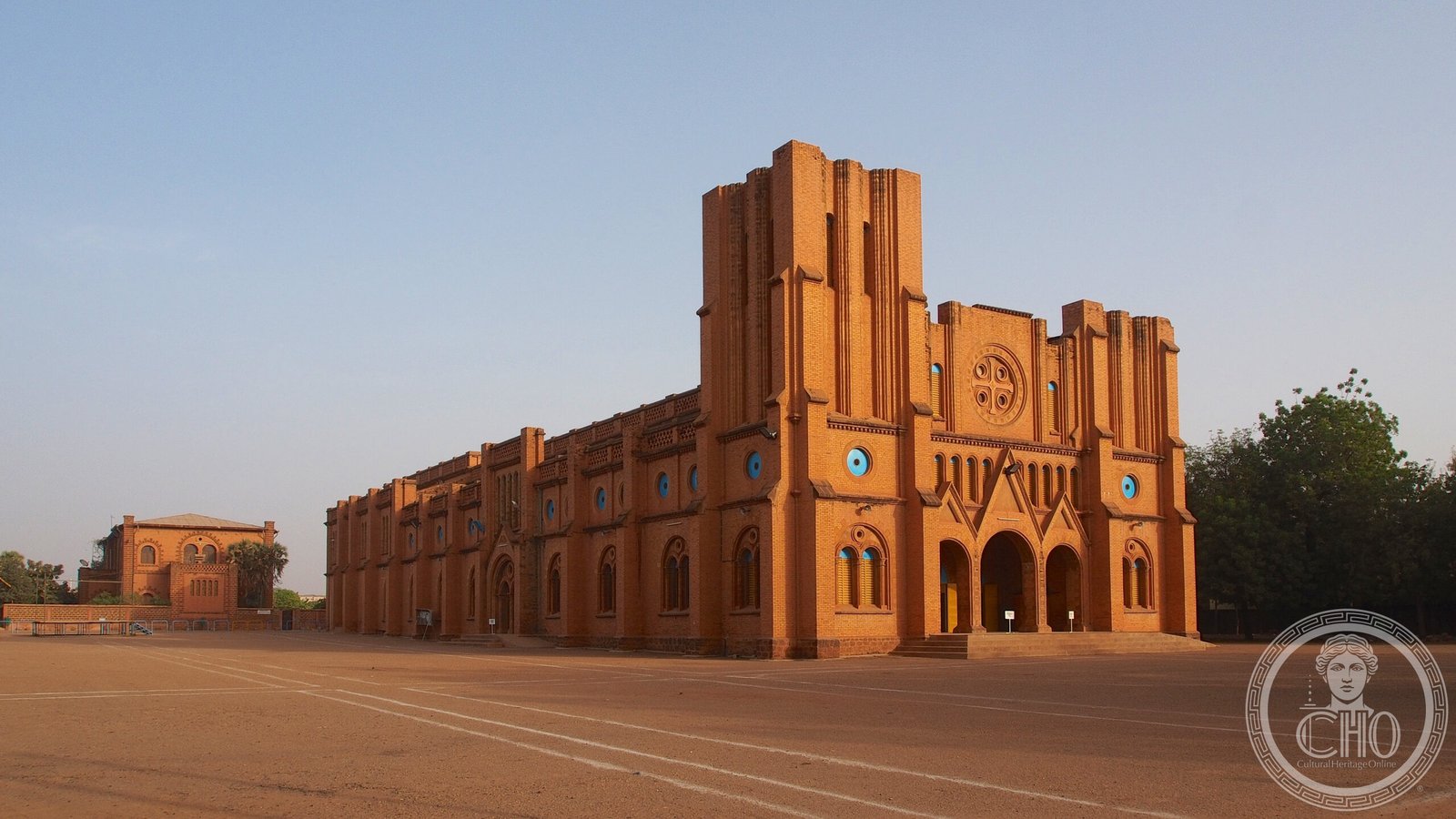
In Ouagadougou, the capital of Burkina Faso, the Cathedral of the Immaculate Conception was built between 1934 and 1936, dedicated on 19 January 1936 according to most sources. It was built under the direction of Monsignor Joanny Thevenoud, Apostolic Vicar of Ouagadougou and a member of the White Fathers. No professional architect is documented, and Thevenoud himself remains the driving figure behind the project. The building is in Romanesque Revival style, with a three-nave basilical plan, a triple entrance portal, and two unequal towers that never received the spires originally planned for them. It is constructed entirely of sun-dried red mud brick (banco), following Sahelian building tradition. The claim that it is the largest mud-brick cathedral in West Africa is not confirmed by authoritative sources and should be treated with caution. The Apostolic Vicariate of Ouagadougou was erected on 2 July 1921 and raised to a metropolitan archdiocese on 14 September 1955, the date on which the building formally became a cathedral. Among its archbishops are two cardinals: Paul Zoungrana, archbishop from 1960 to 1995 and created cardinal in 1965, and Philippe Ouedraogo, archbishop from 2009 to 2023 and created cardinal in 2014. The current archbishop is Monsignor Prosper Kontiebo, in office since 16 October 2023. Since 2019, Burkina Faso has suffered severe jihadist violence, with documented attacks against churches and Christian communities, including those on the Protestant parish of Pansi in February 2019, the Protestant church of Silgadji in April 2019, and the Catholic church of Dablo in May 2019. All of these, however, were concentrated in the Sahel, North, East, and Centre-North regions, not in the capital; no attack or specific documented threat against this cathedral, which stands in Ouagadougou, is recorded. Even the three main jihadist attacks that took place in the capital between 2016 and 2018 struck restaurants, a hotel, and an embassy, not religious buildings. Pope John Paul II visited Ouagadougou on 29 January 1990, addressing the faithful in front of the cathedral and, the same day, priests, religious, seminarians, and catechists inside the building, in a trip also marked by an appeal for international aid against an ongoing severe drought. No documented visit by any other pontiff to this cathedral is recorded.
About the Cathedral of the Immaculate Conception
In Ouagadougou, the capital of Burkina Faso, the Cathedral of the Immaculate Conception was built between 1934 and 1936, dedicated on 19 January 1936 per most sources, under the direction of Monsignor Joanny Thévenoud, Apostolic Vicar of Ouagadougou and a member of the White Fathers; no professional architect is documented, with Thévenoud himself credited as the driving figure behind the project. Built in a Romanesque Revival style, with a three-nave basilical plan, a triple entrance portal, and two unequal towers that never received their originally planned spires, the building is constructed entirely of sun-dried red mud brick, following Sahelian building tradition.
Key facts
- 1934-1936: the cathedral built in red mud brick under Bishop Joanny Thévenoud.
- 14 September 1955: elevated to the seat of the new Metropolitan Archdiocese of Ouagadougou.
- Two archbishops of Ouagadougou, Paul Zoungrana and Philippe Ouédraogo, went on to become cardinals.
- 29 January 1990: Pope John Paul II addresses the faithful and clergy at the cathedral.
- No documented attack has targeted this cathedral, despite Burkina Faso’s severe jihadist violence against rural churches since 2019.
- 16 October 2023: Archbishop Prosper Kontiebo takes office.
History
Built of sun-dried red earthen brick in the mid-1930s under a White Fathers missionary bishop, this cathedral has produced two of Burkina Faso’s Catholic cardinals and stood as the archdiocesan seat since 1955, all while its twin towers still lack the spires originally planned for them. Its capital-city location has spared it from the church attacks that have struck Burkina Faso’s rural regions since 2019, even as the country has recorded some of the world’s highest numbers of anti-Christian violence in recent years.
What you see
A Romanesque Revival basilica of red mud brick rises with round-arched windows and a triple portal, its two unequal towers left without the spires their design anticipated. Inside, a three-nave plan reflects Sahelian building tradition adapted to European ecclesiastical form.
Practical information
- Opening hours: generally open daily outside services; check current hours before visiting.
- Address: 01 BP 90, Ouagadougou 01, Burkina Faso.
Getting there
The cathedral stands in central Ouagadougou. GPS: 12°21′43″N, 1°31′37″W.
Nearby
- Central Ouagadougou — the capital’s administrative core surrounding the cathedral.
Sources
- Wikipedia (English and French) — “Ouagadougou Cathedral” and “Roman Catholic Archdiocese of Ouagadougou”
- Vatican.va — Pope John Paul II, address to the faithful, Ouagadougou, 29 January 1990.
- Wikipedia — “Islamist insurgency in Burkina Faso” and “Terrorism in Burkina Faso”
- Catholic-Hierarchy.org — Archdiocese of Ouagadougou listing.
Find it on the map
See this place and what’s around it →📷 Become a Cultural Heritage Online photographer
Share your photos of places: they stay published under your name as the author. The more they're seen, the more you get noticed — and soon a contest will reward the most appreciated photos.
Log in or sign up free to add a photo