

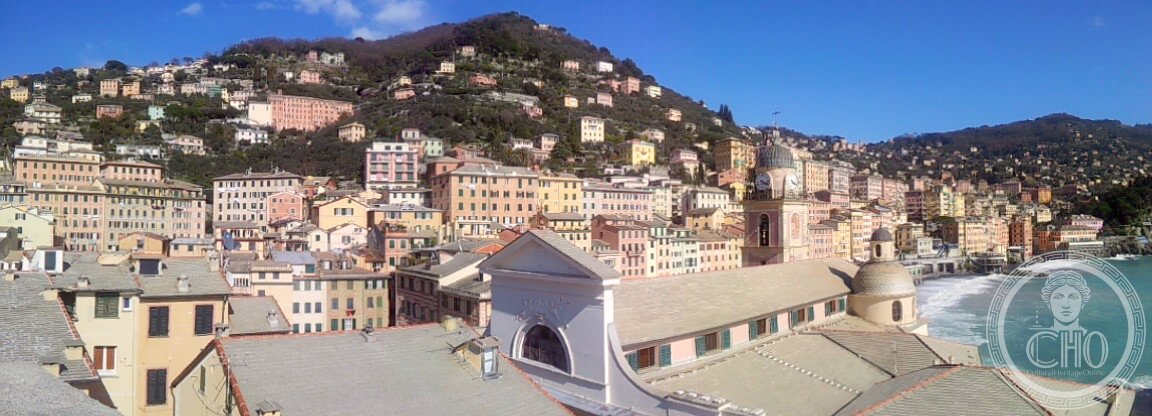
A working seaside village on the Ligurian coast, celebrated for its colorful waterfront, historic marina, and a maritime heritage that made it one of Europe’s great shipbuilding centers.
At a glance
Camogli is a compact fishing and tourist village known for its picturesque harbor lined with pastel-colored buildings and its enduring connection to the sea. Nicknamed the “City of a thousand white sailing ships,” it remains a vital center of Ligurian maritime culture, where centuries of seafaring tradition meet modern tourism.
History
Camogli’s origins extend to prehistoric times. Excavations conducted between 1969 and 1977 near the Castellaro revealed a settlement on artificial terraces with evidence of habitation from the 16th and 13th centuries BC, supported by ceramic finds. Roman artifacts from the 2nd century BC confirm continued occupation.
Under the bishops of Milan from around 1000, the coastal settlement emerged as Vila Camuli in medieval texts. The 12th-century Dragonara castle defended against raids; the village was attacked and destroyed by Visconti and Fieschi forces in 1366 and by the Duchy of Milan in 1438. From the 16th century, Turkish raids by the admiral Dragut prompted fortification and the completion of the marina pier in 1624.
As part of the Genoese Republic until 1797, Camogli flourished under French rule (1798–1814), becoming a canton capital and attracting major investment in merchant shipbuilding after the 1798 Battle of the Nile. By 1856, its fleet numbered 580 registered vessels. Following the Restoration and Italian unification, tourism gradually replaced traditional maritime industries.
What you see
The village’s defining character is its seafront of narrow, vertically-stacked buildings in warm yellows, pinks, and ochres, creating the distinctive harbor panorama that has drawn artists and visitors for generations. The historic marina remains functional, with fishing boats moored alongside pleasure craft.
The Dragonara castle, though damaged by successive attacks, stands as evidence of medieval defense. The 17th-century pier and fortifications reflect Camogli’s maritime engineering heritage.
Cultural significance
Camogli embodies the rise and transformation of Ligurian maritime culture. Its shipbuilding boom during the Napoleonic era produced merchant vessels sought by European powers, making it a engine of regional prosperity and innovation. The 1852 maritime mutual insurance society founded by Nicolò Schiaffino was unique globally.
Today, the village represents continuity between its working past and tourist present, preserving the atmosphere and scale of a 19th-century port while remaining economically tied to the sea.
Key facts
- Address: Via XX Settembre, n. 1, 16032 Camogli (Genova)
- Coordinates: 44.3506019, 9.1518308
- Phone: 0185 72901
- Official website: http://www.comune.camogli.ge.it/hh/index.php
Practical information
The village is easily accessed by road or rail via Genova. Opening hours for public spaces are unrestricted; check the official website for seasonal variations in services and facilities.
Getting there
Camogli lies on the coast east of Genova and is served by regional rail connections from the city center. Parking is available near the harbor, though space is limited during peak season. The compact village center is best explored on foot.
See the place
Sources & resources
Find it on the map
See this place and what’s around it →📷 Become a Cultural Heritage Online photographer
Share your photos of places: they stay published under your name as the author. The more they're seen, the more you get noticed — and soon a contest will reward the most appreciated photos.
Log in or sign up free to add a photo