

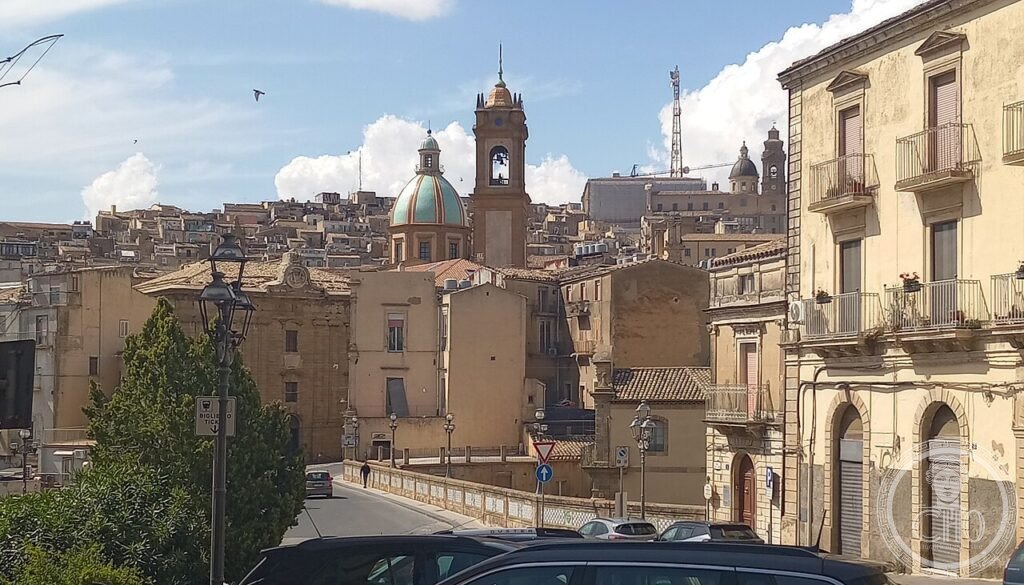
Caltagirone — in the Iblean hills inland from the Catania coast — is the Val di Noto city with the longest ceramic tradition (2,500 years, from the Greek settlement to the present) and the most unusual Baroque monument: the Scala di Santa Maria del Monte, a 142-step staircase built from 1606 to 1726 in which every single step face is decorated with a different hand-painted Caltagirone ceramic tile — making it the only decorative staircase of its kind in the world and the defining visual symbol of a city that has never stopped making and covering its buildings with ceramics.
At a glance
Caltagirone (province of Catania, Sicilia) is one of eight towns in the UNESCO serial property “Late Baroque Towns of the Val di Noto” (2002, ref. 1024). Within the eight, Caltagirone is exceptional for its ceramic tradition: unlike the other seven Val di Noto cities (which are defined by their Baroque architecture after the 1693 earthquake), Caltagirone had a ceramic production industry of documented continuity from the Greek period through the Arab and Norman medieval period to the present day. The earthquake of 1693 damaged but did not destroy Caltagirone (which was on stronger geological ground than the coastal cities) and the reconstruction added Baroque palaces and churches to an already existing urban fabric. The Museo Regionale della Ceramica (in the Villa Comunale gardens, by Giovan Battista Basile, 1898) is the principal repository of Caltagirone ceramic history and has the most comprehensive collection of Sicilian ceramics in any museum.
Key facts
- Scala di Santa Maria del Monte: 142 steps (the staircase runs the full height of the ridge from the Piazza Municipio at the bottom to the church of Santa Maria del Monte at the top, approximately 40 m vertical); the first section (from the bottom to a landing at mid-height) was built in 1606; the full staircase was completed in 1726 after the reconstruction following the 1693 earthquake; the current ceramic tile facing (a different design on every step face, using the full range of traditional Caltagirone ceramic patterns and colours: blue on white, yellow on white, orange, green, and the full polychrome palette) was added in phases from 1954 onward; no two steps have the same pattern
- The Illuminazione della Scala (Lighting of the Staircase): On the nights of 24-25 July (feast of San Giacomo, the patron saint of Caltagirone) and 14-15 August (Assumption), 4,000 hand-painted paper lanterns are placed on the steps, creating a composition of light patterns on the staircase visible across the city and illuminated after dark. It is one of the most spectacular traditional celebrations in Sicily and requires the preparation of all 4,000 lanterns by hand each year
- Ceramic tradition (2,500 years): The Caltagirone area has continuous ceramic production from the Greek period (6th century BCE); the Arab period (9th-11th centuries CE) introduced the tin-oxide glaze technology that produced the white base field characteristic of Caltagirone majolica; the Norman and Spanish periods added the blue-and-white and polychrome decoration; the current production (approximately 120 active ceramic workshops in the city) produces both traditional designs and contemporary work using the same clay bodies and glaze formulas
- UNESCO: 2002, ref. 1024
- GPS: 37.2359, 14.5149 — Google Maps (Piazza Municipio, base of the staircase)
History
Caltagirone (from the Arab Qal'at al-Jarun, “Castle of Caves”) was one of the most important Arab fortified towns in interior Sicily; the ceramic industry was already established before the Arab conquest (the Greek and then Roman settlements had pottery workshops) but reached its most sophisticated form under the Arabs (who introduced the tin-glaze technique from the Middle East). The Norman conquest (1086 CE) maintained the ceramic workshops; the Swabian and Aragonese periods added the blue-and-white decoration inspired by imported Chinese and Persian porcelain reaching Sicily via the Spanish trade networks. The 1693 earthquake was less destructive in Caltagirone than in the coastal cities (the Iblean plateau is on more stable geological substrata), and the rebuilding campaign added a layer of Baroque architecture (the church of San Giorgio, the Palazzo Senatorio, the renovation of the main streets) without erasing the earlier urban fabric. The ceramic industry declined in the 19th century under competition from industrial porcelain but was revived in the early 20th century by the Arts and Crafts-influenced reform promoted by the local ceramics school (Istituto d'Arte della Ceramica di Caltagirone, founded 1918).
What you see
The walk in Caltagirone begins at the Piazza Municipio (at the foot of the Scala) and proceeds up the 142 steps of the Scala di Santa Maria del Monte: each step face has a different painted design in the Caltagirone ceramic tradition; the overall colour palette shifts as you climb (bluer at the bottom, more polychrome higher up). At the top, the church of Santa Maria del Monte (17th century, rebuilt 1693-1718) offers a panoramic view over the city and the Iblean hills. The descent can be made via the same staircase or via the lateral streets, which pass the principal Baroque churches and palaces of the reconstruction period.
The Via Luigi Sturzo (the main shopping street below the Piazza Municipio) is lined with ceramic shops where you can observe the production process and buy directly. The Museo Regionale della Ceramica (in the Villa Comunale gardens, a short walk from the Piazza) has 8,000 objects from 5th century BCE to the 20th century, including the most complete collection of Arab-Norman period ceramics in Sicily. The Ponte San Francesco (a ceramic-decorated bridge at the entrance to the historic centre, 1777) is the most visible public ceramic decoration in the city, with a balustrade entirely covered in blue-and-white majolica tiles.
Gallery
Practical information
- Scala di Santa Maria del Monte: Always accessible (public staircase). The Illuminazione is on the nights of 24-25 July and 14-15 August; arrive early for a good viewpoint on the lower piazza or the terrace above.
- Museo Regionale della Ceramica: Via Roma 3, Caltagirone; open daily 9:00-18:30; admission ~€4.
- Ceramic workshops: Most workshops are open to visitors Monday-Saturday 9:00-13:00 and 15:00-19:00; many offer short demonstrations; buying directly from the maker is preferable to tourist shops. The Via Luigi Sturzo and Via Roma are the main workshop streets.
- Season: April-June and September-October. The Illuminazione period (July 24-25 and August 14-15) is spectacular but crowded; accommodation books out months in advance.
Getting there
Piazza Municipio, Caltagirone (CT), Sicilia. GPS 37.2359, 14.5149. By train: Trenitalia from Catania (1h15-1h30, regional with change at Gela on some routes; or direct; limited service — check schedules). By car: from Catania, SS417 south-west (65 km, 1h); from Ragusa, SP47 north-west (75 km, 1h10); from Palermo, A19 then SS192 (175 km, 2h15). Parking available near the Porta San Giorgio (eastern entrance to the historic centre).
Nearby
- Villa Romana del Casale (Piazza Armerina) — 50 km north-west; (CHO card: Villa Romana del Casale UNESCO 1997); the most extensive and best-preserved Roman floor mosaic complex in the world (3,500 m² of mosaics, 4th century CE); UNESCO 1997 (ref.516)
- Ragusa — 75 km south-west; (CHO card: Ragusa Ibla — il Barocco Tardo del Val di Noto UNESCO 2002)
- Etna — 50 km north-east; the largest active volcano in Europe (3,357 m); the crater rim can be reached by cable car+jeep tour from Rifugio Sapienza on the southern slope (Nicolosi exit from A18); authorized guide required for summit approach; UNESCO 2013 (ref.1427)
Sources
- UNESCO: whc.unesco.org/en/list/1024
- Wikipedia EN: Caltagirone
- Museo Regionale della Ceramica: regione.sicilia.it
Find it on the map
See this place and what’s around it →📷 Become a Cultural Heritage Online photographer
Share your photos of places: they stay published under your name as the author. The more they're seen, the more you get noticed — and soon a contest will reward the most appreciated photos.
Log in or sign up free to add a photo