
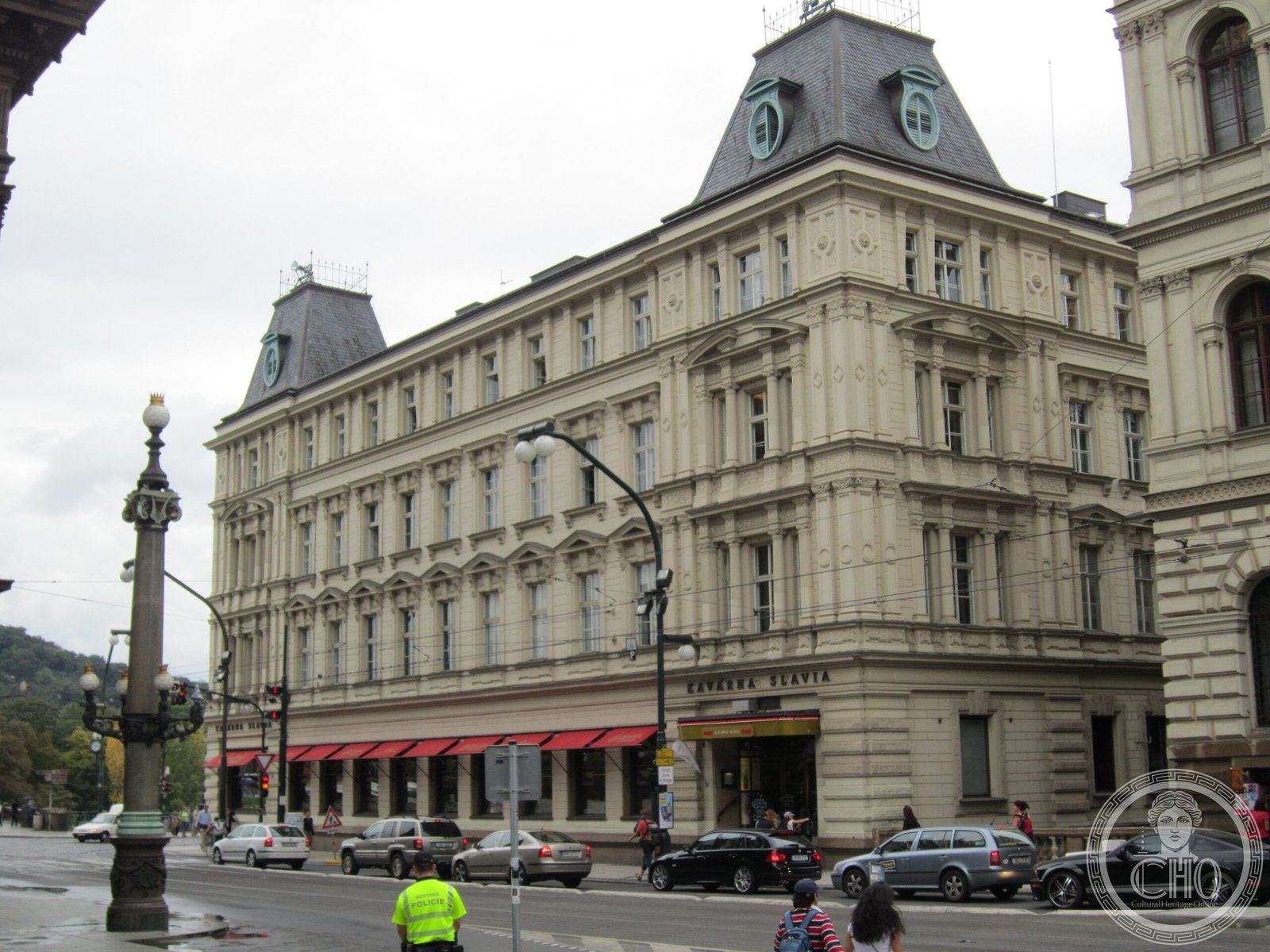
The café across the river from the National Theatre where Rilke read, dissidents met, and Viktor Oliva’s Absinthe Drinker has watched the room for over a century.
At a glance
Café Slavia stands on the corner of Národní street and the Smetana embankment, on the bank of the Vltava directly opposite the National Theatre. Opened in 1884, it has been Prague’s theatre and literary café for well over a century, and it keeps an Art Deco interior and one of the country’s best-known paintings.
History
The café opened in August 1884, its name drawn from the Czech national revival and the idea of Pan-Slavism then stirring the city. Its position facing the newly built National Theatre made it the natural café of actors, writers and audiences.
Between 1931 and 1932 it was rebuilt in Art Deco form by Václav Fišer and his nephew Jaroslav Štěrba, working with the architect Oldřich Stefan. Rainer Maria Rilke was an early regular; in the 1920s the Russian poet Marina Tsvetaeva came with a circle of émigré writers. Under Communist rule the Slavia became a haunt of the dissident community, including the playwright Václav Havel — a future president — and the poet Jiří Kolář. Renamed during the German occupation and closed by a legal dispute in 1992, it reopened in 1997.
What you see
The 1930s remodelling gave the café its functional Art Deco lines, wide windows and river light. On the wall hangs Viktor Oliva’s The Absinthe Drinker (1901), the café’s emblem and one of the most famous Czech paintings of its era.
The corner windows frame the Vltava, the National Theatre and, upstream, Prague Castle.
Cultural significance
The Slavia has kept the same role through very different regimes: the café of the theatre opposite, and of the writers who could not always be published. From Rilke and Tsvetaeva to Havel’s dissident circle, its tables track a century of Central European literature, with Oliva’s absinthe-dreamer presiding over all of it.
Key facts
- Opened: August 1884; name from the Czech national revival and Pan-Slavism
- Rebuilt: 1931–32 in Art Deco, by Václav Fišer and Jaroslav Štěrba with Oldřich Stefan
- Location: Národní / Smetana embankment, opposite the National Theatre
- Regulars: Rilke, Marina Tsvetaeva, later Václav Havel and Jiří Kolář
- Painting: Viktor Oliva’s The Absinthe Drinker (1901) hangs inside
Practical information & getting there
The café is at the National Theatre end of Národní. Nearest tram/metro: Národní třída (line B) or the Národní divadlo tram stop. Open daily; ask for a window table on the river side.
Sources & resources
- Café Slavia — Building and Decoration: cafeslavia.cz/en/about-cafe
- Radio Prague International — “A Prague institution: the famous Café Slavia”
- Avantgarde Prague — Café Slavia
- View Prague — Café Slavia
Find it on the map
See this place and what’s around it →📷 Become a Cultural Heritage Online photographer
Share your photos of places: they stay published under your name as the author. The more they're seen, the more you get noticed — and soon a contest will reward the most appreciated photos.
Log in or sign up free to add a photoIs this page about you?
This page is read by travellers and heritage enthusiasts who find it on Google. Tell us how you are connected to this place and we will take it from there.