
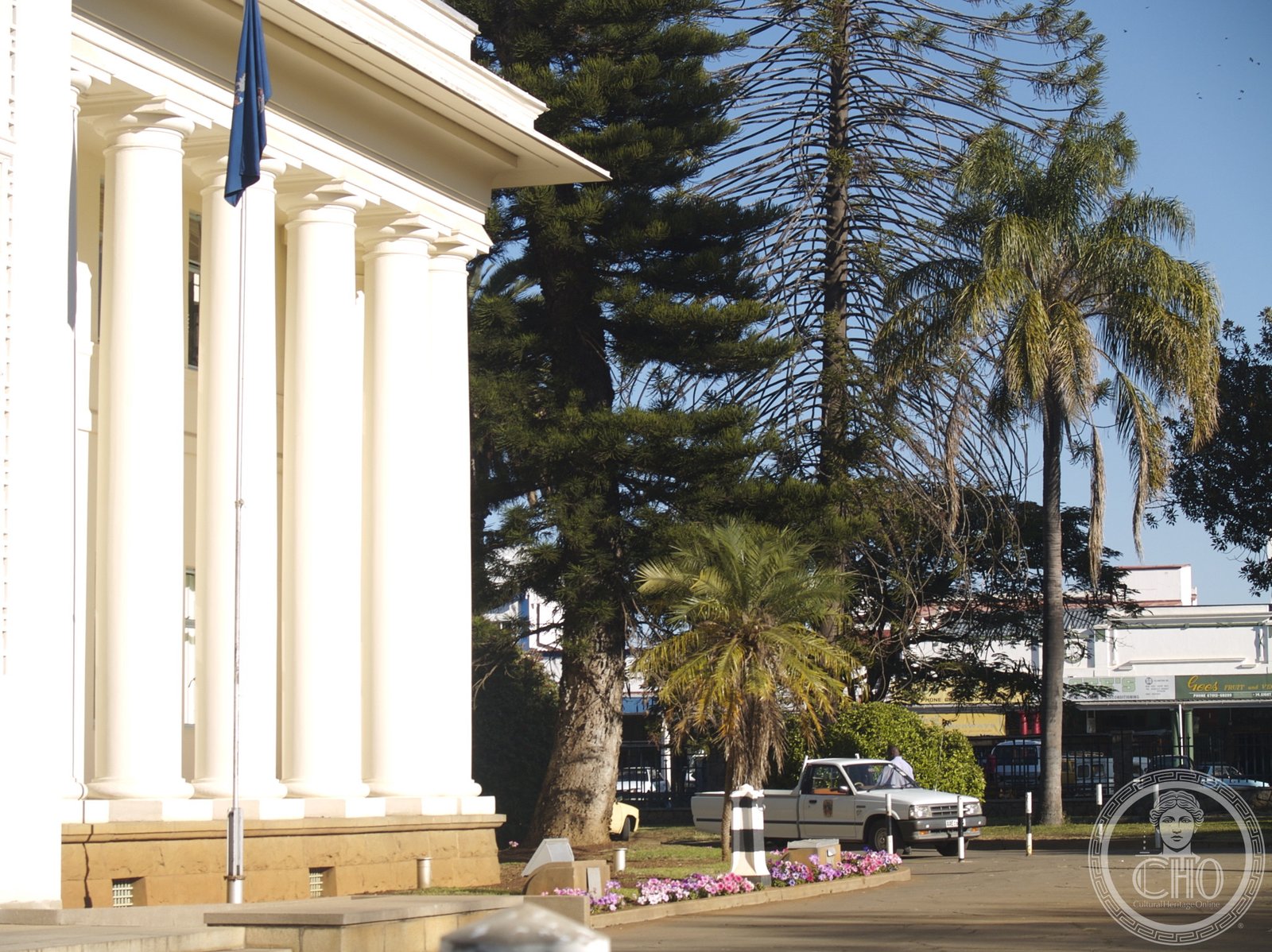
Bulawayo City Hall is the most architecturally distinguished civic building in Zimbabwe’s second city. Completed in 1940 during the height of Southern Rhodesia’s colonial era, its Baroque clock tower and imposing columned facade transport a piece of European civic tradition to the Zimbabwean highveld. The building stands at the head of Bulawayo’s famously wide streets, designed broad enough for a full ox wagon to turn. Today it remains the active seat of Bulawayo City Council, a colonial-era landmark that has outlasted empire and now serves an independent Zimbabwe. Its clock tower is one of the most recognised silhouettes in a city whose architectural heritage is among the most intact in sub-Saharan Africa.
At a glance
- Type
- Civic / Municipal Hall
- Period
- 1940
- Style
- Renaissance Revival / Baroque Colonial
- Location
- Fife Street, Bulawayo, Zimbabwe
- Coordinates
- -20.1536, 28.5833
- Architect(s)
- Anthony Laidlaw
Overview
Bulawayo City Hall anchors the civic core of Zimbabwe’s second-largest city. Its Baroque clock tower is the city’s primary visual landmark, visible from the wide colonial-era grid of streets that defines Bulawayo’s centre. The building combines a colonnaded main facade with Renaissance Revival massing and a clock tower derived from British municipal architecture of the late Victorian and Edwardian periods. The hall was built to serve the growing settler population of Southern Rhodesia and reflects the ambitions of colonial civic planners to transplant European institutional forms into sub-Saharan Africa. Despite its colonial origins, the building has been maintained as a working seat of city government through independence and into the 21st century, accumulating a new layer of meaning as a symbol of Bulawayo’s administrative continuity.
History
Bulawayo was founded in 1894 on the site of King Lobengula’s royal kraal, which the Ndebele king burned before the British South Africa Company troops arrived. The city grew rapidly as a railway and mining hub, and by the 1930s the colonial administration required a purpose-built civic centre equal to its ambitions. Architect Anthony Laidlaw designed the City Hall, completed in 1940. The building served as the centre of civic life through the Federation of Rhodesia and Nyasaland (1953-1963), the UDI period under Ian Smith (1965-1980), and the transition to Zimbabwean independence in 1980. Unlike many colonial-era civic buildings in Africa that were repurposed or demolished after independence, Bulawayo City Hall has continued as the seat of Bulawayo City Council under all subsequent governments. The building is listed as a Zimbabwe Heritage site.
Architecture and Design
The building’s most prominent feature is its clock tower, which rises above the main facade in stepped Baroque stages and gives Bulawayo its skyline anchor. The main entrance block features a colonnaded portico with paired columns supporting a classical entablature. The stone facade, typical of Rhodesian public buildings of the period, was quarried locally and gives the building a warm ochre tone. The interior plan follows the standard British municipal pattern: a council chamber for elected members, administrative offices, and ceremonial spaces. The wide streets of Bulawayo’s grid in front of the hall were part of a deliberate urban plan: ox wagons required a 90-foot turning radius, and the streets were laid out accordingly, giving the city an unusually open centre that still benefits the building’s visibility today.
Cultural significance
Bulawayo City Hall occupies a complex position in Zimbabwe’s cultural landscape. As a product of British colonial administration, it embodies the ambitions of an era that imposed European institutional forms on an African city built on Ndebele royal ground. Yet its continued use as the seat of Bulawayo City Council means it has also become a symbol of the city’s administrative resilience through decades of national political and economic turbulence. The building’s clock tower appears on Bulawayo civic materials and is widely recognised as the emblem of the city. For heritage conservationists, Bulawayo’s relatively intact colonial townscape, of which City Hall is the centrepiece, represents a significant and underappreciated layer of African urban architectural history.
Visiting today
Bulawayo City Hall is an active government building; visits to the interior are by arrangement with the City Council. The exterior, clock tower, and immediate surrounds are freely accessible. The building is best viewed from across Fife Street, which provides the full elevation including the clock tower. Bulawayo’s city centre is compact and walkable; the City Hall is within easy walking distance of the Natural History Museum, the Railway Museum, and the main commercial precinct. The city centre is generally safe for daytime walking. Bulawayo has a pleasant dry climate; avoid the midday heat of October and November.
Getting there
Bulawayo Joshua Mqabuko Nkomo International Airport (BUQ) receives flights from Johannesburg and Harare. The city centre is approximately 22 km from the airport; taxis are available. From Harare, Bulawayo is 440 km via the A5 highway (5-6 hours by road) or accessible by overnight train. The City Hall is in the centre of Bulawayo’s grid at Fife Street and Leopold Takawira Avenue. Metered taxis and informal minibus taxis serve the city centre.
Sources and resources
Find it on the map
See this place and what’s around it →📷 Become a Cultural Heritage Online photographer
Share your photos of places: they stay published under your name as the author. The more they're seen, the more you get noticed — and soon a contest will reward the most appreciated photos.
Log in or sign up free to add a photoIs this page about you?
This page is read by travellers and heritage enthusiasts who find it on Google. Tell us how you are connected to this place and we will take it from there.