
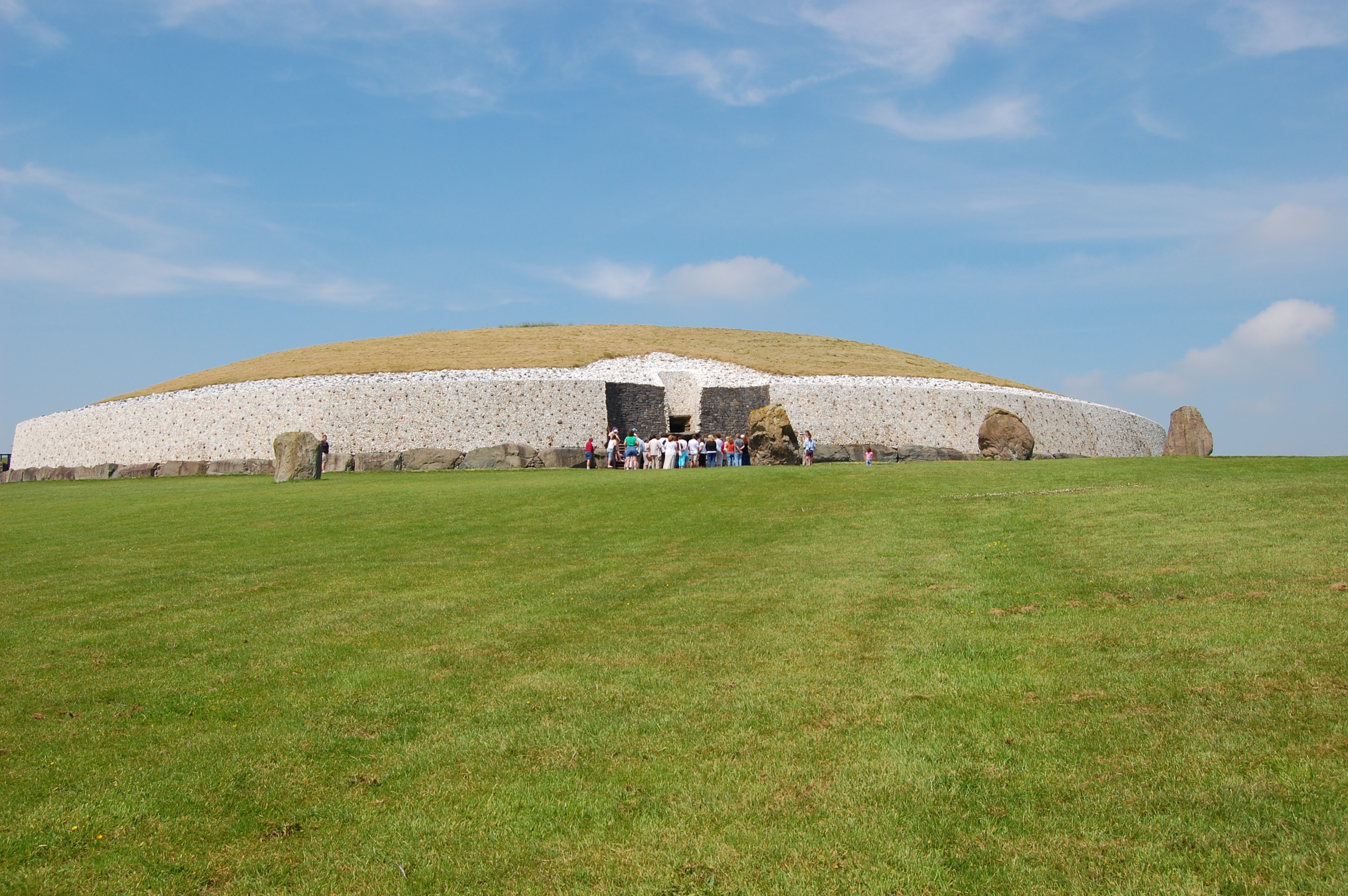
One of the world’s most important Neolithic landscapes, this ancient monument complex in the Boyne Valley contains at least ninety structures—including three monumental passage tombs built around 3200 BC with Europe’s largest collection of megalithic art.
At a glance
Brú na Bóinne (“mansion or palace of the Boyne”) sprawls across a bend in the River Boyne, comprising passage tombs, burial mounds, standing stones, and enclosures. Three passage tombs dominate the landscape: Newgrange, Knowth, and Dowth, all constructed in the 32nd century BC. The site represents a coherent archaeological culture known as the “Boyne culture.”
History
The passage tombs were built during the 32nd century BC, establishing Brú na Bóinne as a major ritual center in Neolithic Ireland. The area remained significant throughout the Bronze Age and Iron Age, continuing to serve ceremonial and ritual functions. In Irish mythology, the tombs are described as portals to the Otherworld and dwellings of deities, particularly The Dagda and his son Aengus. Systematic study began in the 18th century with antiquarians; archaeological excavations commenced in the 20th century, when several passage tombs underwent restoration work.
What you see
The three principal passage tombs—Newgrange, Knowth, and Dowth—form the architectural focus of the complex. Together they contain Europe’s most extensive assemblage of megalithic art. Several of these monuments exhibit precise astronomic alignment, with solar observation built into their architecture: passages and chambers are oriented to capture sunlight during the winter solstice and equinoxes. Surrounding the main tombs are ninety additional monuments, including smaller burial mounds, standing stones, and ritual enclosures that extend the ceremonial landscape across the valley bend.
Cultural significance
Brú na Bóinne represents one of humanity’s earliest and most sophisticated approaches to ritual architecture and celestial observation. The site’s integration of landscape, astronomy, and monumental art demonstrates advanced Neolithic knowledge and social organization. Its prominence in Irish mythology has ensured continuous cultural resonance across millennia, linking ancient religious practice to medieval narrative tradition. The passage tombs’ preservation of megalithic art provides unparalleled insight into Neolithic artistic and spiritual expression.
Key facts
- Location: County Meath, Ireland
- Coordinates: 53.69284, -6.44932
- Period: 32nd century BC
- Principal monuments: Newgrange, Knowth, Dowth passage tombs
- Total structures: at least 90 monuments
- UNESCO World Heritage Site: designated 1993 as “Brú na Bóinne – Archaeological Ensemble of the Bend of the Boyne”
Practical information & getting there
Brú na Bóinne is located in County Meath along the River Boyne, approximately 50 kilometers north of Dublin. The site is accessible by road; visitor facilities and guided tours are available. You can visit the Brú na Bóinne Visitor Centre for information about the monuments and the site’s archaeological significance. Before planning a visit, confirm current access arrangements and opening hours.
Sources & resources
Find it on the map
See this place and what’s around it →📷 Become a Cultural Heritage Online photographer
Share your photos of places: they stay published under your name as the author. The more they're seen, the more you get noticed — and soon a contest will reward the most appreciated photos.
Log in or sign up free to add a photo