
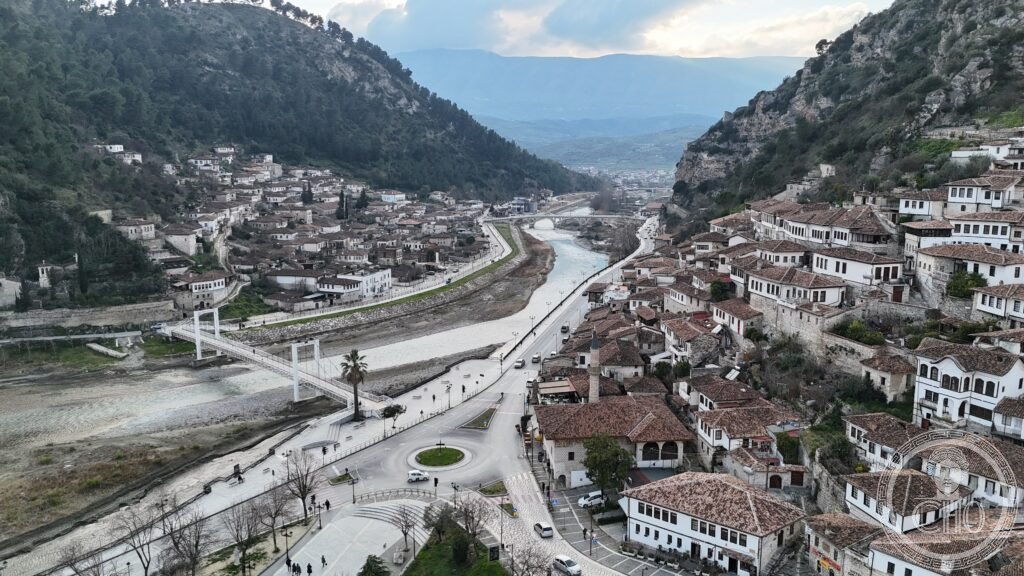
Berat
Albania’s best-preserved medieval and Ottoman city and one of the least-visited UNESCO World Heritage Sites in Europe — Berat (southern Albania; UNESCO WHS 2005/2008) is nicknamed “the City of a Thousand Windows” for the Ottoman-era wooden houses whose large windows step up the steep hillside below the Byzantine citadel, and which contains one of the oldest continuously inhabited castles in the world.
At a glance
Berat (the most precisely BeratAlbania single Berat County southern Albania 50000 population 122 km south Tirana Osum River Berat Mangalem Ottoman quarter steep hillside west bank Osum Gorica opposite hillside east bank Byzantine castle upper citadel Kala inhabited since 4th century BCE ancient Berats ancient name Antipatrea Macedonian times then Pulcheriopolis Byzantine name then Beligrad Slavic name White City then Berat Albanian modern Turkish name Berat City of a Thousand Windows nickname Ottoman houses large windows characteristic floor to ceiling large windows traditional Ottoman residential architecture Mangalem quarter white houses red Ottoman tile roofs large windows facing downhill river valley characteristic pattern nicknamed thousand windows Ottoman period 15th century CE 1417 CE Ottoman conquest Albania Skanderbeg 1443 1468 CE resistance then Ottoman full 1468 CE 1479 CE full Ottoman 1912 CE Albanian independence 1944 1991 CE Communist Albania Enver Hoxha isolation UNESCO heritage in any UNESCO world heritage site)).
Key facts
- The Kala (Berat Castle): the most continuously inhabited citadel in the Balkans: the Kala of Berat (the castle and upper citadel; first fortification 4th century BCE; major Byzantine walls 13th century CE; Ottoman additions 15th-18th century CE; covering approximately 9 hectares on the hilltop above Mangalem) is unique among Balkan castles in that it has been continuously inhabited since antiquity; approximately 80-100 families still live inside the castle walls in 2026 CE; the castle contains 24 Byzantine churches (not all in use or complete), 2 mosques, the National Iconographic Museum (the finest collection of Byzantine icons in Albania, including the 16th-century icon series by Onufri — the most celebrated Albanian medieval painter), a Byzantine-period aqueduct, a Roman city, and the ruins of an Ottoman mosque (the Red Mosque); the presence of living residents means the Kala is not a sterile archaeological zone but a lived medieval city — one of the rarest experiences in European heritage tourism
- GPS: 40.7057° N, 19.9527° E
History
From Macedonian founding to Byzantine citadel to Ottoman conquest to Communist isolation (the most precisely BeratAlbania single 4th century BCE Antipatrea Macedonian King Cassander Cassander of Macedon founded or expanded Antipatrea on Berat site 312 BCE founded Cassandreia Illyrian Wars Rome 232 168 BCE Illyrian Wars Roman Dalmatia 168 BCE Roman province Illyria Roman Antipatrea Roman period settlement 479 CE Saint Clement of Ohrid visited Berat Byzantine period 851 CE Bulgarian Empire briefly 1018 CE Byzantine reconquest 1215 CE Michael I Komnenos Doukas Despotate Epirus Byzantine successor built major castle complex walls 13th century CE Kala Byzantine walls today largely this period 1281 CE Charles I Anjou King Sicily briefly controlled 1345 CE Stephen Dusan Serbian Empire 1355 CE Serbian breakup 1417 CE Ottoman conquest Ottoman Berat rebuilt mosque administration 1443 CE Gjergj Kastrioti Skanderbeg Albanian noble Venetian trained converted to Islam reconverted to Christianity led Albanian resistance against Ottomans 25 years 1443 1468 CE Skanderbeg resisted Ottomans from Albania including using Berat 1457 CE Second Battle of Berat Ottoman win against Skanderbeg 1468 CE Skanderbeg died Lech Albanian resistance ended 1479 CE full Ottoman conquest Albania 1830 CE Ali Pasha of Ioannina destroyed most of Berat old Ottoman structures 1912 CE Albanian independence 1944 CE Communist Albania Enver Hoxha Berat native Hoxha born Gjirokastra but Berat significant in his revolution 1944 1991 CE Communist isolation most severe in Europe 1967 CE Albania declared world first atheist state all churches mosques closed converted to uses closed 2005 CE UNESCO Gjirokastra first inscribed 2005 2008 CE UNESCO Berat added UNESCO heritage: Enver Hoxha and the bunkers of Albania (the most extreme architectural legacy of 20th century communism): Enver Hoxha (1908-1985 CE; Communist dictator of Albania 1944-1985 CE; the longest-serving non-Soviet communist leader) ordered the construction of approximately 173,371 concrete bunkers across Albania (1967-1986 CE) to defend against foreign invasion; one bunker for every 4 Albanians; the bunkers (round domed concrete igloo structures; small military emplacements; impossible to destroy without explosives due to the thickness of the concrete) were designed by a military engineer who tested the design by having it built around himself while Hoxha’s associates drove a tank into the structure to confirm it could survive; the engineer survived unharmed; the bunkers dot every landscape in Albania, from beaches to hilltops to urban streets; visible throughout the Berat countryside; they have become one of Albania’s most distinctive (and absurd) landscape features; some have been converted to cafés, artist studios, and museum displays)) — the most precisely BeratAlbania single 4th century BCE Macedonian Cassander Antipatrea 1215 CE Michael Komnenos Doukas Despotate Epirus Byzantine castle walls Kala 1417 CE Ottoman conquest 1443 1468 CE Skanderbeg resistance 1457 Battle Berat Ottoman won 1479 CE full Ottoman Albania 1944 1991 CE Hoxha Communist longest non-Soviet 1967 CE first atheist state all churches mosques closed 173371 bunkers 1967 1986 CE 2005 2008 CE UNESCO heritage in any UNESCO world heritage site)).
What you see
The Kala castle, the Mangalem and Gorica quarters, and the Onufri icons (the most precisely BeratAlbania single Kala castle hill Byzantine walls 13th century CE 9 hectares hilltop 80 100 families living inside still 2026 CE 24 Byzantine churches 2 mosques inside Kala National Iconographic Museum finest Byzantine icon collection Albania Onufri 16th century CE Albanian painter vivid red colour Onufri Red characteristic Onufri Red Berat Red specific red paint formula Onufri used icon faces precise expressions collection church of Holy Trinity inside Kala Byzantine 13th century CE Church of Archangels 14th century CE 14 Byzantine churches Mangalem quarter steep slope Ottoman houses large windows white plaster red tile 18th 19th century CE characteristic thousand windows Ottoman residential architecture Mangalem meaning “place of merchants” traditional bazaar street Gorica quarter east bank Osum River vine cultivation winemaking local tradition Ottoman period residential Osum River gorge views from Mangalem down to Osum gorge dramatic landscape Skanderbeg Square modern Albanian town center below Berat town Berat Museum small national museum Leaden Mosque 15th century CE well preserved Ottoman mosque in town below Kala UNESCO heritage: Onufri the Albanian painter (the most significant medieval artist of the Balkans): Onufri (active ca. 1550-1570 CE; an Albanian iconographer; court painter to Albanian local rulers; the full name unknown — “Onufri” is the name written on the icons in Greek script) is the most celebrated Byzantine-tradition icon painter of the Albanian church; his innovations: (1) the “Onufri Red” — a specific intense red-vermillion paint that Onufri used for the robes of saints and the background accents; the formula was apparently lost after his death; no subsequent icon painter replicated exactly the same tone; (2) a more humanistic expression in his figures — the faces are less stylised than earlier Byzantine icons; (3) a more detailed treatment of landscape and architecture in icon backgrounds; the National Iconographic Museum at the Kala of Berat holds the largest collection of Onufri’s icons in the world)) — the most precisely BeratAlbania single Kala 9 hectares 80 100 families 2026 CE 24 Byzantine churches 2 mosques Onufri National Museum finest icon collection Albania Onufri Red characteristic lost formula 16th century CE humanistic expression Church Archangels 14th century Church Holy Trinity 13th century Mangalem steep Ottoman 18th 19th century CE 1000 windows white plaster red tile Gorica east bank vine winemaking Osum gorge Leaden Mosque 15th century CE UNESCO heritage in any UNESCO world heritage site)).
Practical information
- Getting there: from Tirana: furgon (shared minivan; approximately every 30-60 min from Tirana South bus station (Stacioni i Jugut); 2h30m; ALL 400/€4); or bus (more formal; same journey; ALL 600/€6); or rent a car from Tirana (122 km; 2h on the SH3/A2; the rental allows visiting also Gjirokastra (80 km south of Berat) on the same day); from Gjirokastra: furgon or bus (2h; ALL 400/€4); the Berat Kala (free to enter; the castle gate is always open; the castle interior churches and the National Iconographic Museum: ALL 200/€2 each; open Tuesday-Sunday 9 AM-5 PM); the Mangalem quarter (freely accessible pedestrian streets; no ticket required; 1h stroll along the main street and up the stepped alleys to the castle gate); the Onufri Museum specifically (inside the Kala; ALL 200/€2; the 16th century icons are the reason to visit Berat if you are interested in Byzantine art); the Berat Old Bazaar below the castle (Albanian crafts, traditional metalwork and embroidery); best time (May-September for Berat; April and October possible but weather can be unpredictable))
Getting there
From Tirana: furgon 2h30m (ALL 400/€4). Kala free entry; churches ALL 200/€2; Onufri Museum ALL 200/€2. Mangalem stroll free. Allow 4h (Kala + Mangalem + Onufri Museum). Add Gjirokastra 80 km south. GPS: 40.7057, 19.9527.
Nearby
- Gjirokastra — 80 km south (UNESCO WHS 2005; the “City of Stone” and birthplace of Enver Hoxha and novelist Ismail Kadare; a perfectly preserved Ottoman stone city with slate-roofed tower houses (kule); the Gjirokastra Castle (one of the largest castles in the Balkans; the US Air Force RF-101C Voodoo aircraft captured and displayed inside the castle — the only such aircraft outside the USA); the National Museum of Armaments; Kadare’s description of his childhood in Gjirokastra in the autobiographical novel “Chronicle in Stone” (1971 CE))
- Apollonia — 70 km west (one of the most important Greek colonies in the Adriatic; founded ca. 588 BCE by colonists from Corfu and Corinth; the largest Greek colony in present-day Albania; the bouleuterion (city council building) and portico are among the best-preserved in the Balkans; Julius Caesar’s general Octavian (later Emperor Augustus) studied at Apollonia in 44 BCE when the assassination of Julius Caesar reached him there))
Sources
- Wikipedia, Berat; Kala of Berat; Onufri; Enver Hoxha, accessed June 2026
- UNESCO, Historic Centres of Berat and Gjirokastra, WHS reference 569bis, inscribed 2005/2008
Find it on the map
See this place and what’s around it →📷 Diventa un fotografo di Cultural Heritage Online
Condividi le tue foto dei luoghi: restano pubblicate con la tua firma come autore. Più vengono viste, più ti fai conoscere — e presto un concorso premierà le foto più apprezzate.
Accedi o registrati gratis per aggiungere una foto