
Dopo le rivolte fallite contro Roma, il giudaismo si reinventò in Galilea. A Beit She’arim, dove visse e fu sepolto il rabbino Yehudah ha-Nasi, redattore della Mishnah, una vasta necropoli di catacombe scavate nella roccia accolse ebrei da tutto il mondo antico: una testimonianza unica della rinascita di un popolo.
At a glance
The necropolis of Beit She’arim, in the Lower Galilee of Israel, is a landmark of the renewal of Judaism after the failed revolts against Rome. From the 2nd century AD the town became a centre of Jewish learning, the seat of the Sanhedrin and the home of Rabbi Judah ha-Nasi, who compiled the Mishnah and was buried here. Around it grew a vast necropolis of rock-cut catacombs, richly carved with inscriptions and art, where Jews from across the ancient world chose to be buried. It was inscribed by UNESCO in 2015.
Key facts
- UNESCO: World Heritage since 2015 (Necropolis of Bet She’arim)
- Jewish renewal: a centre of revival after the revolts against Rome
- Judah ha-Nasi: compiler of the Mishnah, lived and was buried here
- The Sanhedrin: the Jewish high court met here for a time
- Catacombs: extensive rock-cut burial caves with carved sarcophagi
- Inscriptions: in Hebrew, Aramaic, Greek and Palmyrene
History
After the destruction of the Temple and the failure of the revolts against Rome in the 1st and 2nd centuries AD, the centre of Jewish life shifted to the Galilee. Beit She’arim flourished as a seat of learning, and when Rabbi Judah ha-Nasi, leader of the Jewish community and editor of the Mishnah, settled and was buried here around 200 AD, the town became a place of pilgrimage and the most prestigious Jewish burial ground.
Over the following centuries a great necropolis was cut into the soft limestone hills: galleries of tombs and sarcophagi, decorated with menorahs, figures and inscriptions in several languages, where Jews from across the Mediterranean and the Near East were brought for burial. Destroyed in the 4th century, the catacombs were rediscovered in modern times.
What you see
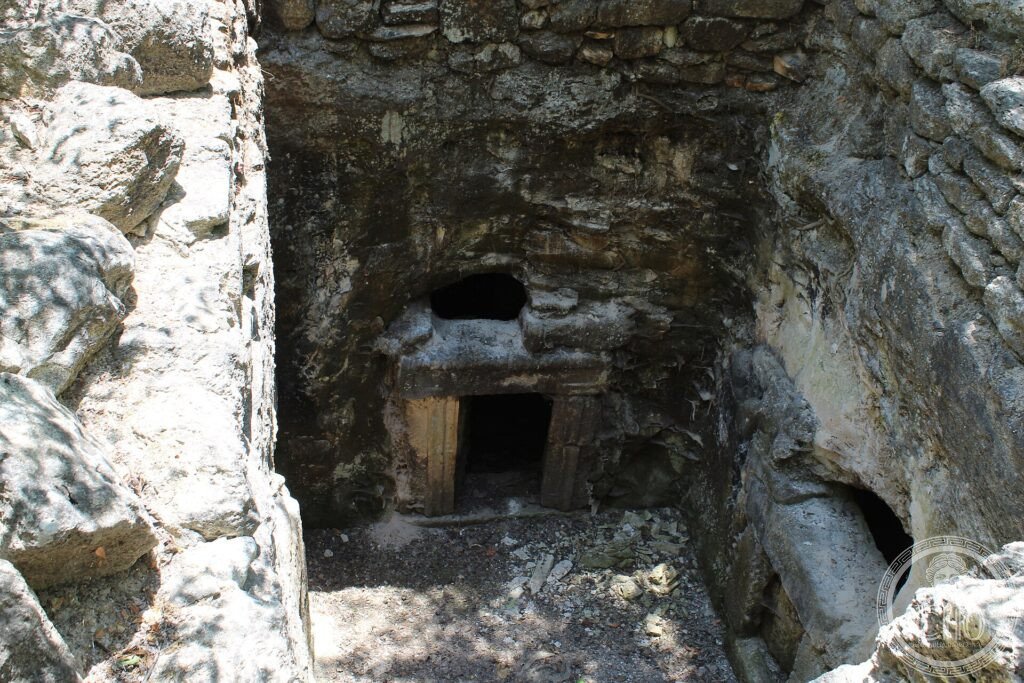
Doorways cut into the hillsides lead into the catacombs — long underground galleries lined with burial niches and stone sarcophagi, many carved with menorahs, animals, human figures and inscriptions in Hebrew, Aramaic, Greek and other scripts. The largest, the Cave of the Coffins, holds rows of decorated sarcophagi.
Above ground, the remains of the ancient town, a synagogue and the rolling Galilee hills complete the site.
Practical information
- Site: a national park; the catacombs are visited on marked routes
- Time needed: 1–2 hours
- Note: bring a light for the deeper caves
- Setting: in the Lower Galilee, between Haifa and Nazareth
Getting there
Beit She’arim is in the Lower Galilee of northern Israel, about 20 km south-east of Haifa, near Kiryat Tivon. It is reached by road. GPS: 32.7019° N, 35.1289° E.
Nearby
- Nazareth — the historic town to the east
- Megiddo — the UNESCO biblical tell nearby
- Haifa — the port city with the Bahá’í Gardens
Sources
- UNESCO World Heritage Centre — “Necropolis of Bet She’arim: A Landmark of Jewish Renewal” (ref. 1471)
- Israel Nature and Parks Authority — official body
- Encyclopaedia Britannica — Judah ha-Nasi; Mishnah
Find it on the map
See this place and what’s around it →📷 Become a Cultural Heritage Online photographer
Share your photos of places: they stay published under your name as the author. The more they're seen, the more you get noticed — and soon a contest will reward the most appreciated photos.
Log in or sign up free to add a photo