
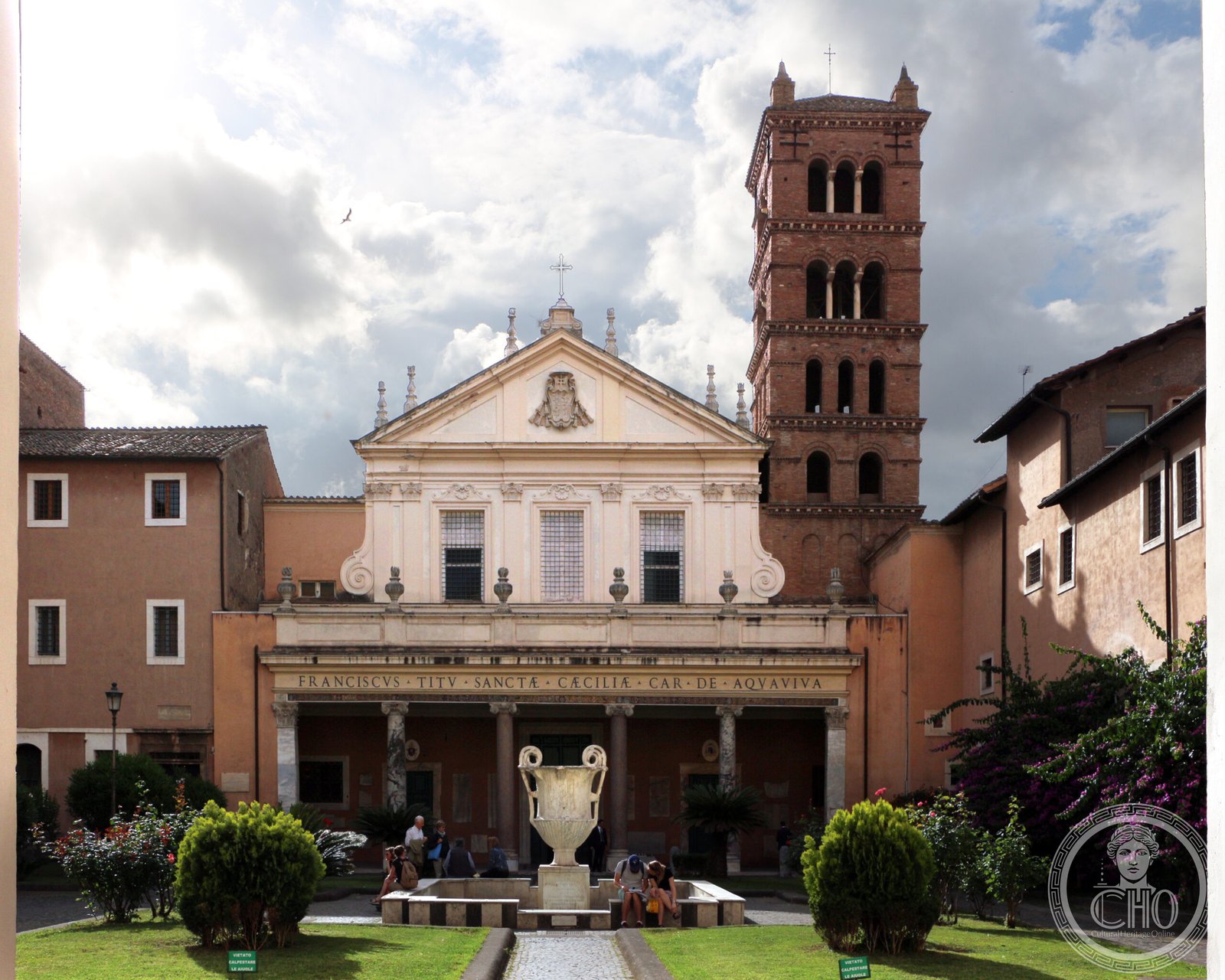
Santa Cecilia in Trastevere is a titular church and minor basilica in the Trastevere neighbourhood of Rome, dedicated to Saint Cecilia, the patron saint of music. Rebuilt under Pope Paschal I in the 9th century on the site of an early Christian house church, the basilica is celebrated for its luminous apse mosaic, for the extraordinary late-13th-century frescoes of the Last Judgement by Pietro Cavallini — among the finest surviving examples of pre-Giotto Roman painting — and for the marble effigy of the saint by Stefano Maderno (1600). The adjacent Benedictine abbey and the feast of Saint Cecilia on 22 November continue to draw pilgrims, choirs, and musicians from across the world.
At a glance
- Type
- Titular church and minor basilica; Benedictine conventual church
- Period
- Early Christian origins; rebuilt under Pope Paschal I c. 817–824; Baroque interventions 17th–18th century
- Style
- Early Christian / Romanesque basilica; Baroque facade and interior fittings
- Location
- Piazza di Santa Cecilia, Trastevere, Rome · 41.8875° N, 12.4758° E
Overview
Santa Cecilia in Trastevere is one of Rome’s oldest places of Christian worship, its origins intertwined with the cult of Cecilia, a Roman noblewoman martyred in the 3rd century AD whose house — according to tradition — was transformed into the first church on the site. The basilica has served as a cardinal titular church since at least the 5th century, placing it within the formal hierarchy of the Roman Church. Today it remains an active place of worship and pilgrimage, its quiet courtyard garden offering an unexpected retreat from the busy streets of Trastevere, while its interior preserves artistic layers spanning from late antiquity to the Baroque.
History
The earliest archaeological evidence beneath the basilica dates to the 1st and 2nd centuries AD, including Roman domestic structures and a mithraeum. The church was formally established by the 4th or 5th century, and Pope Paschal I undertook the major rebuilding of c. 817–824 after discovering what were believed to be the relics of Cecilia, Valerian, and other early martyrs. Paschal commissioned the magnificent apse mosaic, still visible today, as part of this campaign. The late 13th century saw Pietro Cavallini paint the Last Judgement fresco on the interior facade, a work of revolutionary naturalism that anticipates the spatial revolution of Giotto. Subsequent centuries brought Baroque refurbishment of the nave and the famous sculpture by Maderno depicting the saint’s incorrupt body as found at the opening of her tomb in 1599.
What you see
The basilica’s colonnaded courtyard with its central ancient urn fountain prepares visitors for an interior of exceptional richness. The triumphal arch and apse mosaic of Pope Paschal I (c. 820) shows Christ flanked by saints against a gold ground, the cool Byzantine formality of the figures in striking contrast to the warmth of the Roman sunshine outside. Pietro Cavallini’s Last Judgement (c. 1293), partially visible in the nuns’ choir above the entrance, is accessible on limited days and remains one of the most moving experiences in Roman art — figures modelled with a psychological weight that marks the threshold between medieval and Renaissance sensibility. Stefano Maderno’s reclining marble effigy of Saint Cecilia beneath the high altar, positioned exactly as her body was reportedly found, has moved visitors to silence for over four centuries.
Cultural significance
Santa Cecilia in Trastevere is a site of dual significance: as one of Rome’s most important repositories of early medieval and late-medieval art, and as a living place of pilgrimage connected to the cult of music’s patron saint. The Cavallini frescoes alone justify the basilica’s place in any serious survey of Western painting, constituting a hinge point between Byzantine convention and the naturalism that would define the Italian Renaissance. Its continued use as an active Benedictine church connects the present to an unbroken tradition of Christian worship stretching back to the early centuries of the common era.
Practical information
- Address
- Piazza di Santa Cecilia 22, 00153 Roma
- Hours
- Basilica generally open mornings and late afternoons; Cavallini fresco access on limited days — check official website or contact the basilica
- Admission
- Free entry to basilica; small fee for Cavallini fresco area and crypt
Getting there
Trastevere is on the right bank of the Tiber, approximately 1 km south-west of Campo de’ Fiori. The basilica is a 10-minute walk from Trastevere railway station (served by regional trains and the Roma-Lido line). Bus lines H, 8, and 780 stop near Viale di Trastevere; tram line 8 connects Largo di Torre Argentina to Trastevere. From the Vatican, the church is a 20-minute walk through the neighbourhood. On-street parking is limited; walking or public transport is recommended.
Sources & resources
Find it on the map
See this place and what’s around it →Historical events at this place (3)
📷 Become a Cultural Heritage Online photographer
Share your photos of places: they stay published under your name as the author. The more they're seen, the more you get noticed — and soon a contest will reward the most appreciated photos.
Log in or sign up free to add a photoIs this page about you?
This page is read by travellers and heritage enthusiasts who find it on Google. Tell us how you are connected to this place and we will take it from there.