

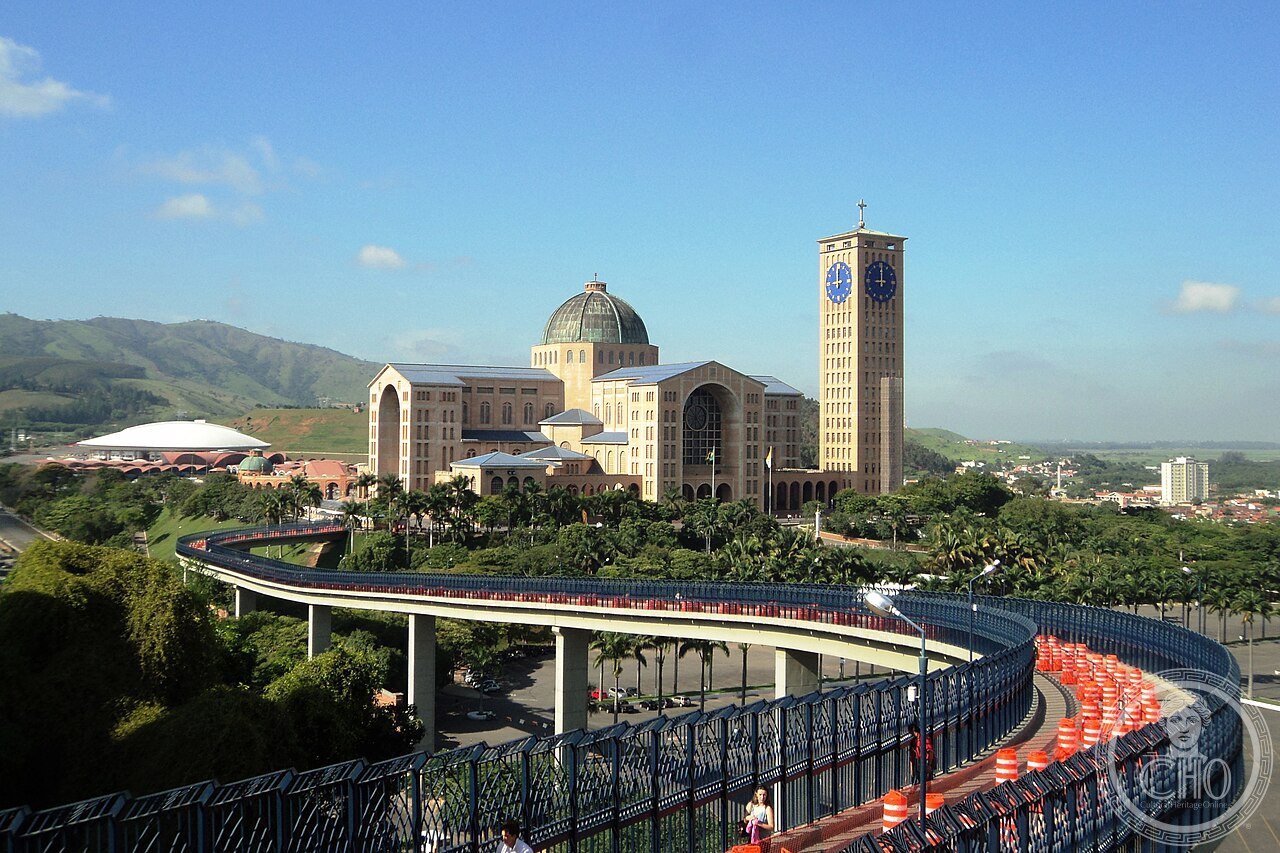
In October 1717 three fishermen on the Paraíba do Sul river hauled up a small headless terracotta statue of the Virgin Mary. A second cast of the net brought up the missing head. Domingos Garcia, João Alves and Filipe Pedroso had been sent out to find fish for a banquet in honour of the Count of Assumar, governor of São Paulo and Minas Gerais, who was passing through the region, and the catch had been poor all day. From that moment, tradition holds, their nets filled with fish. The statue, dark and about 38 centimetres tall, became the object of a growing local cult, Our Lady Aparecida, «the Appeared One», which over the following centuries spread through the whole of Brazil. On 16 July 1930 Pope Pius XI, in a bull signed also by Cardinal Eugenio Pacelli, the future Pius XII, declared Our Lady Aparecida principal patroness of the country. The original church of the eighteenth century, now known as the Antiga Basílica, still stands beside the present one. Work on the new basilica began on 11 November 1955, to a design by the architect Benedito Calixto Neto: Romanesque Revival, on a Greek-cross plan of 188 by 183 metres. It was consecrated by Pope John Paul II on 4 July 1980, although building went on for decades afterwards. By area it is held to be the second-largest church in the world after the basilica of Saint Peter, with standing room for 45,000 people and space for up to 300,000 in the square outside during open-air Masses. Every year the basilica receives about eight million pilgrims, with the peak around 12 October, feast day of Our Lady Aparecida, a Brazilian national holiday since 1980 coinciding with the national day dedicated to children.
About the Basilica of Our Lady of Aparecida
In October 1717, three fishermen — Domingos Garcia, João Alves and Filipe Pedroso — tasked with catching fish for a banquet in honour of the Count of Assumar, governor of São Paulo and Minas Gerais, who was passing through the region, hauled from the Paraíba do Sul river, after a long unsuccessful stretch of fishing, a small headless terracotta statue of the Virgin Mary; a second cast of the net recovered the missing head. From that moment, tradition holds, their nets filled with fish. The dark, roughly 38-centimetre statue became the focus of a growing local cult, known as Our Lady Aparecida (“the Appeared One”), which expanded across Brazil over the following centuries; on 16 July 1930, Pope Pius XI, in a bull also signed by Cardinal Eugenio Pacelli, the future Pope Pius XII, declared Our Lady Aparecida principal patroness of Brazil. The original 18th-century church, now known as the “Antiga Basílica,” still stands beside the current, much larger basilica, whose construction began on 11 November 1955 under architect Benedito Calixto Neto, built in Romanesque Revival style on a Greek-cross plan measuring 188 by 183 metres; consecrated by Pope John Paul II on 4 July 1980, though work continued for decades afterward, it is considered the second-largest church in the world by area after St. Peter’s Basilica, with standing capacity for 45,000 worshippers and room for up to 300,000 in the surrounding plaza during open-air Masses. The basilica draws roughly eight million pilgrims annually, with the largest crowds gathering around 12 October, the feast day of Our Lady Aparecida, which has been a Brazilian national holiday since 1980, coinciding with the country’s Children’s Day.
Key facts
- 1717: three fishermen recover the statue of Our Lady Aparecida from the Paraíba do Sul river.
- 1930: Pope Pius XI declares Our Lady Aparecida patroness of Brazil.
- 1955-1980: construction and consecration of the current basilica by Pope John Paul II.
- 188 x 183 metres, the second-largest church in the world by area after St. Peter’s Basilica.
- 45,000 standing capacity, up to 300,000 in the surrounding plaza.
- ~8 million pilgrims annually, peaking around the 12 October feast day, a Brazilian national holiday.
History
The Basilica of Our Lady of Aparecida’s growth from a small riverside fishing legend into the largest pilgrimage site and one of the largest churches in the entire world reflects the depth of Marian devotion in Brazilian Catholicism, formalised by Pius XI’s 1930 declaration naming the statue’s namesake the country’s patroness. The construction of an entirely new, vastly larger basilica alongside the preserved 18th-century original captures the scale of ambition behind 20th-century Brazilian Catholic institution-building, culminating in a papal consecration that placed Aparecida among the great pilgrimage destinations of the global Church.
What you see
The basilica’s Romanesque Revival exterior, built on a vast Greek-cross plan, rises above the surrounding plaza capable of holding hundreds of thousands of pilgrims during major feast-day Masses. Inside, the venerated statue of Our Lady Aparecida occupies the heart of the sanctuary, while the older 18th-century church stands preserved nearby as a direct link to the site’s founding legend.
Practical information
- Opening hours: generally open daily with seasonal variation; free admission; expect very large crowds around 12 October; check current hours before visiting.
- Address: Aparecida, São Paulo state, Brazil.
Getting there
The Basilica of Our Lady of Aparecida stands in the town of Aparecida, roughly midway between São Paulo and Rio de Janeiro, reachable by bus or car along the Dutra highway. GPS: 22.8504° S, 45.2338° W.
Nearby
- Antiga Basílica — the original 18th-century church, adjacent to the modern basilica.
- São Paulo — Brazil’s largest city, a drive away.
- Rio de Janeiro — reachable along the same highway corridor.
Sources
- Wikipedia — “Our Lady of Aparecida” (en.wikipedia.org).
- Wikipedia — “Basilica of Our Lady of Aparecida” (en.wikipedia.org).
- Vatican News — “Our Lady of Aparecida — Saint of the Day” (vaticannews.va).
Find it on the map
See this place and what’s around it →📷 Become a Cultural Heritage Online photographer
Share your photos of places: they stay published under your name as the author. The more they're seen, the more you get noticed — and soon a contest will reward the most appreciated photos.
Log in or sign up free to add a photo