

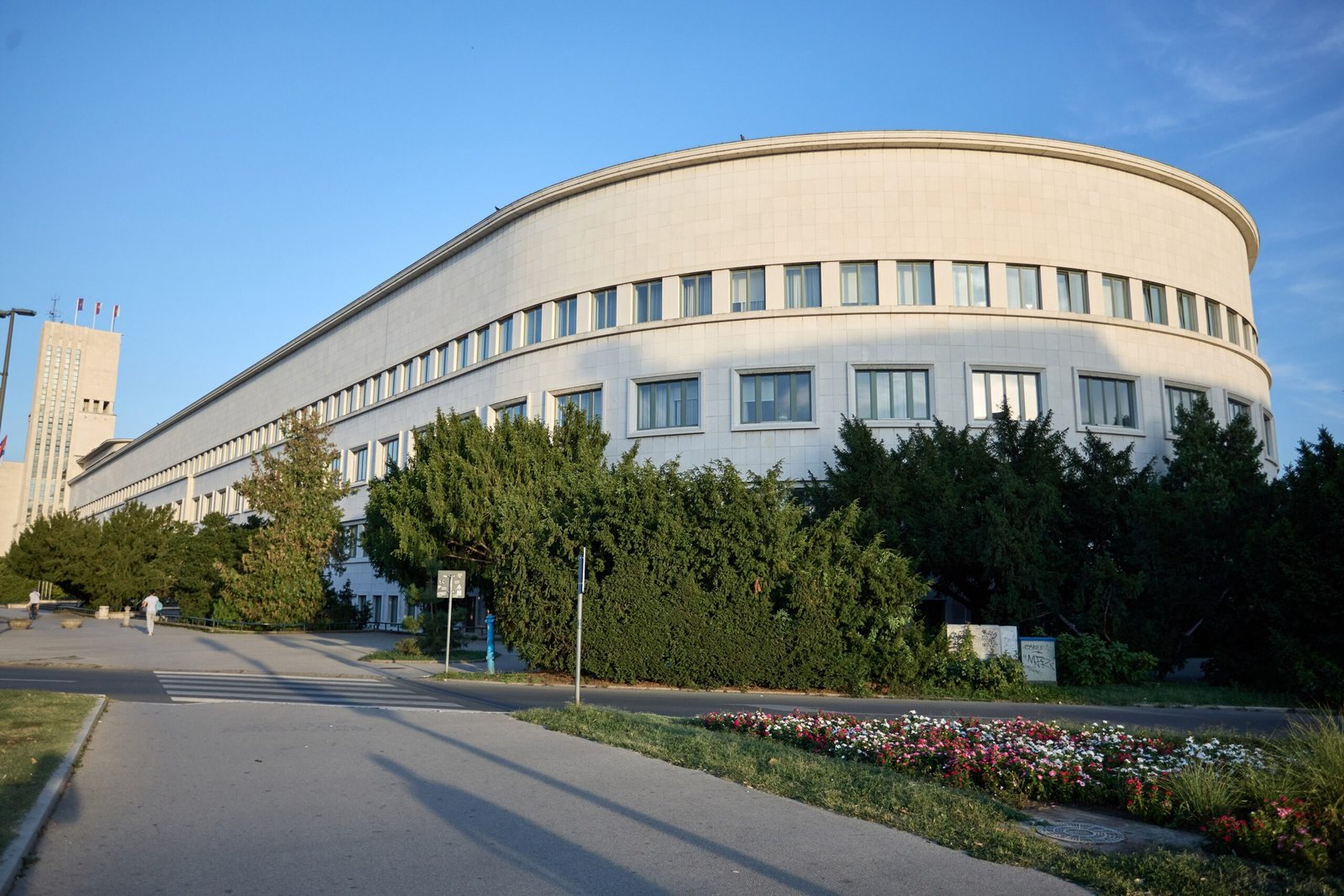
A modernist administrative complex in Serbia’s cultural capital, where two purpose-built buildings house the Government and Assembly of Vojvodina.
At a glance
The Banovina Palace comprises two structures designed by architect Dragiša Brašovan. The larger building serves as the seat of the Government of Vojvodina, while the smaller Banski dvor accommodates the Assembly. Built as the administrative headquarters of the Danube Banovina, they remain key institutions of regional governance.
History
Constructed between 1936 and 1940, the buildings were commissioned as the official administrative centre of the Danube Banovina during the Yugoslav period. Their creation reflected Novi Sad’s emergence as a major administrative and cultural hub in the Balkans.
What you see
Brašovan’s design synthesises modernism with art deco and stripped classicism—a distinctive approach of interwar Yugoslav architecture. The two buildings present a balanced composition, their clean lines and functional forms emblematic of 1930s European administrative design.
Cultural significance
The Banovina Palace documents a crucial moment in Yugoslav institutional history and exemplifies the architectural ambitions of the interwar period. As the working seat of Vojvodina’s government and assembly, it remains integral to regional political life and represents the modernist vision that shaped Central European cities during the 1930s.
Key facts
- Location: Novi Sad, Serbia (45.2534°N, 19.8492°E)
- Completed: 1940
- Architect: Dragiša Brašovan
- Style: Modernism with art deco and stripped classicism
- Current use: Seat of Government and Assembly of Vojvodina
Practical information & getting there
The palace is located in central Novi Sad. As an active government building, public access may be restricted; check local protocols before visiting. Novi Sad is well connected by rail and road from Belgrade and other regional centres.
Sources & resources
Find it on the map
See this place and what’s around it →📷 Become a Cultural Heritage Online photographer
Share your photos of places: they stay published under your name as the author. The more they're seen, the more you get noticed — and soon a contest will reward the most appreciated photos.
Log in or sign up free to add a photoIs this page about you?
This page is read by travellers and heritage enthusiasts who find it on Google. Tell us how you are connected to this place and we will take it from there.