

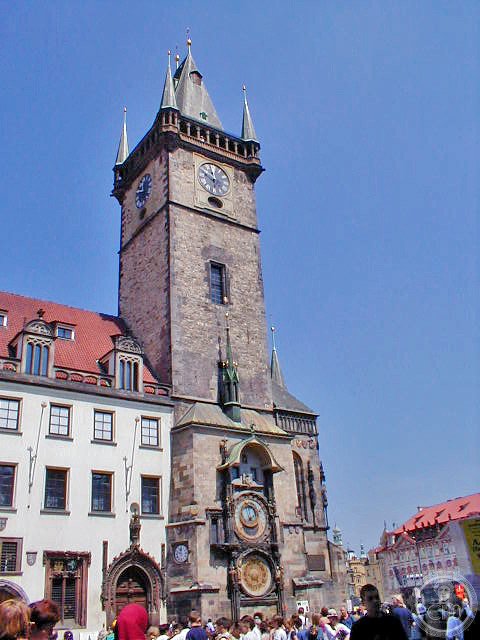
The Prague astronomical clock, known locally as the Orloj, is a medieval masterpiece mounted on the south wall of the Old Town Hall in the heart of Prague. First installed in 1410, it is the oldest astronomical clock still in operation, displaying the positions of the Sun and Moon, the zodiac, and the time according to three distinct systems. Every hour on the hour, its famous procession of animated apostles draws crowds of visitors from across the world.
At a glance
- Type
- Medieval astronomical clock
- Period
- First installed 1410; modified 1490 and later
- Style
- Gothic mechanical craft; Renaissance additions
- Location
- Old Town Hall, Old Town Square, Prague, Czech Republic
- Coordinates
- 50.0870° N, 14.4185° E
Overview
The Prague Orloj is a medieval astronomical clock attached to the Old Town Hall in Prague, the capital of the Czech Republic. It is the third-oldest astronomical clock in the world and the oldest one still operating, making it one of the most celebrated examples of medieval engineering in Europe. Each hour its mechanical apostles parade past two windows on the clock face, a spectacle that has drawn pilgrims and travellers since the fifteenth century.
History
The clock was first installed in 1410 by clockmaker Mikuláš of Kadaň and the astronomer Jan Šindel, then a mathematics and astronomy professor at Charles University in Prague. In 1490 the clock was extended and the calendar dial below the main face was added, work attributed to clockmaker Jan Růže. The mechanism suffered serious damage during World War II when Nazi forces set the Old Town Hall ablaze in May 1945; the clock was painstakingly restored and returned to operation in 1948. A further major restoration was completed in 2018.
What you see
The clock is composed of three main components: the astronomical dial showing the position of the Sun and Moon relative to the zodiac and the horizon; the Walk of the Apostles, a mechanical procession of twelve carved figures that appear every hour; and the calendar dial below, painted with medallions representing the months and Czech rural life. Four allegorical figures flanking the main dial represent Vanity, Greed, Death (a skeleton that rings a bell), and a Turkish figure representing Pleasure or Lust. The entire assembly is housed within a richly decorated Gothic frame on the south façade of the Old Town Hall tower.
Cultural significance
As the oldest continuously operating astronomical clock in the world, the Prague Orloj is both a technical triumph of medieval engineering and a symbol of Czech national pride. It is listed among the most visited monuments in Central Europe and forms the centrepiece of Old Town Square, a UNESCO World Heritage Site buffer zone. The clock’s hourly spectacle has made it one of the defining images of Prague in global popular culture.
Practical information
- Address
- Staroměstské nám. 1, 110 00 Praha 1, Czech Republic
- Access
- The clock is visible from the square at all times free of charge; the Old Town Hall tower offers paid entry for close views
Getting there
Take Prague Metro Line A (green) to Staroměstská station, then walk east approximately five minutes through the Old Town streets to Old Town Square. Trams 2, 17 and 18 also stop nearby at Staroměstská. The square is fully pedestrianised and accessible on foot from most central Prague hotels.
Sources & resources
Find it on the map
See this place and what’s around it →📷 Become a Cultural Heritage Online photographer
Share your photos of places: they stay published under your name as the author. The more they're seen, the more you get noticed — and soon a contest will reward the most appreciated photos.
Log in or sign up free to add a photo